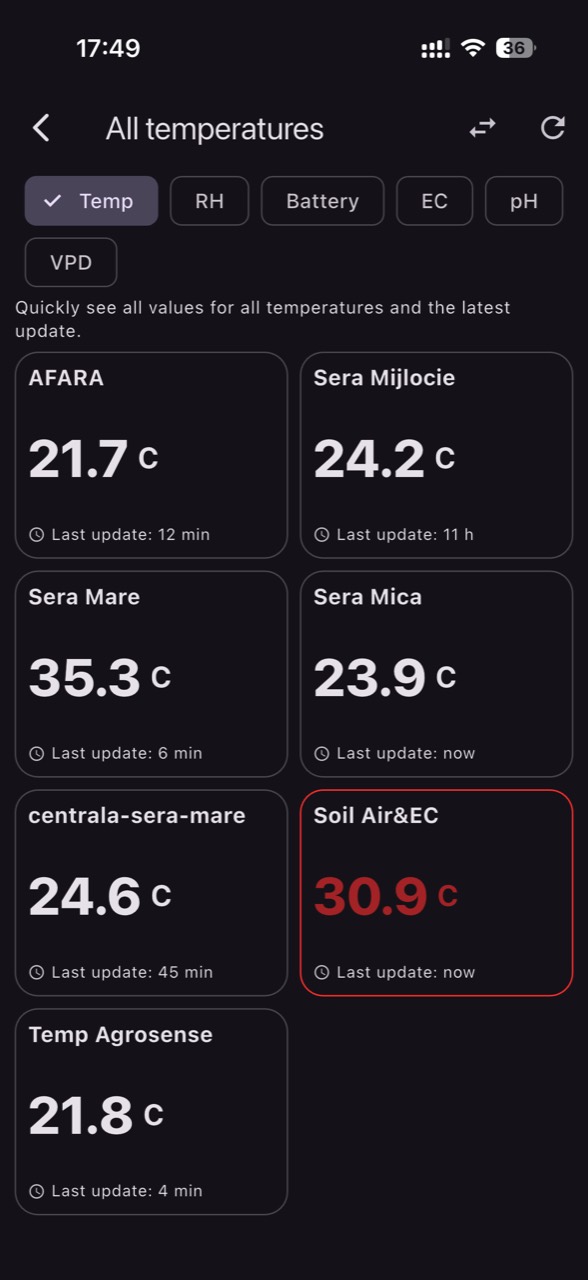
In horticultural production, the most expensive mistakes usually happen when decisions rely on intuition or on a single isolated parameter. Air conditions can look “fine” while the root zone is too wet or too salty; the opposite can also happen, where “wet soil” hides oxygen shortage and slow roots. Correct monitoring means measuring what truly drives growth and quality.
Parameters should be selected by mechanism: what affects transpiration, water and nutrient uptake, vegetative rhythm, and stress risk. Then comes the practical part: where sensors belong, which units to track, how fresh the data must be, and how you independently confirm that readings reflect reality in the crop—not an installation or measurement problem.
This article explains, briefly but practically, what is worth monitoring in air, soil/substrate, EC, pH, VPD and weather forecast. The focus is a commissioning workflow: start with an agronomic hypothesis, verify the measurement, make a small decision, then check the result. Any examples are hypothetical so you can adapt them to your situation.
1) Air: temperature and humidity as the “engine” of transpiration
The mechanism is straightforward: leaves lose water by transpiration, and that flow “pulls” water and nutrients from the root zone. Air temperature and relative humidity (plus air movement) control how fast that flow runs. What you observe in practice: day/night swings, stagnant-air periods, and episodes of high humidity that keep leaves wet for longer. Without these data, you tend to correct ventilation, shading, or heating too late.
What to verify independently: compare your sensor against a reference thermometer/hygrometer (even temporarily) and confirm it is protected from direct radiation and not sitting in the jet of a fan. A practical decision might be adjusting ventilation timing or a heating strategy to reduce condensation. Check the result in the hourly history: after the change, humidity drops faster in the morning and you see fewer long intervals of very high RH.
2) Soil and substrate: moisture and temperature in the root zone
Roots do not “experience” a field average; they experience water, air, and temperature in the volume they occupy. In substrate (coco, peat, rockwool) dynamics are fast; in mineral soil they are slower but often more heterogeneous. What to observe: how quickly moisture rebounds after irrigation, how long it takes to start falling, and whether some zones stay consistently wetter (hypoxia risk) or drier (water stress). Soil temperature also affects root activity and uptake.
What to verify independently: dig near the probe and assess texture and smell (anaerobic conditions), drip distribution, and the actual rooting depth. A common commissioning failure is installing a sensor in an unrepresentative “pocket”: next to a faulty dripper, in a compacted strip, or too close to the bed edge. A practical decision may be to correct uniformity (filter cleaning, pressure checks, emitter inspection). Check results by whether curves between zones converge and differences shrink after similar irrigations.
3) EC: a useful salinity indicator—dependent on medium and method
EC (electrical conductivity) indicates dissolved salts, not “how much nitrogen” or “how much potassium.” Even more important: EC is not one single measurement. EC in irrigation water, EC in fertigation solution, EC in drainage (for substrates), EC from a substrate extract, and bulk-soil EC are different measurements and cannot be compared directly. Mechanistically, high EC increases osmotic pressure, makes water uptake harder, and can intensify stress on hot, high-demand days.
What to verify independently: always label the medium and method when interpreting values—“EC in irrigation solution” versus “EC in drain” or “EC in soil.” On-site pH/EC monitoring complements laboratory water analysis; it does not replace it, because pH, alkalinity, and soluble salts play different roles. A practical (hypothetical) decision could be to introduce a leaching irrigation/drainage fraction or adjust the fertilization recipe, but only after confirmation. Check the outcome by trend: EC drops after intervention and the crop returns to steadier transpiration (cross-checked with VPD and root-zone moisture).
4) pH: nutrient availability and the role of water (not only fertilizer)
pH affects the chemical form and availability of many elements, and it can block uptake even when EC looks “acceptable.” pH also shifts differently in plain water, in fertigation solution, and in the root zone, where exudates and ion exchange matter. What to observe: slow pH drift in irrigation solution, differences between tank and delivery point, or large swings after changing the water source. Plant symptoms (chlorosis, stiff growth) are late and non-specific.
What to verify independently: pH probe calibration is mandatory—otherwise you are tracking instrument error. Also check water parameters that influence pH control, such as alkalinity; sometimes the issue is not a setting but the buffering capacity of the water. A practical decision might be adjusting the pH target of the fertigation solution or checking fertilizer compatibility—without assuming that “more acid” automatically solves it. Check results by stability over time, and by periodic lab analysis of water/solution when relevant to confirm variation is real, not measurement noise.
5) VPD: an atmospheric “demand” indicator, with clear limits
VPD (vapour pressure deficit) combines air temperature and relative humidity into an indicator of how “thirsty” the air is. Mechanistically, high VPD increases transpiration and can cause stress if roots cannot supply enough; low VPD reduces transpiration and can slow calcium transport, increasing physiological disorder risk in young tissues. What to observe: long periods of very low VPD in the morning (condensation risk) or sudden peaks at midday (for example when vents open).
What to verify independently: VPD calculated from air T/RH is an estimate; leaf temperature can differ because of radiation and airflow, so interpretation must be cross-checked with symptoms and root-zone conditions. A practical decision might be a finer ventilation/heating sequence, or irrigating ahead of demand peaks—only if root-zone moisture allows it. Check results by comparing similar days: after changes, VPD peaks “flatten,” and substrate moisture does not enter stress territory during the same time window.
6) Forecast: an external parameter that changes your operating plan
Forecast does not measure the crop, but it provides context for decisions before stress happens. The mechanism is operational: anticipating a heat wave, a cold night, or a humid period lets you prepare ventilation, irrigation, and protection strategy. What to observe is the difference between reacting after the event versus acting preventively—for instance, when two days of high radiation and wind are expected, which can rapidly increase water demand.
What to verify independently: compare forecast against your on-site sensor data; the microclimate inside a tunnel or within an orchard block can deviate from a regional station. A practical decision might be revising irrigation planning (not as a fixed template, but as a plan you update), staging protection materials, or scheduling treatments only when the weather window allows. Check results after the event: did actual conditions match the scenario, and do your thresholds or plans need adjustment before the next similar episode?
7) Commissioning: turning “installed sensor” into credible measurement
A commissioning workflow starts with a question: “Which decision do I want this parameter to support?” Then define units, reading frequency, and provisional thresholds. Verify data freshness (latency and gaps) and baseline behaviour: temperature follows day/night, moisture rises after irrigation (in soil/substrate), EC/pH respond when fertigation changes. A common failure is enabling alerts before you have 7–14 days of history to understand what “normal” looks like on that site.
Independent verification during commissioning includes visual inspection, spot manual measurements, and an installation audit (depth, good soil contact, radiation shielding, cables). A practical commissioning decision is to run a small “test intervention”: hypothetically, a short irrigation in one zone, then watch the soil-moisture response and the EC trend in the root zone. The result is validated when the response makes agronomic sense—and when two nearby points do not show irreconcilable behaviour without a physical cause.
8) Integration into the production routine: from alerts to post-action checks
Monitoring pays when it becomes routine: observe, decide, act, verify. For each parameter, define a typical action and a verification: for air (ventilation/heating), for soil moisture (irrigation duration/frequency), for EC/pH (recipe check, uniformity, drainage), for VPD (peak-reduction strategy). What you observe matters more than any “universal threshold,” because each farm has constraints of cultivar, density, soil/substrate type, and equipment.
What to verify independently in routine: short in-crop checks after alerts (leaf wetness/condensation, actual drainage, drip uniformity, anaerobic smell), plus periodic lab checks for water/soil when relevant. A practical decision may be creating distinct monitoring zones (for example, tunnel end versus centre; sandy versus clay areas), because averages can hide local problems. Results show up as more consistent interventions: fewer surprises, more small corrections evaluated through history and observations. A platform like GrowGuard can help with live monitoring, alerts, and zone-based interpretation, but the discipline of verification remains with the team.
Conclusion
The parameters worth monitoring are not the popular ones—they are the ones that explain growth mechanisms: atmospheric demand (T, RH, VPD), root-zone status (moisture, temperature), and relevant chemistry (EC and pH, clearly defined by medium and method). Forecast completes the picture because it changes your plan before stress begins. The key is linking each parameter to a decision and to a post-action check.
Starting with a commissioning workflow helps you avoid two traps: having “nice” data that are not credible, or having many alerts that are not useful. Begin with a few validated sensors in representative zones, then build farm-specific thresholds confirmed by observations and analyses. If you use GrowGuard, keep one simple rule: no alert replaces walking the crop, but it can make scouting more targeted. For faster commissioning, you can request a technical review of placement and monitored parameters.