LoRaWAN is a low-power radio technology designed for sensors that send small packets infrequently over long distances. In horticulture, it is attractive for scattered greenhouses, distributed tunnels, orchards, or open fields where cabling is costly and where you want months or years of battery operation. But LoRaWAN is not “the internet”: it has clear limits on throughput, latency, and diagnostics.
The right question is not “does LoRaWAN work everywhere?”, but “what data do I need, how fresh must it be, and what packet-loss risk can I accept?”. For irrigation, microclimate, or frost warnings, some values can be every 5–15 minutes while others can be hourly. At the same time, EC and pH require dedicated probes and maintenance—not just connectivity.
A second sensitive point is the data path: sensor → radio → gateway → network/application server → integration (often MQTT) → monitoring platform. This is where most confusion appears: LoRaWAN is the radio/network layer, MQTT is an application-layer messaging protocol; they don’t compete, they complement each other. Below is when LoRaWAN is worth using and a practical workflow for getting data into GrowGuard, with independent checks and common traps.
1) When LoRaWAN is worth it—and when it isn’t: technical criteria, not preferences
LoRaWAN is worth it when you need long autonomy and coverage across land with moderate obstacles, while accepting small payloads and less frequent reporting. In horticulture, that fits local weather stations, multi-point air temperature/RH, soil moisture at fixed depths, or tank level (when a sensor is designed for it). The mechanism is straightforward: transmit little, rarely, at low power; the gateway primarily listens and forwards.
It is not worth it when you need very frequent data, real-time control, or large volumes (for example waveforms, images, or detailed logs). Observe how often you truly need updates and what a delay would cost. Independently verify by writing down a concrete decision (hypothetically starting irrigation) and how late you could learn the root zone dried. Practical decision: tune send intervals (slower at night, faster in critical windows). Check results by tracking battery stability and received-packet consistency over the next days.
2) LoRaWAN architecture: what each link does and where bottlenecks appear
In LoRaWAN, the end device transmits by radio to one or more gateways. The gateway does not “understand” crops or sensors; it forwards packets to a network server that handles authentication and radio parameters. Then an application server exposes the application data to integrations; commonly, that exposure is done via MQTT. The important distinction is: LoRaWAN describes radio transport and network control; MQTT is simply a way applications consume the messages.
Observe where data stops—at radio (nothing reaches a gateway), at the network layer (validation fails), at the application layer (payload can’t be interpreted), or at the integration layer (subscription/permissions). Independently verify by confirming messages exist in the LoRaWAN server before involving any monitoring platform. Practical decision: treat each link as a separate test, and don’t change gateway position, payload format, and reporting interval all at once. Check results by seeing whether messages appear consistently at the same point after each single change; otherwise troubleshooting becomes guesswork.
3) Choosing sensors for LoRaWAN: what is realistic to measure on battery
In horticulture, sensor choice should follow the measurement medium and method, not just “what would be useful”. Air temperature and relative humidity are typically feasible on battery; so are pressure or rainfall if a station is engineered correctly. Soil moisture (often dielectric-based) can be compatible, but cable quality, burial depth, and long-term stability matter. EC and pH require dedicated probes; EC measures conductivity of a medium (irrigation water, drainage, nutrient solution, moist soil), but it does not identify individual nutrients.
Observe the units and the medium being measured. An EC value measured in irrigation water is not directly comparable to EC in drainage or to “soil EC” without context. Independently verify pH/EC by periodic control measurements using a reference instrument or lab analysis, so you can separate probe drift from real change. Practical decision: on LoRaWAN, prioritize variables that change meaningfully between transmissions (for example soil moisture response after irrigation), not details that require streaming. Check results by comparing trends to real events (irrigation, rainfall, ventilation) and confirming the sensor responds logically—not only that it transmits.
4) LoRaWAN field parameters that matter: interval, payload, classes, and freshness
LoRaWAN forces payload discipline: every byte matters. That affects how often you can transmit and how quickly the battery drains. Also, not all devices can receive commands whenever you want: many are uplink-focused and only listen for downlinks briefly after they transmit, depending on class and configuration. For horticultural monitoring, you usually want stable uplinks with intervals aligned to operations (irrigation cycles, ventilation patterns, frost/heat protection routines) rather than “as fast as possible”.
Observe data “freshness”—the time between measurement and when it appears in the platform. Independently verify by logging the time you performed an action (hypothetically irrigation at 10:05) and checking whether soil moisture changes show up within the expected window, given the reporting interval. Practical decision: if you need faster awareness during certain hours, configure a day/night schedule or event-based reporting if the device supports it. Check results by monitoring whether average latency stays consistent and whether repeated “gaps” occur at the same hours, suggesting congestion or marginal coverage.
5) Coverage and placement: how to check radio without blaming the crop
Horticultural environments change: canopy grows, soil water content shifts, and plastic films or metal structures reflect signals. All can affect the radio link. A gateway mounted too low or too close to metal can create dead zones even if it seems nearby. Mechanistically, LoRa can work with weak signals, but it still needs enough signal-to-noise margin; wet vegetation and interference reduce that margin. That is why a winter test may not repeat in summer.
Observe reception stability, not just “it worked once”. Independently verify that, before calling a sensor defective, messages appear in the LoRaWAN server with consistent reception metadata (for example being heard by two gateways vs. only one, or showing large fluctuations). Practical decision: adjust gateway placement (height, distance from obstacles) or the sensor antenna position; in greenhouses, moving an antenna one meter higher can change outcomes. Check results by repeating a 24–48 hour test and confirming missing packets no longer cluster in the same intervals.
6) Data flow to the platform: from LoRaWAN server to MQTT and interpretation
Once messages are accepted by the LoRaWAN network, applications consume them through an integration. A common pattern is: The Things Stack exposes application data via MQTT, and another service collects and forwards it. Here the roles separate cleanly: LoRaWAN moves radio packets; MQTT delivers messages to applications. A typical problem is not “no signal” but “the message arrives and the payload is not decoded, or the units are wrong”. The same number can mean 235 (23.5°C scaled) or 2350 (23.50°C), depending on definition.
Observe decoding and units for each channel (temperature, RH, soil moisture, and so on). Independently verify by comparing a spot reading to a control instrument placed near the sensor (a reliable thermometer for air; for pH/EC, an appropriate reference measurement in the same medium). Practical decision: establish a single source of truth for payload format (manufacturer documentation or a tested decoder) and apply it consistently. Check results by confirming values no longer jump outside plausible bounds (for example RH above 100% or negative temperatures in a summer greenhouse), which often indicates interpretation errors. In this flow, GrowGuard can ingest LoRaWAN data and interpret payloads—but only after mapping and units are defined correctly.
7) A 10-step commissioning workflow: install, validate, then enable alerts
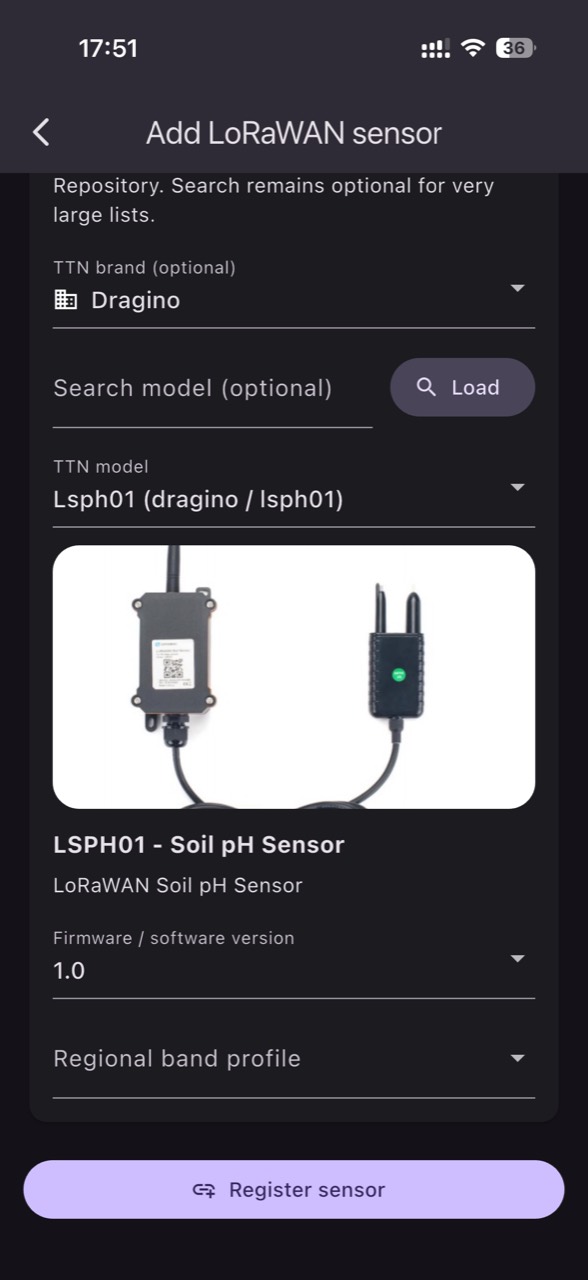
A practical (hypothetical) workflow starts with defining the “why”: what decision the data must support and what freshness is required. Then: (1) inventory sensors and confirm measurement method; (2) define units and scaling; (3) register devices in the LoRaWAN server; (4) verify uplinks appear consistently; (5) confirm coverage at the final field point, not just near the office; (6) fix mechanical placement and protection; (7) document location and soil depth for probes; (8) configure the MQTT integration; (9) decode payload and validate with control measurements; (10) only then enable alerts and thresholds.
Observe whether each step produces evidence you can point to. Independently verify by keeping a simple field log (dates/times) of events: irrigation, rain, ventilation, treatment, shading. Practical decision: start alerts conservatively to avoid false alarms, then calibrate them after 1–2 weeks of history. Check results by, after an alert, verifying the likely cause in the field (for example genuinely dry soil vs. a probe pulled out) and recording the action; in the following days confirm the trend returned, not merely that the alert stopped. In GrowGuard, the workflow typically completes by assigning sensors to zones and confirming data freshness before relying on it.
8) Frequent failures and how to separate them: battery, sensor drift, network, interpretation
The most common failures in horticultural LoRaWAN projects are: overly aggressive send intervals (battery drops quickly), marginal coverage (missing packets), sensor drift (especially probes sitting in harsh media), and payload interpretation mistakes (units/scaling). The mechanisms differ: network issues cause intermittent gaps; drift creates a slow slope or stuck values; interpretation errors create impossible values immediately. Also, VPD derived from air temperature and RH is an estimate; leaf temperature can differ, so decisions should be validated visually in the crop.
Observe the error pattern. Independently verify “network vs. sensor” using a second indicator—battery status/internal temperature (if available) or a manual reading next to the sensor. Practical decision: if you suspect network, optimize radio (antenna/gateway placement) before replacing probes; if you suspect drift, schedule cleaning/calibration or replacement and treat that period as “suspect” in interpretation. Check results by tracking three things after intervention: continuity (no gaps), plausibility (no impossible values), and event response (clear reaction to irrigation/ventilation). GrowGuard can help with status alerts and history that shows when the problem began, but final confirmation still happens in the field.
Conclusion
LoRaWAN is a strong horticultural option when you design around its constraints: small messages, smart intervals, seasonally validated coverage, and sensors chosen by method and medium. The key is to treat “data” as a technical chain: radio, network, integration, decoding, and units. Done this way, you can quickly separate a real crop issue from connectivity trouble or interpretation errors.
If you want to turn that chain into a repeatable commissioning routine, set freshness and validation criteria first, then add alerts and thresholds once you have enough history and independent checks. For bringing LoRaWAN data into GrowGuard, disciplined onboarding of payload and zones is the difference between “I have a chart” and “I trust it to decide.” If helpful, ask your team or integrator to document the commissioning steps as a short, verifiable internal protocol.