Basil has thin leaves rich in volatile oils and a dense canopy that dries slowly. In a greenhouse, that makes it sensitive to short periods of high humidity and wet leaf surfaces, especially at night and early morning. Botrytis takes advantage of these intervals: it doesn’t need “rain,” only local condensation or a fine film of water on leaves.
Real prevention starts with the mechanism: Botrytis is not “triggered” by a single number, but by a combination of temperature, humidity, still air, fragile tissues, and inoculum sources (plant debris, planting material, water). Sensors tell you when conditions become conducive; they do not confirm the pathogen is present or provide a confirmed diagnosis.
In practice, the difference between a clean crop and one with brown leaf spots comes down to drying rhythm: how long leaves stay wet after irrigation, fogging/misting, or a cool night. VPD (vapor pressure deficit) and condensation risk can turn “guesses” into decisions you can verify—especially when you manage different zones inside the same greenhouse.
1) Why basil gets Botrytis easily: the canopy microclimate
In basil, leaves overlap quickly and form pockets of air with weak circulation. If you irrigate late, run high density, or delay ventilation until a sudden sun warm-up, the canopy air layer stays humid. In these micro-zones, leaves can remain wet for a long time even when the aisle-level climate seems “fine.” That is where the first lesions and sporulation often appear.
What to observe: differences in temperature/humidity at canopy height versus general greenhouse level, plus moments when leaves feel cool and damp to the touch. What to verify independently: do a morning walk (hypothetically, 30–60 minutes after sunrise) and record where leaf dampness or film/plastic “sweating” is noticeable. Practical decision: adjust irrigation timing and start air movement earlier. Check the result: the observed “wet-leaf duration” drops at the same points.
2) VPD as a working tool: what it tells you—and what it doesn’t
VPD is an estimate derived from air temperature and relative humidity, describing how strongly the air pulls water from plants. In basil, very low VPD (air close to saturation) means slow drying and higher risk that a water film persists on leaves. Caution: VPD is calculated from air conditions, while leaf temperature can be lower than air—especially at night or near cold surfaces—so condensation can occur even when air-based VPD looks acceptable.
What to observe: repeated episodes of very low VPD in the evening/night and first morning hours, and how long it takes to return to values that permit drying. What to verify independently: compare the pattern with direct leaf observations and with condensation forming on cold elements (pipes, film, glass). Practical decision: when low VPD persists, prioritize lowering humidity (venting, holding heat, circulation) before deciding to “add a little more water.” Check the result: subsequent nights show shorter critical low-VPD periods and visibly drier leaves in the morning.
3) Condensation: proof you crossed a physical limit, not just “high humidity”
Condensation forms when a surface (including leaves) drops below the air’s dew point. In greenhouses this often happens on clear nights when the roof cools while indoor air stays moist. Basil’s thin leaves cool quickly and may condense without obvious big droplets. Once a water film forms, Botrytis has time and a suitable environment to colonize, especially on senescing tissue or wounds created during harvesting and handling.
What to observe: temperature differences between zones (for example, greenhouse ends, near doors, near sidewalls) and moments when temperature drops quickly after sunset. What to verify independently: inspect for fine droplets on leaves and for spots where the cover “sweats.” Practical decision: reduce humidity before the cooling period (controlled venting) or avoid strong surface cooling through a steadier temperature strategy. Check the result: fewer visible condensation events and a weaker link between cold mornings and new spotting.
4) Choosing and placing sensors so the greenhouse average doesn’t mislead you
For VPD you need air temperature and humidity measured correctly: shielded from radiation, away from direct heater discharge, and mounted at a height relevant to the basil canopy. A single “central” point can miss cold zones or stagnant corners—exactly where Botrytis often begins. For condensation confirmation, a leaf-wetness sensor can help validate wetness duration, but it must be interpreted as a surface indicator, not as a disease diagnosis.
What to observe: if two sensors in the same greenhouse show consistent nighttime differences, you likely have real microclimates—not “bad sensors” as the first assumption. What to verify independently: periodic checks with a portable thermo-hygrometer at fixed points, especially at leaf level. Practical decision: define distinct zones (for example, cold end versus center) and place at least one representative sensor in each. Check the result: alerts become meaningful (they match where you observe dampness) rather than appearing at random times.
5) Zone alerts: building them to trigger action, not noise
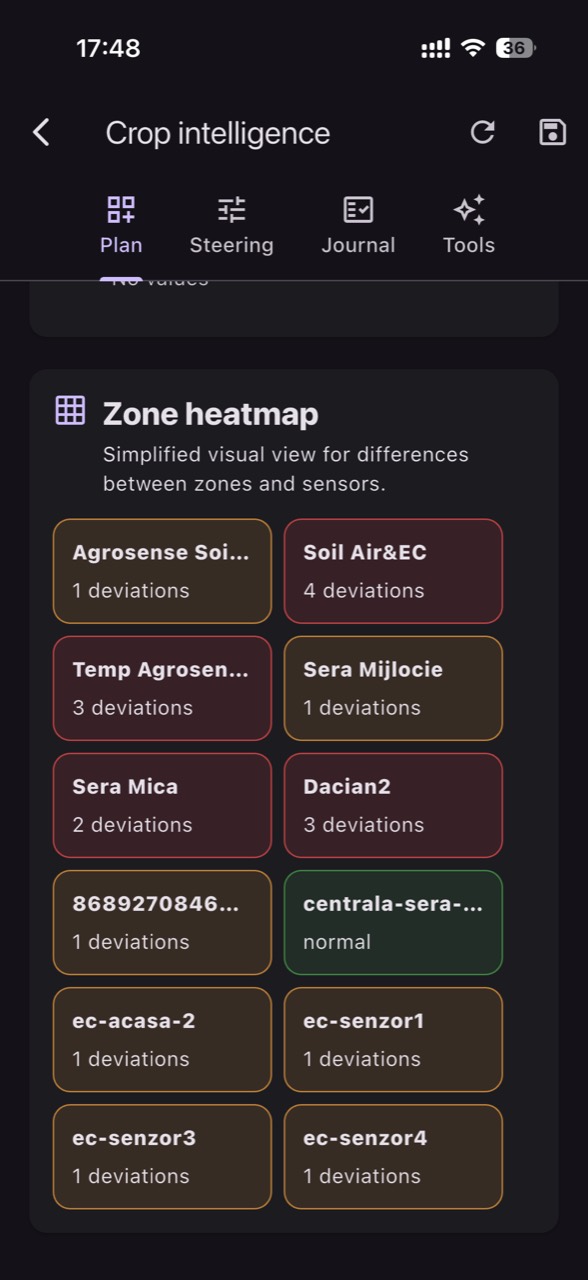
A useful alert is not “high humidity,” but “conducive conditions for long enough.” For Botrytis, duration matters: a brief low-VPD dip may be tolerable if leaves never stay wet. Zone-based alerts in GrowGuard help separate a real problem (a cold, damp end bay) from the rest of the house. Set thresholds after a week of observation: identify recurring risk hours and the zones where the pattern repeats.
What to observe: how many alerts occur per night and whether they cluster in the same time windows. What to verify independently: after an alert, enter the greenhouse and note whether there is condensation, leaf-to-leaf sticking, a damp smell, or areas with still air. Practical decision: define two levels—warning (rising risk) and critical (prolonged risk)—each tied to a different response (for example, increase circulation versus combine circulation with a temperature correction). Check the result: critical alerts become fewer, and warning alerts resolve faster after interventions.
6) Irrigation and wet leaves: avoiding a longer risk window
In basil, overhead irrigation/fogging—or any foliar wetting—amplifies risk, especially when followed by a cool night. Even with drip irrigation, wet surfaces and evaporation can raise canopy humidity and sustain wetness through secondary condensation. A practical protocol is to synchronize irrigation with the greenhouse’s drying capacity: irrigate early enough that you have time for ventilation and air movement before temperatures fall.
What to observe: the relationship between irrigation timing and low-VPD/condensation alerts in the following hours. What to verify independently: note whether the canopy shows a “steamy” feel after watering and how long it takes to clear. Practical decision: if nighttime risk is recurrent, shift the main watering earlier and split it into pulses (hypothetically) to avoid sharp humidity spikes. Check the result: in microclimate history, post-irrigation humidity peaks are smaller and normalize before evening.
7) Hygiene and inoculum sources: good microclimate won’t compensate for debris
Even with good VPD and condensation management, Botrytis still needs a source: plant debris, fallen leaves, stressed plants, dirty crates, or already-contaminated planting material. In greenhouses, pathogens can be introduced or maintained by residues and water, while microclimate determines how readily problems express. Basil’s frequent cuts create wounds; if trimmed leaves remain on benches or aisles, you create multiplication points exactly when humidity rises overnight.
What to observe: lesions originating near debris zones, weedy corners, or handling/packing points. What to verify independently: short scheduled inspections after harvest and before closing the greenhouse in the evening; remove fallen leaves and check for wet accumulation under benches or conveyors. Practical decision: standardize a cleaning routine and separate material flow (in/out) to reduce re-inoculation. Check the result: fewer recurring point outbreaks in the same locations even when you still experience humid nights.
8) The verification loop: knowing interventions truly worked
In Botrytis management, “we ventilated” is not evidence; evidence is that the duration of conducive conditions decreased and leaves dry faster. Work with windows: record (hypothetically) three risk nights, intervene earlier (circulation or temperature strategy), then compare. Watch data freshness: a signal gap or a low-battery sensor can create missing nighttime data exactly during critical hours, making conclusions fragile.
What to observe: trends, not isolated moments—how many hours per night are risky, in which zones, and how that changes after adjustments. What to verify independently: periodically confirm sensors read realistically (compare two nearby points, check mounting and radiation shielding) and that units are interpreted correctly (temperature/humidity for VPD, leaf wetness for surface moisture). Practical decision: keep interventions that shorten risk duration and drop those that merely shift the problem to another zone. Check the result: fewer mornings with damp leaves and fewer new symptoms on young leaves.
Conclusion
In basil, controlling Botrytis is not about chasing a perfect number; it’s about reducing the time leaves stay wet and the canopy air stays near saturation. VPD helps quantify drying capacity, and condensation tells you when physics has overtaken your plan. Combine that with synchronized irrigation, air movement, and hygiene, and the risk windows become visibly shorter.
If your greenhouse has strong differences between ends or between benches, zone alerts in GrowGuard can help you respond where risk forms, not where the “average” looks safe. Start with direct observation, validate sensors, then refine thresholds until each alert triggers a check and a measurable action. If you want, set up a simple zone commissioning plan with your team and iterate from there.