As a cut flower, tuberose shows management mistakes immediately: softer spikes, overly long internodes, uneven opening, and fragrance that feels “on and off.” In a greenhouse, the issue is rarely “too little water” in general. More often it is a mismatch between atmospheric demand (transpiration) and the delivery of water and nutrients to the root zone—especially when microclimate differs by zone.
VPD (vapor pressure deficit) is a good tool for anticipating transpiration rhythm, but it is not a universal setpoint button. VPD is calculated from air temperature and relative humidity and remains an estimate: the leaf can be cooler or warmer than the air, and stomata can respond with a lag. That’s why “VPD-based irrigation” must also be tied to what actually happens in the root zone.
In parallel, EC and pH in fertigation influence how easily plants can take up ions from solution and how quickly salts can accumulate in substrate or soil. Confusions are common: EC of water, EC of the fertigation solution, EC of drainage (runoff), and EC from a substrate extract are not the same measurement and are not interpreted the same way. A zone-based protocol with independent checks helps you keep spikes firm and fragrance consistent without water stress.
1) Why tuberose is sensitive to water–VPD “synchronization”
Tuberose has a growth pattern where the flowering spike elongates and tissues must be formed and filled steadily. That process depends on continuous water flow and calcium transport without interruptions. When VPD rises quickly (warmer or drier air), transpiration demand increases; if the root zone is too dry or its hydraulic conductivity drops, short stress episodes occur. The outcome can be more elastic spikes and fragrance variation, because stress shifts metabolism and timing.
What you may observe in practice: at the same cultivar and age, some greenhouse strips look “fresh” in the morning and subtly “flat” by afternoon, without obvious wilting. Independent verification: check substrate/soil moisture at active root depth, not just the surface, and note when VPD changes fastest during the day. Practical decision: shift the first irrigation pulses earlier to anticipate the VPD rise. Result check: confirm daily moisture swings shrink and spikes feel more rigid at harvest.
2) VPD is a demand signal, not a volume recipe
A common mistake is converting VPD into a fixed liters-per-day program. VPD tells you how strongly the atmosphere pulls water, but it does not know your substrate water reserve, distribution uniformity, or whether roots are active (temperature, oxygen status). On a high-radiation day, VPD can rise without harming plants if the root zone is well supplied. On another day, the same VPD becomes stressful if the substrate is near dry limits or cold.
What to observe: if similar VPD values trigger different crop responses from week to week, the root-zone “context” is usually the driver. Independent verification: measure root-zone temperature and compare it with moisture curves at several points, plus a simple root inspection on a few check plants. Decision: use VPD mainly as a timing trigger (when to start or tighten pulses) and validate volume through substrate response. Result check: compare how quickly moisture rebounds after irrigation and whether peak-hour turgor stays stable.
3) EC and pH: what you measure, where, and why it matters for tuberose
EC does not tell you “how much nitrogen you have.” It reflects total dissolved salts; pH influences the availability of many elements and lockout risk. In tuberose, unstable management often creates alternating phases: weak uptake when roots are stressed, salt accumulation in substrate, then aggressive “flushing” that destabilizes again. The key is to separate measurement media: EC/pH in source water, in fertigation solution, in drainage, and in substrate extract are different measurements and cannot be compared directly.
What to observe: foliage that looks “tired” without a classic deficiency pattern, or flower/spike size differences between zones. Independent verification: beyond online readings, periodically measure with a calibrated handheld meter from correctly collected samples (for example, solution at the end of line and drainage caught in a clean container). Practical best practice: lab water analysis remains complementary; on-site pH/EC monitoring does not replace it, and pH, alkalinity, and soluble salts are distinct water-quality factors. Decision: first stabilize solution quality and distribution uniformity, then adjust your EC target. Result check: watch whether the gap between feed EC and drainage/extract EC becomes more stable by zone.
4) Zone management: why a single average ruins spike firmness and fragrance
In greenhouses, tuberose beds can sit in zones with different air movement, shading, proximity to doors, or flow differences on irrigation branches. That means different VPD, different evapotranspiration, and different water consumption. If you irrigate “by average,” one zone turns too dry exactly when VPD peaks, while another stays too wet and loses root oxygenation. Because fragrance ties to metabolism and stress status, it becomes patchy—especially in blocks harvested daily.
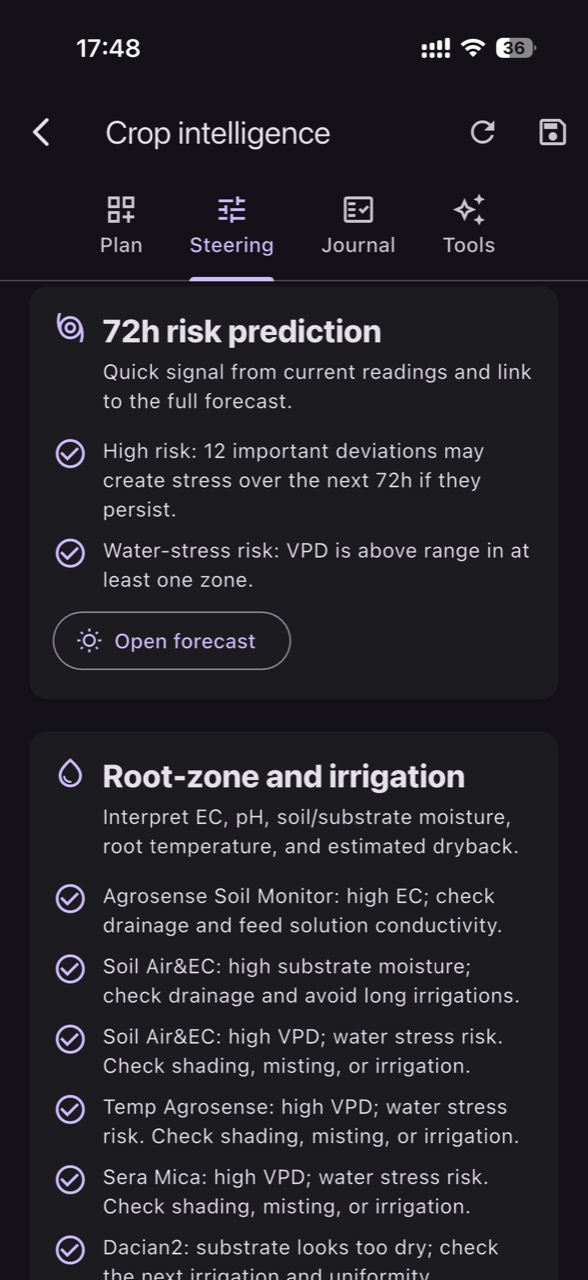
What to observe: same day, two greenhouse ends show different spike stiffness. Independent verification: do a fixed-time walk (for example, just before first irrigation and mid-afternoon) and note temperature/humidity differences and how “heavy” the substrate feels in a few reference pots/beds. Decision: split the house into real zones (not just “sector A/B”) and set separate alert thresholds for VPD and moisture. In GrowGuard, viewing a sensor map and comparing zones helps avoid managing by one number. Result check: zones should converge in daily moisture amplitude, and harvest lots should become more uniform in firmness.
5) A VPD-linked irrigation protocol: pulses, delays, and validation
Instead of sharply increasing volume when VPD is high, more frequent pulses often work better, so the root zone does not cross a threshold where uptake slows. Mechanism: at high VPD the plant transpires more; if the substrate is too dry, water tension rises and roots cannot keep up. Pulses maintain availability without prolonged saturation. However, on cold days or when VPD is low, the same pulse density can cause hypoxia and softer spikes—so the protocol must be conditional.
What to observe: after a large midday irrigation, leaves may look fine, yet the next morning the substrate remains overly wet and roots behave “lazy.” Independent verification: use a root-zone moisture sensor and inspect the curve in the hours after a pulse; if moisture jumps high and declines slowly, the pulse was too large or drainage is limiting. Decision: define a zone reaction-time window (how long until you see a measurable rise after start) and use it as an operational test. Result check: track whether peak-hour subtle stress signs decrease (slight edge curling, internodes “running”).
6) Fertigation: preventing EC/pH swings without “drowning” the crop
Stable fertigation means consistent solution at entry and controlled accumulation in the root zone. If you alternate plain water periods with concentrated feeds, tuberose can experience waves of uptake and osmotic stress, especially when VPD is high. Also, pH behavior depends on water alkalinity, not only measured pH; two waters can share the same pH but respond differently to acid addition. That’s why water analysis and separate interpretation of pH, alkalinity, and soluble salts are essential groundwork.
What to observe: good growth overall, but fragrance varies from one harvest wave to the next without obvious temperature shifts. Independent verification: check EC/pH directly in the tank and again at the end of line (differences can indicate poor mixing, deposits, or stagnation time). Then compare with EC in drainage or a substrate extract to understand accumulation—remembering these are different methods. Decision: correct delivery uniformity and stability first, then adjust concentration in small steps validated over several days. Result check: watch whether root-zone EC stops spiking after recipe changes.
7) Sensor choice and commissioning: units, data freshness, and typical failure modes
This protocol relies on three measurement families: climate (air temperature and relative humidity for VPD), root-zone moisture, and EC/pH using dedicated probes. A temperature sensor does not measure EC or pH, and a clean-looking chart is not “truth” if the probe is poorly placed. Data freshness matters, too: a delay of tens of minutes on a day with rapidly changing VPD can shift decisions too late, especially around the first irrigation events.
What to observe: alerts that feel “wrong” exactly when you need them. Independent verification: during commissioning, run provocation tests—briefly vent or irrigate only one row and confirm the relevant sensor sees the change within the expected time window. For EC/pH, calibrate with appropriate standards and record dates; drift over time is a common cause of bad decisions. Decision: define for each zone a reference point and a “risk” point (end of line, warmer corner) and compare them. In GrowGuard, battery/status alerts help you avoid mistaking a failed sensor for a “miracle” microclimate. Result check: after 1–2 weeks, zone differences should be explainable by position, not random.
8) The verification loop: proving firmer spikes and steadier fragrance without stress
A good protocol has a simple loop: hypothesis – adjustment – verification. With tuberose, verification is not only “the plant didn’t wilt,” but harvest quality consistency. The mechanism you want is fewer alternations: smaller daily moisture swings in the root zone, fewer EC peaks in substrate, and a clearer link between VPD and pulse frequency. When alternations shrink, the spike has a better chance to thicken normally and remain firm, rather than stretching under intermittent stress.
What to observe: instead of constantly changing the “recipe,” you see repeatability from week to week. Independent verification: keep a short log with three indicators: (1) hours when VPD peaked, (2) number of irrigations/pulses that day by zone, (3) a harvest-quality note (spike firmness, uniform opening, perceived fragrance intensity). Decision: if one zone repeatedly needs correction, treat it as a distribution/flow or drainage issue—not “the plant is picky.” Result check: compare consecutive lots; in a hypothetical example, moving the first pulse earlier in the warm zone reduces firmness differences noticeably within 10–14 days.
Conclusion
Tuberose needs less “luck” and more synchronization: when atmospheric demand rises (higher VPD), the root zone must provide water with oxygen, and the nutrient solution must remain stable. The practical keys are working by real zones, separating EC/pH measurements by medium and method, and validating each change through substrate and plant response—not only dashboard values.
If you want to turn observations into routine, build zone alerts for VPD, moisture, and EC/pH, then run a weekly independent check using proper sampling and calibration. GrowGuard can support monitoring and zone comparisons, but the decisions remain agronomic: small, verified changes until spike firmness and fragrance become consistent. If you’d like a safer rollout, start with one reference zone and expand after you confirm the result.