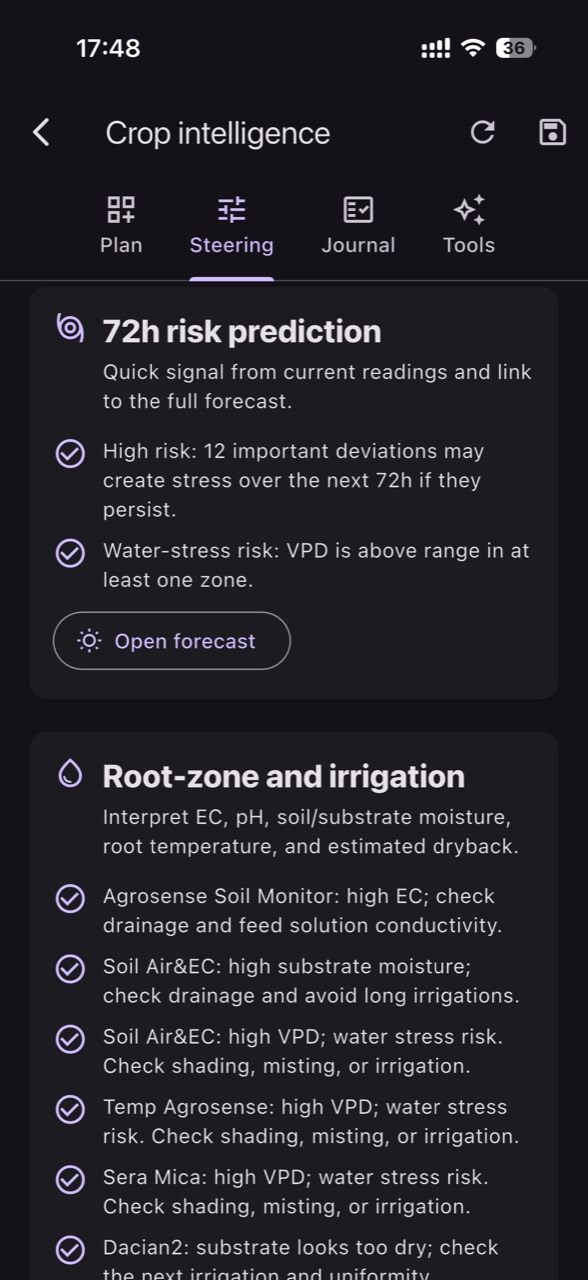
Anthurium is a high-value crop with little tolerance for root-zone mistakes. In greenhouses, the biggest losses don’t necessarily come from lack of water, but from the combination of a substrate that stays too wet, low oxygen around roots, and long periods when plants transpire poorly. That is when the risk window opens for Phytophthora root rot.
VPD (vapour pressure deficit) helps describe plant “demand”: how easily the crop can transpire into the surrounding air. Substrate-based irrigation describes “supply”: how much water remains available at the roots and how much air the substrate still holds. When demand drops while supply remains high, the root zone stagnates wet and risk increases.
The protocol below shows how to connect VPD to irrigation decisions, what to verify independently so sensors don’t mislead you, how to interpret differences by greenhouse zones, and how to turn the logic into actionable alerts. The examples are hypothetical and must be adapted to your substrate, pot size, crop density, and irrigation system.
1) Why Anthurium rots easily when the microclimate “closes the tap” on transpiration
Phytophthora damages roots most readily when they spend long periods under low-oxygen conditions. In pots, oxygen depends on substrate porosity, drainage speed, and how often you re-fill pore space with water. Anthurium performs best with a well-aerated root zone; when transpiration drops, the plant pulls less water and the substrate can remain wet much longer than you expected from the irrigation schedule.
What to watch in practice: drying rhythm between irrigations, anaerobic odours, browning roots during spot checks, and plants that “stall” even while leaves still look green. Independent verification: weigh a few reference pots and cut a small substrate section from a few pots to see whether moisture is only on top or throughout the volume. Decision: reduce inputs when demand (VPD) is low, then confirm after 24–48 hours that drying time shortened without wilting.
2) VPD as a demand signal: how to interpret it without turning it into a rigid setpoint
VPD is calculated from air temperature and relative humidity and expresses the air’s tendency to absorb water vapour. Operationally, low VPD means air close to saturation: transpiration slows, leaves cool less, and water uptake from the substrate decreases. Caution: VPD is an estimate derived from air conditions; leaf temperature can differ, especially under shade, right after irrigation, or near cold walls.
What to observe: long low-VPD stretches, commonly early morning, after heavy irrigations, on cloudy days, or when ventilation is limited. What to verify independently: differences between your climate sensor and a handheld thermometer/hygrometer placed within the canopy, confirming you’re not reading a warmer/drier “air pocket” than the crop actually experiences. Decision: use VPD as “permission” for substantial irrigations, not as a recipe; when VPD stays low, split irrigation into smaller events or delay it. Result check: compare the substrate-moisture curve before and after the change.
3) Substrate-based irrigation: why “high moisture” does not mean the same thing in every pot
In a greenhouse, the same applied water volume can produce very different root-zone states depending on substrate particle size, compaction, crop age, root colonisation of the pot, and drip uniformity. Stratification is also common: the surface can look dry while the active root zone remains saturated. Under these conditions, “watering by schedule” becomes risky because it ignores what the root zone actually retained.
What to watch: the moisture rise slope during irrigation (does the substrate absorb, or is it already full?), then the return speed toward lower values (dry-down). Independent verification: visually check drainage in a few pots and run a simple uniformity check (pots at line ends versus the middle after the same irrigation). Decision: adjust duration/frequency based on response, not on applied volume; if moisture stays high for hours while VPD is low, reduce pulses. Result check: look for shorter “too-wet” time without increased water stress.
4) Linking VPD to substrate readings: the working rule to reduce “stagnation hours”
Linking means treating VPD as a predictor of water use and substrate moisture as feedback. If VPD has been low for many hours, expect slower dry-down; therefore your “start irrigation” trigger must effectively be lower or later. Conversely, when VPD rises (higher demand), you can allow irrigations that keep the plant active without prolonging saturation. The goal is not maximum dryness—it is fewer hours where roots sit wet with no real uptake.
What to do in practice: define 2–3 operational “modes” based on VPD (for example: low, medium, high), and for each mode decide how you interpret the same substrate-moisture value. Hypothetical example: at the same measured moisture, if VPD has been low in recent hours, you delay irrigation and re-check in 30–60 minutes; if VPD is high and the curve shows fast dry-down, you apply a short pulse. Check results by watching whether moisture jumps and stays flat (excess) or declines gradually after watering (real consumption).
5) Sensors and units: what you measure, where, and how to avoid mix-ups that drive wrong decisions
For a VPD–irrigation protocol you need two measurement families: climate (air temperature and relative humidity, from which VPD is calculated) and the root zone (substrate moisture; optionally EC/pH in the substrate solution, but only with dedicated probes). A temperature sensor does not measure EC/pH; and EC depends on medium and method—irrigation water, fertigation solution, substrate extract, or drainage are different measurements and cannot be compared directly as if they were the same number.
What to verify during commissioning: data “freshness” (avoid acting on stale values), reading stability over time, and coherence between sensors in the same zone. Do a controlled test: a short irrigation pulse should produce a visible moisture change within an expected interval; if nothing changes, either the probe isn’t in the active root zone or water isn’t reaching that spot. For EC/pH, remember that on-site monitoring complements laboratory water analysis, not replaces it; water, fertigation, and substrate extract each describe different parts of the system. Decision: before changing irrigation strategy, confirm that the sensor actually “sees” irrigation.
6) Greenhouse zones: why the same strategy can be right at one end and wrong at the other
Anthurium responds strongly to microclimates: light gradients, cold drafts, proximity to doors, thermal screens, heating pipes, and differences in plant density. In a cooler, more humid zone, VPD drops more often and the substrate dries more slowly—exactly where Phytophthora can gain time. In a warmer zone, the same irrigation might be perfectly safe. That is why zone comparison is usually more valuable than a whole-house average.
What to watch: hours when one zone has consistently lower VPD than the rest and whether, during those same hours, substrate moisture remains persistently high. Independent verification: physically inspect the “suspect zone” (pot weight, drainage, smell, and temperature at substrate level) to confirm the pattern is real and not caused by poor sensor placement. Decision: adjust irrigation only there (shorter duration, fewer pulses, or a time shift) and correct the climate driver (local ventilation, avoiding direct cold airflow, balancing screens). Result check: see whether moisture differences between zones shrink and whether fewer plants look “lazy” in the risk zone.
7) Zone alerts: how to make them actionable rather than noisy
A good Phytophthora-focused alert does not attempt to “detect the pathogen.” Instead, it flags the window of conditions that favour it: substrate too wet for too long, alongside prolonged low VPD. In GrowGuard, the practical idea is to set thresholds and durations by zone, not just instant values. Otherwise you’ll be notified by every short fluctuation (for example, a brief ventilation change) and the team will learn to ignore alarms.
What to configure: a team-agreed logic alert (for instance, “substrate moisture above a threshold for X hours” plus “VPD below a threshold for Y hours”), tuned from your own history. Independent verification: for the first triggers, go to the zone and note whether pots are truly heavy, whether drainage is excessive, or whether it’s a sensor issue (poor contact, wrong position, atypical pot). Decision: when an alert fires, choose one of three responses—delay irrigation, reduce/split pulses, or intervene climatically (ventilation/dehumidification). Result check: after the response, confirm VPD recovers gradually and moisture begins to decline rather than merely oscillate.
8) Validation after action: proving you reduced risk without “thirsting” the crop
Any reduction in irrigation to limit root rot can push the crop toward water stress and poor quality, especially as light increases. Validation must therefore track two things at once: fewer hours with saturated substrate and maintained plant function (firm leaves, steady growth, white roots in checks). Instead of chasing perfection in a single day, watch trends over 7–14 days, because substrate inertia matters and the crop’s response lags behind a schedule change.
What to verify independently: weigh a few reference pots at fixed times, plus a weekly root inspection on “control” plants (hypothetically, sacrificing a few if production allows). Decision: if moisture declines faster but stress shows up during high-VPD hours, don’t revert to large irrigations; it is usually safer to fragment water into small pulses during true-demand periods. Result check: confirm long flat “wet plateaus” disappear while plants maintain turgor. If not, revisit sensor placement and irrigation uniformity before adjusting thresholds again.
Conclusion
Preventing Phytophthora in Anthurium is not about one universal setpoint; it is a balance between demand (VPD) and supply (substrate water). When you link them, you reduce the hours when roots sit in water that isn’t being used. At the same time, you avoid acting on misleading data by doing simple checks: reference pots, drainage observations, root inspections, and zone-to-zone comparisons.
If you want this logic to become a repeatable team routine, use zone-based alerts in GrowGuard only after confirming sensors reflect real irrigation and real microclimate. A simple invitation: run a one-week validation, record what action you took for each alert, then confirm on the graphs that “too-wet duration” is shrinking without stress signals.