In greenhouse chrysanthemums, the same fertigation recipe can produce different results across benches or sectors. The difference often comes from what you do not see: what happens inside the substrate after each irrigation. Runoff (drainage) is your window into the root zone, where salts can accumulate and where pH can drift without immediately obvious symptoms.
Checking runoff EC/pH is not a lab ritual; it is a calibration tool. It tells you whether irrigation volume, frequency, and uniformity are producing a stable root-zone solution. EC and pH depend on the medium measured and on the sampling method. Runoff EC is not the same measurement as stock-tank EC, and water pH does not replace pot/root-zone pH.
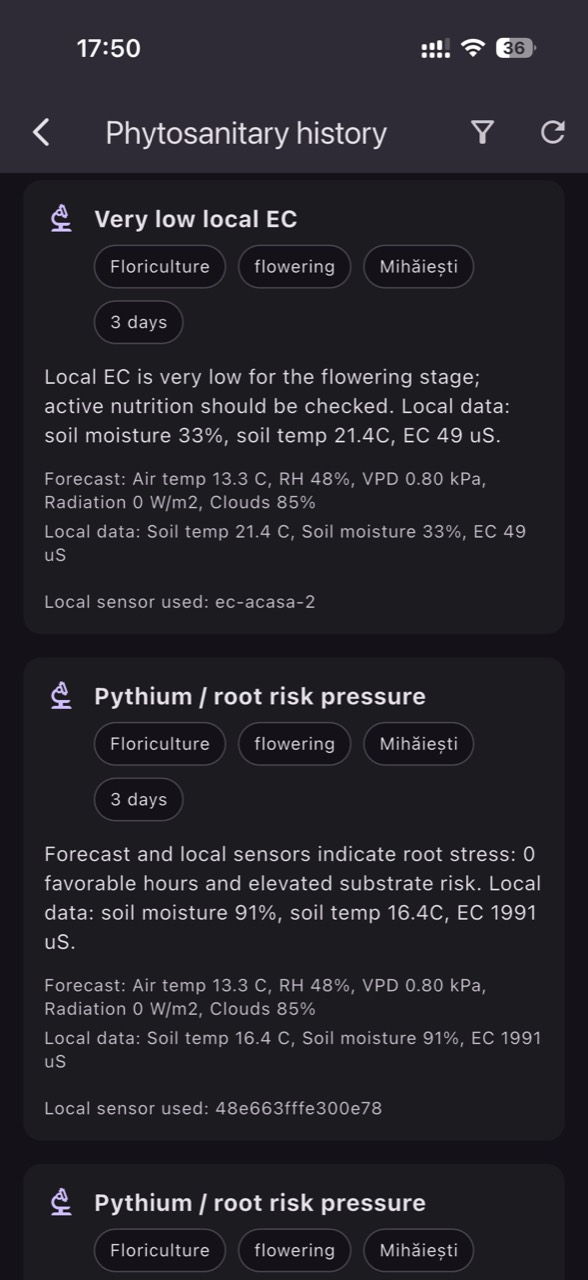
Below is a decision-oriented protocol: what to observe in chrysanthemums, how to collect runoff without fooling yourself, what to verify independently (meter calibration, units, method), what adjustments are sensible, and how to check whether they worked. Where useful, you can use GrowGuard to organize measurements by zone and set alerts based on values you manually enter or integrate from dedicated instruments.
1) Why runoff matters specifically in chrysanthemums (mechanism and delayed symptoms)
Chrysanthemums can build vegetative mass quickly, and their water and ion uptake changes sharply between phases (after pinching, during stem extension, and around bud initiation). When transpiration temporarily drops (for example lower light or high humidity), nutrient input via fertigation can exceed what the plant consumes. Salts remain in the substrate, root-zone EC rises, and water uptake becomes harder even when the substrate still looks wet.
Root-zone pH can drift differently by zone depending on water alkalinity, substrate type, how much drainage occurs, and the balance of N forms in the recipe. Early signs are not always “classic deficiencies.” More often you see unevenness: smaller leaves, slightly rigid tips, shorter roots, or a subtle slowdown in crop rhythm. Runoff lets you detect change earlier, before it gets misattributed to genetics or light differences.
2) What you measure, in which medium, and with what tool (avoid wrong comparisons)
In practice you are dealing with at least four different “ECs”: source-water EC, fertigation-solution EC (in tank/line), runoff (drainage) EC, and substrate-extract EC (a lab or on-farm extraction method). They are not interchangeable. Runoff EC higher than applied-solution EC indicates net salt accumulation in the root zone; similar EC can mean balance, or sometimes irrigation that is too short and only flushes part of the pots.
To measure EC and pH you need dedicated instruments: a conductivity meter and a portable pH meter, or inline probes. A temperature sensor or a substrate-moisture sensor does not measure EC/pH. In GrowGuard, EC/pH values arrive either through manual entry (a sampling log) or through integration of equipment/probes that transmit readings; any EC/pH alerts are based on those inputs, not on estimates. Always confirm units (mS/cm vs µS/cm) and label the medium as “runoff EC,” not just “EC.”
3) Correct runoff sampling: how to avoid “cosmetic” samples
Choose representative pots for each zone: not at edges, not near doors, and not from a drafty corner. It helps to mark the same pots to follow trends, but periodically include new pots so you do not unintentionally “optimize” around a fixed sample. Sampling only makes sense after an irrigation event that produces real drainage; if you only wet the surface, samples can underestimate what is accumulating deeper in the pot.
Collect runoff into a clean container immediately after irrigation, avoiding contact with floors or gutters that can contaminate the sample. If you use saucers, rinse and dry them beforehand. Gently mix to homogenize, then measure promptly; pH can shift if the sample sits open for a long time. Record context: which recipe was applied, how long irrigation ran, whether it was pulsed, and whether that zone had different shading or ventilation that changes uptake.
4) Calibration and independent checks: the instrument can lie before the crop does
Before reacting to a “shocking” EC/pH number, verify the instrument. pH meters need calibration with appropriate buffer solutions and a maintained electrode; a dried, dirty, or aging electrode can drift significantly. For EC, check the meter with a standard solution and inspect the cell for deposits. If you have two meters, a side-by-side reading on the same sample is a fast way to catch obvious errors.
Then verify the cause chain: measure the applied solution on the same day (input EC/pH) so you know whether the issue originates in the recipe or in accumulation. If source water has high alkalinity, root-zone pH can be pushed upward even when initial water pH looks “fine,” which is why water analysis complements on-site monitoring rather than being replaced by it. For traceability, record results in a consistent format by zone, with date and method.
5) Interpreting zone differences: EC/pH are indicators, not a verdict
Interpret the difference between input and runoff first, not the isolated number. If one zone’s runoff EC is consistently higher than the applied solution EC, that signals accumulation or insufficient drainage in that zone. If runoff pH systematically moves away from input pH, suspect substrate and alkalinity effects, uneven acid/fertilizer distribution, or even unlogged water sources (for example hand-watering) that alter what the pots actually receive.
Then compare measurements with crop observations: uniformity of growth, leaf color, firmness, any marginal burn, and root quality in check pots. A common hypothetical case: two benches receive the same run time, but one has stronger airflow and higher use; runoff may show lower EC and a different pH even if the recipe is not wrong. The correct decision is not automatically “change fertilizer,” but to calibrate irrigation for that zone’s demand.
6) Adjusting irrigation by zones: volume, frequency, uniformity (and how to verify the effect)
When runoff suggests salt build-up, the first adjustment is often hydraulic: confirm the zone receives enough volume and uniformity to wet the entire pot and produce comparable drainage between pots. Frequent issues include partially clogged lines, pressure differences along laterals, mismatched emitters, sloped benches, or run times that favor only the first pots in the line. Observe drainage distribution: if only a few pots drain heavily, your “runoff sample” may not represent the zone at all.
As a decision, adjust toward consistent, representative drainage in the problem zone without turning every irrigation into permanent flushing. Verification is done by comparing input-to-runoff trends over multiple relevant irrigation events and, in parallel, a substrate moisture curve (if you have moisture sensors) or weights of check pots. Avoid a universal retest interval; tie follow-up checks to the next one or two irrigation events that actually produce drainage and to weather-driven shifts in demand that can change the balance quickly.
7) Adjusting fertigation: when to change the recipe vs when to change control
If runoff EC/pH deviates repeatedly in one zone, do not assume the recipe is “too strong” for the whole greenhouse. First confirm the applied solution (input EC/pH) is stable throughout the irrigation event; start and end can differ if mixing is poor or if there is lag in long lines. If input is stable but runoff EC keeps rising, the problem is more likely the relationship between supply and consumption (transpiration, drainage fraction, microclimate), not the fertilizer itself.
When does zone-specific fertigation actually make sense? When the same zone repeatedly shows more concentrated runoff and the crop symptoms align (for example slowed growth with poorer roots), and after hydraulic checks come back clean. If infrastructure allows, you may choose a different recipe for that zone only. Check the result by confirming runoff moves closer to input and crop uniformity improves. Remember: EC does not identify which nutrient is high or low; that requires analysis and agronomic context.
8) Zone organization and follow-through in GrowGuard (don’t confuse measuring with monitoring)
To calibrate “by zones,” you need disciplined data: the same sampling method, the same units, and the same zone identification. GrowGuard can serve as a shared log for the team: define real zones (benches, sectors, compartments) and attach each zone’s EC/pH values measured with dedicated meters, together with notes about irrigation and crop observations. That structure turns zone differences into comparable evidence rather than anecdotes.
Zone alerts only make sense if you understand the trigger: they are based on EC/pH values you enter or receive from integrated probes/meters, not values “inferred” from temperature or moisture. Set internal thresholds from your own history and chrysanthemum guidance, then refine them after several cycles of measurement and correction. A hypothetical example: you trigger an alert when the gap between input EC and runoff EC exceeds a zone-specific limit you defined; when it fires, you check hydraulics, then confirm with a second properly collected runoff sample.
Conclusion
Runoff is not just an EC/pH number; it is a check of the balance between microclimate, crop demand, and how water and nutrients move through the pot. In chrysanthemums, where batch uniformity is critical, zone differences develop quickly and can show up late if you do not measure in the root zone. The key is consistency: same method, traceable records, input-to-runoff comparisons, and independent verification of instruments.
To make changes with minimal risk, start with hydraulic and scheduling corrections (uniformity, representative drainage), and only then consider zone-specific recipe changes. For teams, a zone-based journal and alerts built on real measurements can shorten time to diagnosis; in that sense, GrowGuard can be a useful framework for communication and follow-through. If you want, we can clarify which meter/probe type and data flow fit your installation.