Asiatic lily (Lilium) is sensitive to “invisible errors” in the greenhouse: irrigations that look right by eye, yet keep the root zone saturated for too long. In those windows, Pythium and other root rots don’t need much—excess water, low oxygen, and favorable temperatures. From outside you notice wilting or stalled growth, but the cause starts in the pot.
Effective prevention is not a calendar spray; it is controlling the conditions that make roots vulnerable. Three data streams are decisive: pH and EC in water/fertigation solution (and separately in the substrate), root-zone moisture dynamics, and the microclimate that governs transpiration—usefully summarized by VPD. Without these reference points, irrigation changes become guesswork.
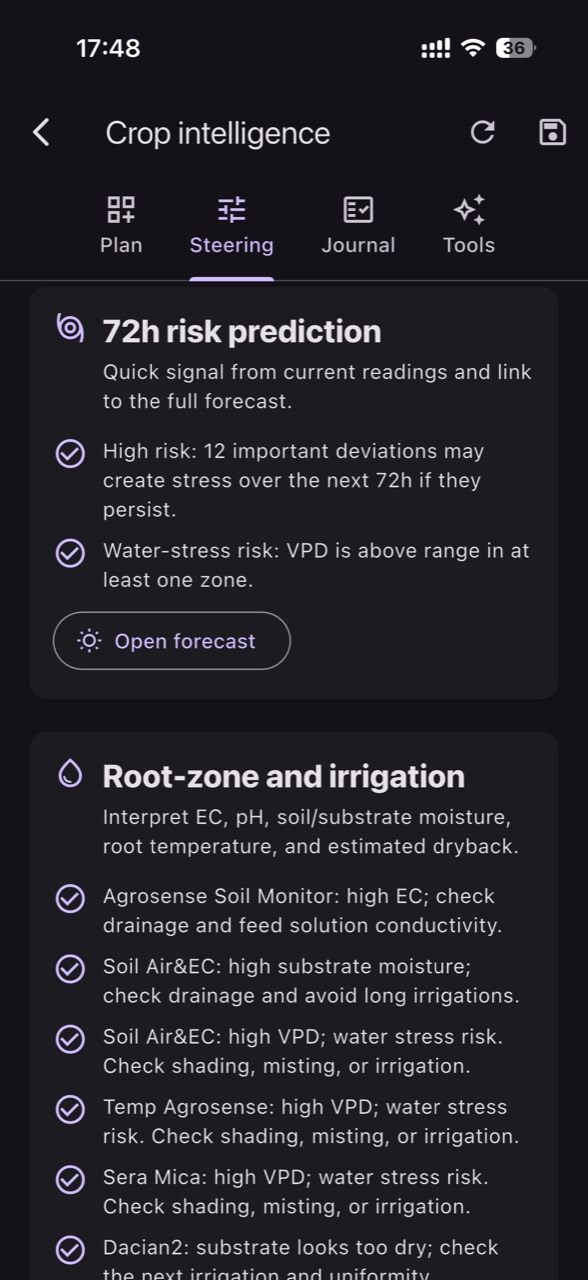
Even in one greenhouse, there are distinct zones: near doors, along sidewalls, under heaters, or where screens change airflow. Those areas dry differently, run warmer or cooler, and hold humidity differently—so root-rot risk is uneven. Zone-based monitoring and location-aware alerts are therefore more useful than a single “average” value. In GrowGuard, you can track these differences and respond selectively rather than uniformly.
1) Why Pythium starts with water management, not “bad luck”
Pythium is favored when roots are stressed: hypoxia (not enough oxygen) in the substrate, temperatures that increase root respiration, and long periods when pore spaces remain filled with water. In Asiatic lily, roots must support rapid vegetative growth and strong stems; when roots are compromised, you may see pale foliage, soft tips, and uneven stem development. Often, visible symptoms appear well after the initial management mistake.
What to observe: mid-day wilting on bright days, weak overnight recovery, pots that stay heavy, and browned or sloughing roots. What to verify independently: pull a few “check plants” and assess substrate odor, root firmness, and how deep the wet layer extends. Practical decision: shorten the saturation period using more fragmented irrigations or longer gaps between events—but only after sensors confirm the substrate is truly staying too wet. Check the result by seeing less time spent at “stuck-high” moisture and a return to steady growth.
2) pH, alkalinity, and EC: what each measurement means—and doesn’t
In greenhouses, pH is often mistaken for “how acidic the water is,” and EC for “how much fertilizer is present.” pH reflects hydrogen ion activity in the measured medium, while pH stability depends strongly on alkalinity (buffering capacity). EC indicates total dissolved soluble salts, but it does not identify which nutrients are high or low. Crucially, pH/EC in source water, in fertigation solution, and in a substrate extract are different measurements and cannot be substituted for one another.
What to observe: pH drifting in the tank, EC rising over time without recipe changes, or large differences between incoming solution and drainage. What to verify independently: periodic laboratory water analysis (including alkalinity), plus routine on-site measurements with dedicated, calibrated pH and EC probes. Practical decision: when solution pH swings widely, don’t “correct at random”; look at alkalinity and at how your system adds acid/base. Check the result by achieving steadier pH trends and consistent, explainable differences between input and drainage rather than sharp oscillations.
3) Where pH/EC measurements matter: solution vs drainage vs substrate
For preventing root rot, measuring at three points tells three different stories. In fertigation solution you confirm what the crop receives. In drainage you see the cumulative effect—what is building up in the pot and how the root zone is behaving. In the substrate (using one standardized extraction method, applied consistently) you evaluate the actual root environment. Without separating these media, you may see an EC that looks “perfect” in the tank while roots sit in a concentrated substrate due to short irrigations and evaporation.
What to observe: in lily, osmotic stress in the substrate can reduce water uptake and intensify the impact of excess moisture (a weakened root system becomes less functional). What to verify independently: compare EC/pH from incoming solution with drainage collected from several representative pots, and separately run the same substrate extraction method on comparable batches. Practical decision: if drainage indicates accumulation, adjust the irrigation strategy (for example, a planned leaching-type event if it fits your production and system constraints) and watch whether the trend normalizes. Check the result by a more stable input-to-drainage relationship and fewer “see-saw” wilting episodes.
4) Root-zone moisture sensors: selection, placement, and common traps
In pots and trays, moisture is not uniform: the surface can dry quickly while the bottom remains saturated. So the sensor must be selected and placed to read the active root zone—not just the top layer. Use dedicated substrate-moisture sensors (do not confuse them with temperature probes) and decide from the start what unit you are interpreting (for example, volumetric water content or tension), because the graph “shape” matters. A poorly placed sensor can convincingly “prove” a problem that is not real.
What to observe: after irrigation, a healthy profile shows a quick rise followed by a gradual decline as the pot drains and the plant uses water. A Pythium-risk signature is a long plateau at very high moisture, or no meaningful drop between irrigations. What to verify independently: weigh a few pots (hypothetically, same size and substrate) and check moisture by hand at depth to confirm the sensor. Practical decision: if sensors show persistent saturation, adjust event duration and frequency—then verify success by shortening the post-irrigation plateau, not merely by “using less water.”
5) VPD as a demand indicator: why it affects roots and Pythium risk
VPD (vapor pressure deficit) describes the air’s evaporative demand, derived from air temperature and relative humidity. It is a useful indicator for how strongly the plant can transpire and therefore how much water it will pull through the roots. When VPD is very low (humid air), transpiration drops; if you irrigate as if it were a “dry day,” water remains longer in the substrate, oxygen declines, and vulnerability to Pythium rises. Conversely, very high VPD can raise demand and tempt you into frequent irrigations that don’t allow re-oxygenation between events.
What to observe: timing links between low-VPD periods (humid nights, foggy mornings inside the greenhouse) and pots that stay heavy. Note the limitation: VPD is an estimate from air measurements; leaf temperature can differ, especially under strong radiation or drafts. What to verify independently: temperature/RH readings at multiple points and practical transpiration cues (such as pot dry-down rate). Practical decision: during low-VPD stretches, reduce routine irrigations and rely more on root-zone moisture thresholds. Check the result by fewer prolonged saturation episodes and improved growth uniformity across zones.
6) Commissioning protocol: calibration, data freshness, and typical errors
Before you set alerts, prove the data is credible. For pH/EC, use dedicated probes and calibrate with appropriate standard solutions; recalibrate when you notice drift or after maintenance events. For moisture, document the exact sensor position and run a basic two-point reality check (a well-watered substrate and a drier substrate) to see whether response direction and magnitude make sense. For climate, mount air sensors shielded from direct radiation and away from heater jets or vent blasts that can bias readings.
What to observe: “too perfect” data (for example, a nearly flat moisture line for days) may indicate a stuck sensor, poor substrate contact, or very infrequent updates. Data freshness matters: making an irrigation decision from a value that is hours old can be wrong on a sunny day. What to verify independently: compare nearby sensors in the same zone and do spot manual checks. Practical decision: when you suspect an error, don’t change the entire greenhouse recipe or irrigation plan; isolate the issue, remount, or recalibrate. Check the result by returning to a plausible pattern—rises after irrigation, declines between events—that matches what you see in the pots.
7) Zone-based alerts: making them actionable instead of noisy
Good alerts are not “more alerts”; they are more specific. For Asiatic lily and root-rot risk, structure alerting as triage: (1) root-zone moisture too high for too long, (2) persistently low VPD suggesting low demand, (3) pH/EC drift in solution or drainage suggesting instability. In GrowGuard, you can set these alerts by zone, so a sector near a door isn’t judged by the same thresholds as a central block if its drying pattern and microclimate differ.
What to observe: if you get simultaneous alerts across the whole greenhouse, thresholds may be too tight—or you may have a systemic issue such as an irrigation program that no longer matches season and light. What to verify independently: check two or three pots in the alerted zone plus a “control” pot elsewhere. Practical decision: respond locally first (sector timing changes, nozzle/dripper checks, drainage, distribution uniformity) rather than globally. Check the result by fewer nuisance alarms and by zone differences that become explainable (for example, edges drying faster) instead of chaotic.
8) The control loop: from alert to action, then back to proof
The protocol becomes robust when every intervention has a clear verification step. Hypothetical example: one zone triggers prolonged high moisture and low VPD over the same window. Likely mechanism: low demand plus irrigation too close together equals saturation. Practical action: delay the next irrigation in that zone and, if your facility allows, improve humidity management/ventilation—without creating cold drafts or temperature stress. The goal is not “fast drying,” but a return to a normal wet-dry rhythm with adequate oxygen recovery.
What to observe after the change: the moisture curve should drop gradually and drainage should better match applied volumes. What to verify independently: inspect roots on a few weak plants and a few apparently healthy ones; if roots are already damaged, improving conditions may not fully reverse those plants. Practical decision: flag suspect batches for denser monitoring and tighten operational hygiene (tools, trays, any recirculated water) within your existing practices. Check the result by fewer plants collapsing on bright days and improved zone-to-zone uniformity confirmed by trends, not impressions.
Conclusion
Preventing Pythium in greenhouse Asiatic lily comes down to controlling how long the substrate stays saturated and keeping the root environment stable. pH/EC measured in the correct medium (water/solution, drainage, substrate), root-zone moisture dynamics, and air VPD show when “normal irrigation” becomes a risk factor. The discipline is to verify every sensor signal with at least one independent observation before making large, greenhouse-wide changes.
If you want to turn sector differences into fast, consistent actions, zone-based alerts in GrowGuard are most useful when commissioned with realistic thresholds and validated on crop. Start with a few well-chosen points, follow trends, then adjust gradually. If helpful, invite your team to review the zone map and alert history together so responses become standardized rather than improvised.