Cyclamen (Cyclamen persicum) has a structure that easily holds moisture: dense foliage, flowers sitting above the crown, and a growth point that reacts badly to cold water. In a greenhouse, a humid night followed by rapid cooling can create condensation on petals or inside the rosette. From there you may see spotting, deformation, and sometimes Botrytis.
The problem often shows up in “islands”: a bench near an outside wall, under a heater outlet, beside a door, or in a corner with weak air movement. If you watch only one sensor, humidity can look acceptable while the microclimate inside the cyclamen canopy is completely different—especially at flower height and during the night/morning transition.
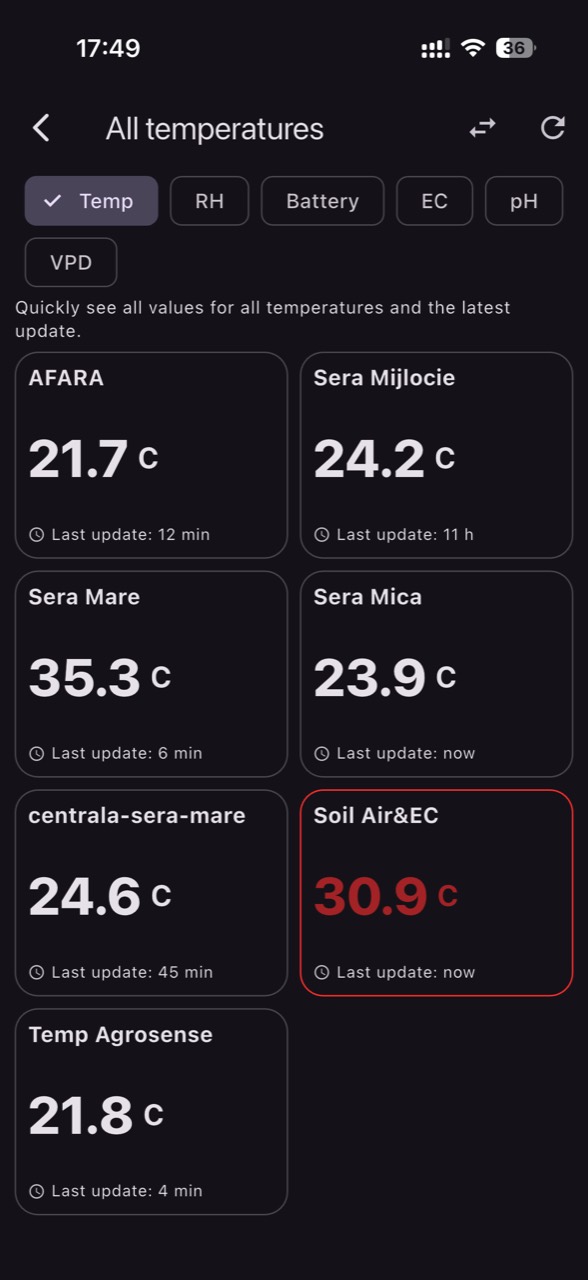
A useful protocol is not about finding a magic number; it is about shortening the hours when leaf and flower surfaces stay wet. That is done with three levers: condensation-risk alerts (dew point risk), VPD alerts (air too “wet” or too “dry”), and zone-based watering so you don’t create puddling and unnecessary evaporation. GrowGuard can help you see these patterns by zone and react earlier.
1) Why Botrytis and flower spotting are so common in cyclamen
Botrytis does not come from a sensor; it appears when inoculum is present (from plant debris, planting material, or water) and conditions are favorable. In greenhouses, fallen flowers, aging leaves, and wet pockets between pots maintain disease pressure. Microclimate data only indicates whether the environment is conducive to infection—it does not confirm pathogen presence or provide a diagnosis. Confirmation remains visual and, when needed, via specialist diagnostics.
In cyclamen, petal spotting can start even without Botrytis: cold droplets on flowers, splash during irrigation, repeated condensation, or petals resting against wet leaves. What to observe: small marginal or central spots, sometimes “scorched” or water-soaked; flowers that spot after cold nights; clear differences between benches. What to verify independently: water traces in the crown, flowers stuck to wet foliage, plant debris in the crop. Practical decision: reduce the hours flowers stay wet; check the result by tracking whether the affected batch stops “flaring up” after cold mornings.
2) Condensation: mechanism, what to watch, and how to turn risk into action
Condensation forms when the flower or leaf surface becomes cooler than the air’s dew point. In greenhouses, this commonly happens during nighttime temperature drops, under thermal screens, or when air stratifies—warmer above, cooler at crop level. Petals cool quickly and become ideal for fine droplets. What to watch: repeated episodes of very high humidity during temperature decline periods. What to verify: early morning scouting for droplets on petals and in the rosette, especially in “lazy-air” zones.
The practical decision is not to “dry the greenhouse” aggressively, but to avoid transitions that push the crop below dew point: brief ventilation with drier incoming air, mixing air within the volume, avoiding late watering, and reducing evaporation from wet aisles. In GrowGuard you can set zone-based condensation alerts (from temperature/humidity and estimated dew point) to see where risk starts first. Check the result simply: after a few mornings, compare alert zones versus non-alert zones and record whether droplets are still visible on flowers.
3) VPD: why it is more useful than RH alone—and where it can mislead you
High RH sounds bad, but it does not fully describe how strongly air can pull water from plant surfaces. VPD (vapor pressure deficit) combines air temperature and humidity and indicates how capable the air is at drying surfaces. For cyclamen, very low VPD means petals dry slowly after condensation or splash; very high VPD can dehydrate flowers and foliage, especially when roots are sensitive to cold or excess water. What to watch: prolonged low VPD periods at night and in the early morning.
Caution: VPD calculated from air temperature and RH is an estimate; leaf and flower temperature can be lower than air temperature (radiative cooling), exactly when condensation risk matters. So when you receive a VPD alert, verify independently: are leaves cool to the touch, are flowers wet, does the air feel stagnant between pots? Decision: use VPD alerts as “inspect and adjust ventilation/heating” signals, not as a verdict. Check the result by seeing shorter low-VPD intervals and fewer mornings with visible moisture on flowers.
4) Why watering is often the invisible cause: a wet crown and canopy evaporation
In cyclamen, the critical point is not only the substrate, but the crown and rosette. Water that reaches leaves or the center—even if it seems minor—extends wetness within the plant mass and increases the chance of spots. Also, overly wet substrate becomes an evaporation source: air between pots turns more humid right at flower height. What to observe: spotting mainly on benches where watering is “generous,” a glossy substrate surface, mold on fallen leaves. What to verify: differences between lines/nozzles, drainage uniformity, and whether watering ends early enough for surfaces to dry before night.
The practical decision is to separate “how much water the plant needs” from “how you apply water.” Zone-based watering means you do not treat all benches the same when microclimates differ: a corner zone may need a different rhythm than the center. In GrowGuard you can link zones to substrate moisture sensors and receive alerts when a zone stays too wet for too long after irrigation (or dries faster than expected). Check the result by comparing moisture curves across zones and looking for reduced periods of persistent canopy humidity together with fewer new spot events.
5) Sensor choice and placement: read the plant, not the aisle
For cyclamen, a good sensor placed badly is almost useless. Temperature and humidity must be read at flower height, within the plant mass, not only near a door or an automation cabinet. Place at least one point in the known “problem” zone and one in a “control” zone (where spotting is rare). If you have hanging benches or clear ventilation differences, treat them as distinct zones. What to observe: zone deviations during key hours (evening, night, early morning). What to verify: that the sensor is shielded from direct radiation and not hit by a heater jet or a fan blast.
Also, do not mix measurement types. A temperature sensor does not measure EC or pH; those require dedicated probes, and you must specify the medium: irrigation water, fertigation solution, substrate extract, or drain. EC does not tell you which nutrient is missing; it reflects total dissolved salts. If you suspect water contribution (e.g., deposits, salts, unsuitable pH), laboratory water analysis remains foundational, while on-site pH/EC monitoring complements it rather than replaces it. Check the result by confirming sensor patterns match crop reality (droplets, spots, drying rhythm).
6) Commissioning alerts: robust thresholds, time windows, and data freshness
A useful alert must send you toward a verifiable action. Start by defining risk windows rather than absolute values: for example, “estimated condensation for X minutes in Zone A” or “very low VPD sustained for a period,” not a single short excursion. Avoid alerts that trigger on every door opening. What to observe: when alerts arrive and whether they match the moments you actually find wet flowers. What to verify independently: a short walk-through 30–60 minutes after an alert and a brief log of plant surface condition.
Data freshness matters: a VPD calculated from an old reading can prompt a late reaction. Before trusting alerts, confirm sensors report at intervals suitable for greenhouse dynamics and that there are no gaps (battery, signal). In GrowGuard, status/battery alerts help you avoid confusing “silence” with “missing data.” Practical decision: if a zone has intermittent data, treat it temporarily as unknown-risk and increase physical inspection frequency. Check the result by seeing fewer “nuisance” alerts and a higher share of alerts that lead to a real finding in the crop.
7) Daily protocol after an alert: what to inspect, what to correct, and how to confirm effect
When a condensation or VPD alert arrives, do not jump straight to treatments. Botrytis and flower spotting require triage first: (1) is moisture visible on flowers/leaves? (2) is there plant debris or aging flowers trapped in the canopy? (3) was watering recent or late? (4) is there a clear zone difference? What to observe: symptom location and relation to airflow paths. What to verify: that fans run, vents/screens respond as expected, and there are no barriers (plastic, curtains, stacked pallets) blocking air movement.
The practical decision should be the minimum effective change: remove debris quickly, reduce surface wetness with air management, and adjust watering in the zone that stays wet. Hypothetical example: Zone B triggers condensation alerts two nights in a row; in the morning you find fine droplets on petals. You shift watering earlier for that zone and increase nighttime air mixing. Confirm the effect: over the next 3–5 mornings compare alert duration and check whether flowers are dry at first light; then track whether new spots decline (old spots will not disappear).
8) When the problem is not climate: inoculum sources, water, and wrong interpretations
If graphs look “good” but you still see outbreaks, look for sources: plants introduced already infected, accumulated debris, dirty trays/pots, areas where water stands, or handling that wounds tissue. Pathogens can persist in residues and water; therefore hygiene and rapid removal of diseased material are part of the protocol, not an optional add-on. What to observe: symptoms appearing despite the absence of wet-flower episodes. What to verify: the pathway of planting material, cleanliness of surfaces, and whether differences align with specific batches or deliveries.
Another frequent failure is misreading measurements. EC in fertigation solution is not the same as EC in drain or in a substrate extract; each indicates something different and they cannot be directly compared unless the method is consistent. If you suspect physiological stress (fragile flowers, sensitive tissue), you need independent checks: water analysis (pH, alkalinity, salts), root observations, and—if needed—substrate testing. GrowGuard can help correlate climate-risk moments with watering and zones, but it does not confirm pathogen presence. Check the result by seeing fewer new hotspots after hygiene plus climate control, not just “prettier charts.”
Conclusion
In cyclamen, the key to reducing Botrytis risk and flower spotting is managing how long surfaces stay wet, not chasing a single number. Condensation and VPD show when the crop enters risk windows, and zone-based watering prevents you from amplifying evaporation exactly where air movement is weak. Every alert should lead to an inspection and a small correction, then be confirmed through repeated observations at the same critical hours.
Start with two contrasting zones, mount sensors at flower height, and build thresholds that trigger rarely but usefully. Adjust watering as an application method (timing, uniformity, zoning), not as a reflex, and keep hygiene current to reduce inoculum sources. If you want, use GrowGuard to visualize where risk repeats by zone and share scouting responsibility across the team—without confusing “climate risk” with a disease diagnosis.