Iron chlorosis in petunia and calibrachoa shows up fast: young leaves turn yellow between veins, tips stay small, and the crop loses uniformity exactly when you need a saleable finish. The instinctive reaction is often “add more iron,” but the real problem is iron availability in the root zone, not necessarily the amount sitting in the tank.
In a greenhouse, three factors commonly stack up in the wrong direction: irrigation water with alkalinity that nudges pH upward, fertilization that increases soluble salts (EC), and a watering routine that swings between saturation and drying. Petunia and calibrachoa are sensitive to these swings, and peat/coir substrates can hide the trend until symptoms appear on new growth.
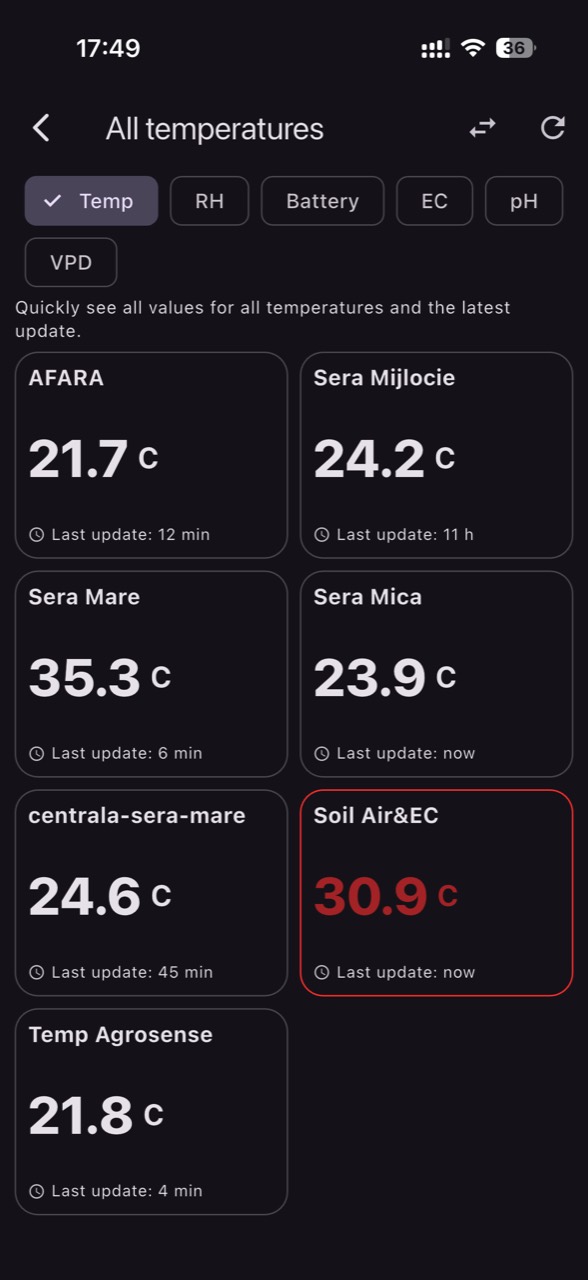
A practical protocol starts by separating measurements (raw water, fertigation solution, substrate extract), watching true root-zone moisture, and managing by zones rather than “the whole house.” With suitable sensors and zone alerts in GrowGuard, you can spot drift early, intervene where it started, and then verify whether your action changed the trajectory instead of only cosmetically greening leaves.
1) Why petunia and calibrachoa turn chlorotic even with “correct” feeding
Iron becomes difficult for plants to take up when root-zone pH rises, especially when irrigation water contains bicarbonates (alkalinity). In practice you can have iron included in the recipe, yet the plant cannot use it: new tissue stays chlorotic while older leaves may still look acceptable. With petunia and calibrachoa, high vigor and rapid growth make this functional deficiency appear quickly at the shoot tips.
At the same time, root stress from uneven watering amplifies symptoms: low oxygen after overwatering, or osmotic “burn” when EC spikes after strong drying. What you may observe in the greenhouse is chlorosis on whole benches, strips, or tables, often aligned with an irrigation line, a tank, or a water-source change. What to verify independently: a water-quality assessment (pH, alkalinity, soluble salts) plus separate measurements in the substrate—not only in the reservoir.
2) What “properly measured” pH and EC mean: the medium matters
When you compare pH/EC values you must always state where they were measured: raw water, fertigation solution, leachate, or a substrate extract. These are different measurements and cannot be treated as equivalents. Water-quality assessment separates pH, alkalinity, and soluble salts (EC); on-site pH/EC monitoring complements laboratory analysis rather than replacing it. Otherwise you risk “correcting” a number that does not describe the root zone.
For iron chlorosis you’re usually trying to answer two questions: is substrate pH drifting up over time (a trend), and is substrate EC accumulating or swinging hard? What you may observe is chlorosis occurring most where substrate dries more, or where drainage is weak. What to verify: probe calibration for pH/EC, spot checks with a handheld meter, and a consistent extraction method (the same procedure each time) so you can compare results week to week rather than chasing noise.
3) Sensor choice and placement: read the root zone, not the pot
For potted petunia/calibrachoa, one measurement point “in the middle of the house” is rarely enough. You typically need substrate-moisture sensors (volumetric water content or equivalent) plus dedicated EC and pH probes in the relevant medium (substrate or solution), not inferred “from the air.” An air temperature or humidity sensor cannot measure EC or pH; these require different probes and different measurement principles. Sensor selection starts with the question: do you want substrate trends or line control in the fertigation system?
Correct placement means sitting in the active root volume, not against the pot wall and not in a spot where water briefly pools right after irrigation. A hypothetical example: on a bench with 1,000 pots, install one sensor in a representative pot and a second in the same zone but with different exposure (edge versus interior) to capture airflow and evaporation effects. What to verify: compare readings with pot weight, observe drainage behavior, and inspect roots from a few “reference” plants to confirm the sensor pot is not atypical.
4) Moisture monitoring: oscillations are the “engine” behind many lockouts
Iron chlorosis often follows a sequence: substrate too wet (low oxygen) so roots slow uptake, then substrate too dry so local EC rises as water evaporates and salts remain, and the root experiences osmotic stress. Petunia and calibrachoa carry large leaf area and transpire quickly; this accelerates drying and can push operators into “rescue irrigations” that create waves in the root zone rather than a stable rhythm.
What you may observe in graphs is substrate moisture with deep sawtooth patterns (large drops between irrigations) or long flat plateaus (too wet for too long). The practical decision is not to adopt a universal irrigation template, but to reduce oscillation amplitude through small, testable adjustments: smaller fractions per event, intervals adapted by zone, and a drainage check. How to check the result: over the next several days, look for a more stable EC trend in substrate readings and greener new tips—not only older leaves looking temporarily better.
5) pH moves slowly; alerts should be designed around trends
In many greenhouses, tank pH looks stable while substrate pH rises gradually due to water alkalinity and selective ion uptake by the plant. With petunia and calibrachoa this drift can stay unnoticed until chlorosis is obvious. The mechanism is straightforward: iron—chelated or not—becomes less available as the medium becomes more alkaline, so the crop receives “iron on paper” but not in metabolic flow in new growth.
What you may observe is chlorosis in waves after a water-source change, after periods of high evaporation, or after aggressive corrections. What to verify independently: separate pH from alkalinity; an “acceptable” pH does not automatically imply low alkalinity. If you rely mainly on online readings, confirm periodically with lab testing of water and with substrate measurements. A practical decision is to adjust acidification/fertilization strategy based on the substrate trend, then check within 48–72 hours whether substrate pH has started to shift—not only reservoir pH.
6) EC: salts can “steal” iron through stress, not direct chemistry
High substrate EC does not tell you which nutrient is lacking, but it does indicate how hard it is for roots to pull water. In petunia and calibrachoa, when EC rises after repeated dry-downs, the plant can enter water stress even if you irrigate “enough” in weekly volume. The result can mimic deficiencies: slowed growth, smaller leaves, and stronger chlorosis at shoot tips. In such cases, adding more iron often misses the point; restoring stable moisture and avoiding salt peaks is usually the more relevant correction.
What you may observe is higher-EC zones at line ends, exposed benches, or smaller pots that dry faster. What to verify: whether EC is measured in leachate or in the substrate; values are not directly comparable across methods. The practical decision may be a controlled leach (where production system and crop stage allow), but more often it’s a gradual adjustment of concentration and frequency to reduce EC spikes. How to check the result: a downward trend in substrate extract EC plus a return of steady growth rate and more uniform color in new leaves.
7) Zone alerts: uniformity is won by comparison, not by averages
Petunia and calibrachoa are often grown in large batches where small differences in light, airflow, or line flow become large quality differences. That’s why it helps to define real zones (benches, bays, sectors sharing the same water source) and track substrate moisture plus pH/EC separately. A whole-house average can say “everything is fine” while one zone is already drifting upward in pH and starting chlorosis in the newest leaves.
In GrowGuard, zone alerts are most useful when each alert maps to a clear action: check the source (tank/fertigation line), check the crop (reference pots), and intervene only where the deviation started. A hypothetical example: you get an alert that substrate moisture falls faster on an edge zone; the decision is to verify irrigation uniformity and shield drafts, not to change the recipe for the entire greenhouse. How to check the result: after adjustments, the zone-to-zone gap narrows in the trend lines, and chlorosis stops progressing on the newest growth.
8) Independent checks and failure cases: when the data look good but the crop doesn’t
Even with sensors, simple independent checks catch common errors: scheduled pH/EC calibration, root inspection, pot weighing, and comparing pots irrigated in the same event. A typical failure case is a moisture probe sitting in a pot with unusual drainage (more compacted), reading “wet” most of the time; you reduce irrigation, and the rest of the zone runs too dry, intensifying chlorosis. Another failure case: pH measured in leachate while the substrate is stratified, and the fine-root layer sits at a different pH than the collected drainage suggests.
The practical decision is to treat data as indicators, not verdicts. If you see chlorosis but pH/EC “do not confirm,” first check the method: measurement medium, timing relative to irrigation, solution temperature, and probe condition. In these situations, history helps you decide whether the change is abrupt (equipment fault or source change) or slow (drift or accumulation). How to check the result: after correcting the method or sensor placement, readings begin to align with crop observations over the next days, and decisions become consistent rather than reactive.
Conclusion
Iron chlorosis in petunia and calibrachoa is prevented more reliably when you follow the full mechanism: pH pushed by alkalinity, EC that swings with dry-down, and roots stressed by moisture oscillations. Watch symptoms on young leaves, confirm with measurements in the correct medium (water versus solution versus substrate), then make small, reversible interventions that you can verify—rather than aggressive corrections without feedback.
When you manage by zones and compare trends, you catch deviations before they become a quality loss across whole batches. If you already have sensors or are planning installation, set up zone monitoring and alerts in GrowGuard so each alert triggers a check, a decision, and a result review in the history.