Kalanchoe (Kalanchoe blossfeldiana and hybrids) can be relatively forgiving on light and temperature, yet surprisingly sensitive to how water is delivered. In greenhouses, leaf edema, tissue cracking and loss of marketable appearance often come not from a single “too much,” but from alternations: too wet–too dry, especially when evapotranspiration demand shifts abruptly.
The mechanism is straightforward: when roots push a lot of water at a time when transpiration is limited, cells swell, rupture locally and you see blisters, scarring or splits. In Kalanchoe, succulent leaves amplify the effect; additionally, a substrate kept constantly “soaked” reduces oxygenation and can make plants slower, with more fragile leaves and less intense color.
The key is a protocol that links pulse irrigation to EC/pH checks and to correct greenhouse observations. This is not about imposing a rigid irrigation template, but about commissioning measurement and decisions: what you measure (and in what medium), how fresh the data is, what you confirm independently, and how you verify that an intervention worked at zone level rather than only “on average.”
1) Kalanchoe edema: why it happens and how to distinguish it
Edema occurs when internal water pressure (turgor) exceeds the local elasticity of tissue, typically during low-transpiration periods: humid nights, cool mornings, after heavy irrigations, or when ventilation is delayed. In Kalanchoe it shows as translucent specks, blisters, then corky (rough) patches on the underside of leaves or as distorted margins. It is not a disease; it can appear without a pathogen and it does not “spread” plant-to-plant.
What to observe: how it distributes across the crop (often worse in cold corners, under coverings, near walls) and whether it tracks days with high humidity and large irrigations. What to verify independently: pot weight (comparing two zones) and root appearance on a small sample, to rule out severe suffocation. Practical decision: reduce peak water inputs, not necessarily the daily total. Result check: look for fewer new symptoms after 7–14 days, not for old damage to disappear.
2) Cracking and quality loss: the role of moisture swings
Cracking of leaves or petioles in succulents is often linked to rapid swings in plant water potential: a period of mild dehydration followed by abrupt rehydration. In a Kalanchoe batch, this happens when irrigation “jumps” between infrequent but large events and periods where the substrate surface gets excessively dry while the lower profile remains loaded with salts.
What to observe: splits showing up after “catch-up” watering, leaves that suddenly become very turgid and then develop micro-lesions. What to verify: flow uniformity across benches/zones and whether drainage exists (and where it goes), without assuming every row receives the same. Practical decision: move toward more frequent, smaller pulses so re-wetting is gradual. Result check: fewer plants develop new symptoms and the visual consistency improves in the problematic zone.
3) Pulse irrigation: a working protocol, not a trick
Pulse irrigation means dividing one irrigation into a sequence of short cycles separated by pauses that allow water to distribute in the substrate and air to re-enter pores. For Kalanchoe, the goal is not repeated saturation, but avoiding a sudden step-change in water content in the pot. Pulses also help re-wet substrates that repel water when the surface has become too dry.
What to track in practice: after each pulse, check 2–3 “reference” pots from the hardest zone (for example, bench edges) and confirm water infiltrated rather than running down the side of the root ball. What to verify independently: that nozzles/drippers deliver repeatably and that pressure does not vary strongly from start to end of line. Practical decision: adjust pulse duration and pause based on real absorption. Result check: less pot-to-pot weight variation and fewer “recovery” irrigations.
4) EC and pH: what you measure, in which medium, and why it matters in Kalanchoe
EC and pH are only useful if you know exactly what was measured: raw water, fertigation solution, substrate extract (lab method or quick test), or drainage. These are not equivalent. Periodic water analysis helps separate pH from alkalinity and from soluble salts (EC); on-site pH/EC monitoring complements lab analysis, it does not replace it. EC indicates total salinity, not individual nutrient concentrations.
What to observe in the crop: burned tips, stiffer leaves and slowed growth can suggest salinity stress; overly soft leaves and washed color can also appear from unstable nutrition, not only from watering volume. What to verify: compare EC of the fertigation solution with EC from drainage or a substrate extract to understand accumulation direction. Practical decision: stabilize solution quality before aggressively changing irrigation strategy. Result check: substrate EC stops climbing in zones where irrigation has been infrequent or uneven.
5) Typical drifts: when you “fix” pH/EC and ruin watering (and vice versa)
A common failure is treating leaf symptoms as a single-factor problem—only fertilizer or only water. For example, if substrate EC has risen through evaporation and small irrigations, a massive leaching can trigger the same water peak that causes edema and cracking. Conversely, if you sharply cut irrigation to “reduce edema,” you may concentrate salts; the plant responds with osmotic stress and poorer visual quality.
What to observe: large jumps in pot weight and days when leaves look “puffed up” after corrective actions. What to verify independently: pH/EC probe calibration/cleanliness and the sampling method (same pots, same time of day). Practical decision: make corrections incrementally—first reduce irrigation amplitude, then adjust salt management through controlled drainage events rather than shocks. Result check: the substrate EC graph shows a trend, not a saw-tooth pattern of spikes and crashes.
6) Sensors and data freshness: choosing inputs that don’t create wrong decisions
For pulse irrigation you need a root-zone moisture measure (not only “air humidity”) and a salinity reference (EC) plus reaction (pH) in solution or substrate, depending on your system. A temperature sensor does not measure EC/pH; those require dedicated probes and specific maintenance. Likewise, VPD derived from air temperature and RH is an estimate; the leaf can be cooler or warmer than air, so interpretation remains agronomic.
What to verify at commissioning: reported units (for example EC in mS/cm), transmission interval and latency—a “60-minute value” may be too slow to evaluate the effect of short pulses. What to observe: whether the moisture sensor actually responds to a short pulse; if not, either placement is wrong or the pulse does not reach the monitored zone. Practical decision: fix placement first, then thresholds. Result check: the moisture curve shows small, repeatable step-ups after pulses.
7) Zone alerts: how to make them useful for edema and cracking
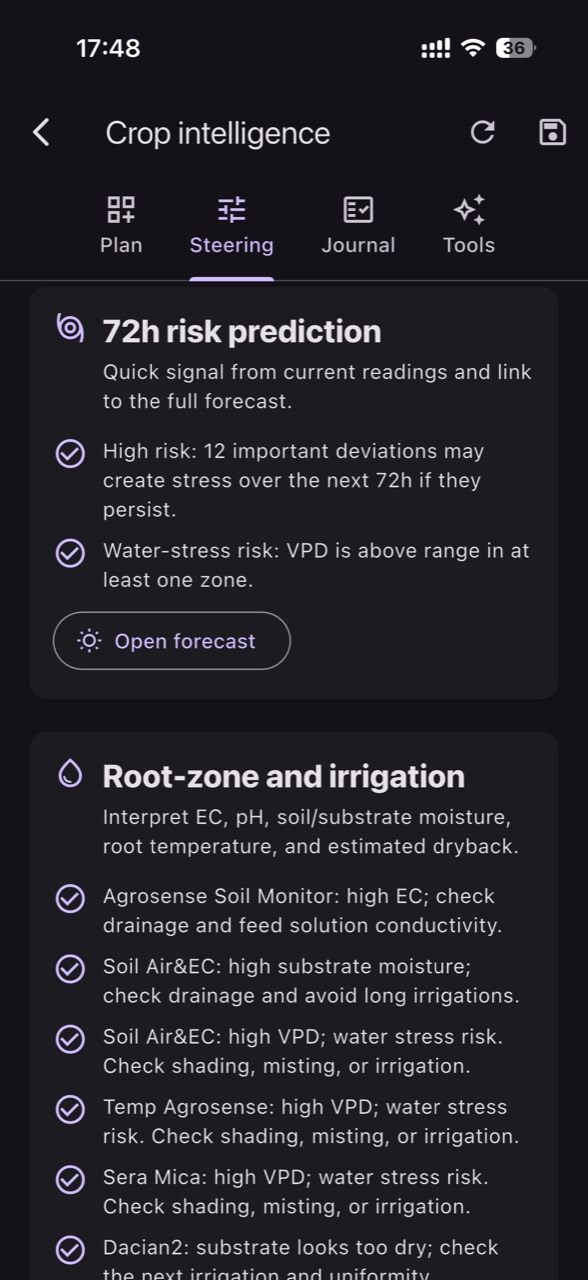
Kalanchoe problems are rarely uniform; they appear in “islands” with different microclimate or different hydraulics. That is why zone interpretation matters more than a greenhouse-wide average. In GrowGuard, zones can separate cold benches from central ones, low-pressure lines, or batches with different substrates, then trigger alerts that require action: inspection, manual measurement, pulse adjustment.
What to track: alerts must map to something verifiable. A hypothetical example: you receive an alert that moisture in Zone A stays high for a long time after irrigation; you physically check two pots and find poor drainage or compacted substrate. Practical decision: change pulse duration/pause only for Zone A or repair distribution, rather than changing the whole plan. Result check: after intervention, the “return time” to a working moisture level shortens only in the corrected zone.
8) The control loop: intervention, confirmation and documentation for uniform batches
A robust protocol has a clear loop: observe the symptom (edema/cracking), look for time correlation (when irrigation happened, what nighttime humidity was, how EC evolved), verify one hypothesis independently (pot weight, drainage, substrate EC), apply a small adjustment, and measure the response. In Kalanchoe, the response is not instantaneous; what matters is fewer new symptoms and more uniform appearance, not “healing” damaged leaves.
What to document: what you changed (for example “shorter, more frequent pulses” in a zone), the date, and what indicator you follow: moisture steps, substrate EC trend, alert frequency. In GrowGuard, zone history helps you avoid confusing weather-driven improvement with intervention-driven improvement. Practical decision: keep a change only if the effect confirms across two irrigation cycles and across two or three days with different microclimate.
Conclusion
For Kalanchoe, avoiding edema and cracking is more about the “shape” of watering than a fixed daily volume: pulses that smooth peaks, an aerated substrate, and salinity corrections without shocks. EC and pH become powerful tools only when you specify the measurement medium and periodically validate water quality and probe performance; otherwise you may optimize for correct numbers that are agronomically irrelevant.
If you work by zones and verify hypotheses in the greenhouse (pot weight, drainage, distribution), symptoms become a tuning signal rather than a quality loss. For a consistent monitoring-and-alert routine by zone, you can set thresholds and checks in GrowGuard so the team intervenes consistently and can confirm results, not just react at random.