In greenhouse pansies (Viola), leaf spotting and Botrytis often show up during cold periods—exactly when you’re tempted to water “a little, but often” to avoid wilting. The issue is not only extra water in the crop, but water that reaches the foliage and how long it stays there in cold, near-saturated air.
In cold weather, air reaches saturation with relatively little added moisture. Overhead watering, fine spray from nozzles, or slow evaporation from the substrate can push relative humidity up quickly and pull VPD down. When VPD is low, plants transpire poorly, leaves dry slowly, and you get the ideal window for opportunistic infections and spotting.
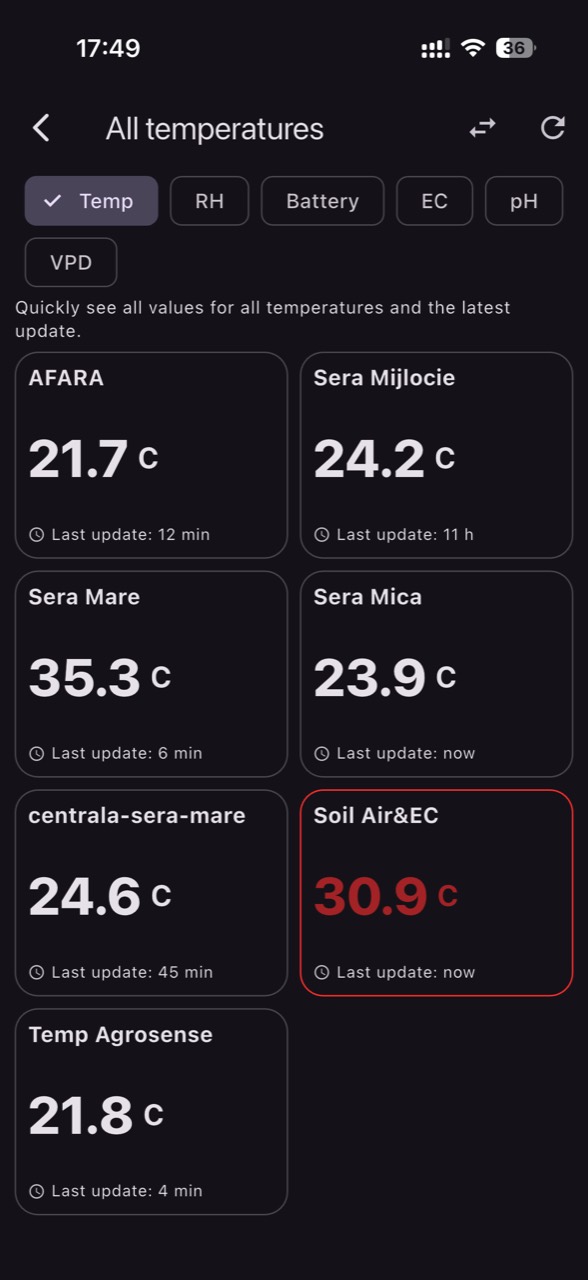
The practical key is tying irrigation decisions to three measurable things: VPD (estimated from air temperature and relative humidity), condensation likelihood (when surfaces are colder than the air’s dew point), and real differences between greenhouse zones. With zone alerts in GrowGuard, you can see where wetness is being prolonged and adjust watering and ventilation without “freezing” the crop.
1) Why pansies are vulnerable in winter: wet leaves + cold tissue
Pansies form a low rosette with dense leaves that trap droplets in the crown and at the base of petioles. In the cold season, growth slows, stomatal behavior shifts, and transpiration declines. If water lands on leaves, drying depends almost entirely on air movement and the atmosphere’s vapor deficit—not on “how bright it is.” Inside the rosette, boundary layers are thicker, so even small pockets of still, humid air can keep tissues wet longer than you expect.
What to observe: circular or irregular spots, sometimes with darker margins; spotted flowers; leaves sticking together after a cold night. What to verify independently: look for inoculum sources (plant debris, symptomatic plants, contaminated irrigation water) and separate spotting from physiological scorch or spray phytotoxicity. Microclimate readings show conducive conditions only; they do not confirm a pathogen or diagnosis. Practical decision: treat “wet leaf during cold conditions” as a risk event and focus on shortening leaf-wetness time.
2) VPD in cold spells: when “humidity looks fine” but risk is high
VPD (vapor pressure deficit) describes how strongly the air can pull water vapor from wet surfaces. In cold air, even moderate relative humidity can correspond to very low VPD, and any evaporation can drive RH upward quickly. For pansies, low VPD means leaves stay wet, stomata contribute less to drying via transpiration, and the rosette’s interior becomes a stagnant microclimate where moisture persists—exactly what Botrytis and leaf-spotting problems exploit.
What to observe: after watering, greenhouse humidity stays elevated for a long time, and in the morning leaves are cool and glossy. What to verify: ensure temperature and RH sensors sit at crop level and are protected from direct heater jets and from irrigation splash; otherwise they can report misleading values. VPD calculated from air T/RH is an estimate; leaf temperature can be lower than air temperature, so condensation can occur even when VPD “seems acceptable.” Practical decision: schedule watering so there is real drying time before evening cooling begins.
3) Condensation: the mechanism that turns a “correct” watering into a problem
Condensation occurs when a surface (leaf, bench, film) is colder than the air’s dew point. In greenhouses this is common at night and in the morning, especially near walls, under cold gutters, or in areas with weak air circulation. A late watering increases absolute moisture in the air, raises the dew point, and makes condensation more likely—even if you never see visible fog or mist forming in the house.
What to observe: droplets on leaves even when you did not wet foliage (the water is from condensation), water tracks running off structures, localized mold on plant debris. What to verify: compare temperatures between zones (center vs perimeter) and watch how quickly RH approaches saturation with small temperature drops. Practical decision: when a cold night is expected, avoid irrigations that load moisture into the air late in the day; prioritize morning watering when you can support drying with controlled ventilation and air movement.
4) Cool-weather irrigation protocol: “water the substrate, not the microclimate”
In greenhouses, the risk is not just water volume but water form. Irrigation that wets foliage (overhead spray, excessive flow, rebound splash from the substrate) extends the wetness window. In cold periods, aim for application methods that move water into the substrate quickly and evenly with minimal aerosol and splash. If you use troughs/capillary systems or drip, check for side jets, misaligned emitters, or pressure issues that send water into the rosette instead of the root zone.
What to observe: tray weight differences, plants that look wet on the surface while the root volume is still dry—or the opposite. What to verify independently: confirm substrate moisture by weighing, or with a dedicated substrate-moisture probe placed correctly; do not rely on leaf appearance as a root-zone indicator. Practical decision: use fewer, better-targeted irrigations when the substrate actually requires it, and avoid repeated “tiny corrections” that repeatedly push RH upward. Result check: after changes, leaf-wetness duration should shorten and new spots should appear less often in the previously problematic areas.
5) Sensors and units: what to measure to link irrigation to risk without confusion
For this topic you need, at minimum: air temperature and relative humidity (to estimate VPD), plus a root-zone moisture reference (in the substrate). Don’t mix measurement media: EC and pH require dedicated probes, and the value only makes sense when you specify where it was measured (irrigation solution, drain, substrate extract). A temperature sensor does not measure EC or pH, and EC cannot tell you which nutrient is deficient; it indicates total conductive salts, not individual ions.
What to observe: RH alarms with no visible issues—or spotting with no alarms. What to verify: data freshness (how often readings arrive) and whether the sensor is shielded from radiation and splash; otherwise you may get “perfect” numbers from a non-representative spot. Practical decision: use VPD plus a condensation indicator as a risk signal, but confirm by crop inspection and by checking irrigation behavior (uniformity, leaks, actual drying time). Result check: compare the timing of new spotting to periods when VPD was very low and condensation events occurred.
6) Zone alerts: finding the “cold corner” that ruins a batch
In practice, pansies won’t behave the same everywhere: at doors, along walls, under cold films, or near a fan that isn’t moving air as intended, the microclimate can diverge sharply. That’s why dividing the greenhouse into real zones and tracking VPD and humidity separately is so useful. In GrowGuard, zone mapping helps you see where high-condensation-risk nights repeat, and where irrigation translates into long-lasting “misty” conditions rather than a quick root-zone recharge.
What to observe: spotting concentrated at one bench end; Botrytis pressure strongest near perimeter walls; worse issues in denser batches. What to verify independently: scout specifically in the zone the data flags—check for wet leaves deep in the rosette, accumulated plant debris, and overly tight spacing that blocks air exchange. Practical decision: adjust locally—slightly reduce irrigation frequency in the colder zone, improve air movement, or space trays to open the canopy. Result check: over 1–2 weeks, spotting distribution should become more uniform or decline in that zone even if the rest of the house remains unchanged.
7) When you must water but it’s cold outside: the “water–dry–cool” sequence
Some days the substrate genuinely needs water, but the forecast calls for low temperatures and limited ventilation. Then sequence matters. Target irrigation as early as possible in the window where you can still support drying: a bit of temperature lift, minimal air circulation, and time before the evening temperature drop. Avoid watering that pushes air moisture toward saturation right before night, when the dew point gets dangerously close to leaf and structure temperatures.
What to observe: late afternoon RH climbs, night condensation develops, and in the morning you find stuck leaves and spotted flowers. What to verify: the next day, check whether the upper canopy dried completely; if it didn’t, watering was too close to the cooling phase or created too much splash/spray. Practical decision: move irrigation earlier, reduce aerosol (delivery height/impact), and—where possible—split applications so water enters the substrate without wetting the rosette. Result check: watch whether condensation alerts decrease after irrigation events and whether the time to “dry leaf” shortens.
8) Troubleshooting: when it isn’t only microclimate (and how to avoid wrong decisions)
Not every spot is Botrytis, and not every outbreak starts with watering. Phytotoxicity from sprays, salt accumulation in the substrate, unsuitable pH, or irrigation water with problematic alkalinity can weaken tissues and increase susceptibility. Here, separating measurements is essential: periodic lab water analysis (pH, alkalinity, soluble salts/EC) is the correct foundation, while on-site pH/EC monitoring complements rather than replaces it. EC measured in irrigation solution is not the same as EC in substrate extract or in drain.
What to observe: spotting that appears evenly across all zones, including areas without condensation risk, or symptoms that follow a recent treatment. What to verify: keep a simple log of irrigations, sprays, and recipe changes and compare it to periods of low VPD. If the data shows low microclimate risk, investigate source factors: incoming plant material, plant debris, water quality, hygiene, or leaks that keep bench surfaces wet. Practical decision: correct the base factor first (sanitation, water source, irrigation uniformity), then refine alert thresholds so you don’t chase nuisance signals. Result check: if new spots become rarer and occur mainly after condensation events, you’ve reconnected the problem to the true mechanism.
Conclusion
For pansies, cool-weather irrigation becomes safer when you treat it as a microclimate intervention: keep water in the substrate and off the leaf, and plan drying before evening cooling. VPD and condensation logic indicate how fast wet tissue can dry, while zone differences reveal where risk repeats and where a routine change matters more than changing total volume.
A robust approach is: observe symptoms, independently verify likely sources (inoculum, hygiene, water, treatments), make a small operational change, and check whether leaf-wetness time actually shortened. If you want, you can use GrowGuard for zone-based VPD/condensation alerts and documentation to see whether an irrigation change reduced risk events before losses show up in the crop.