Freesia has a narrow margin between “enough water for stems and buds” and “too much water for bulbs.” Bulb rot associated with Fusarium often shows up when moisture stays high for too long around the bulb, especially during low-light periods with humid air and a cold substrate. In a greenhouse, these conditions arrive in waves, not as a constant state—so watering “by the clock” becomes risky.
The practical key is to link two things that strongly influence each other: the plant’s transpiration demand (approximated by VPD from air temperature and humidity) and the roots/bulbs’ ability to take up water (highly dependent on root-zone temperature). When VPD is low and the root zone is cold, generous irrigation extends saturation and opens a risk window.
The article below does not give “universal recipes.” It lays out a working protocol: what signs to watch, which sensors are worth it, what to verify independently (before blaming Fusarium—or blaming sensors), and how to make gradual, measurable decisions. Any examples are explicitly hypothetical so you can adapt them to cultivar, substrate, density, and season.
1) Why Fusarium hits bulbs when “everything seems watered correctly”
Fusarium in freesia is not only about the pathogen being present; it is also about context: root stress, too little oxygen in substrate pores, and long durations of high moisture around the bulb. The bulb and stem base are vulnerable when root metabolism slows (low root-zone temperature) while the substrate remains wet. In that situation the plant uses little water, and applied irrigation simply lingers.
What you observe in practice: batches that “don’t dry down” from day to day, a faint fermenting smell in colder spots, uneven growth, and leaves that wilt paradoxically even though the substrate is wet (because roots are compromised). Verify independently: lift a few bulbs from different zones and cut them lengthwise; note firmness, color, and odor. Then decide: shorten the time the bulb zone stays very wet, not just the total volume applied.
2) VPD: an indicator of water demand, not an “irrigation setpoint”
VPD calculated from air temperature and humidity tells you how strongly the plant can pull water through transpiration. When VPD is low, transpiration is low, so the plant empties the substrate slowly; any large irrigation prolongs wetness. When VPD is high, the plant may use water quickly, but that does not mean roots can keep up if the root zone is cold or already damaged. That is why VPD should not be used alone.
What to watch: after an irrigation event, if VPD stays low for hours (for instance on cold, overcast mornings), the substrate can remain saturated until evening. Verify independently: compare estimated VPD with simple observations such as how quickly the surface dries and how leaf turgor looks at midday. Practical decision: on low-VPD days, switch from big shots to short pulses, and only if moisture at bulb depth is actually dropping.
3) Root-zone temperature: the “hidden brake” on uptake
In freesia, roots and bulbs respond strongly to temperature: when the root zone is cold, water and nutrient uptake slows, and substrate aeration becomes more critical. You can have air conditions that seem “fine” while pots or substrate strips run several degrees colder—especially at edges, near aisles, on metal benches, or where drafts hit. The result is persistent moisture and chronic root stress.
What to observe and verify: growth differences between rows or bench ends that match colder areas. Confirm independently with spot checks using a probe thermometer even if you have a fixed sensor: insert the probe to bulb depth in 5–10 points and note variability. Decision: manage irrigation in cold zones differently from warm zones; then check the result by seeing whether the moisture sensor spends less time at “very wet” readings after watering.
4) Which sensors matter—and where to place them so microclimate doesn’t mislead you
For the “Fusarium + irrigation” problem you need: air temperature/humidity (to estimate VPD), root-zone temperature (at bulb depth), and substrate moisture (also at the relevant depth). If you also monitor EC/pH, remember EC/pH require dedicated probes and that EC differs by medium and method: fertigation solution, substrate extract, or drain. Do not mix these numbers as if they are the same measurement.
Placement matters more than quantity: install one set in a “good” zone and one set in a “problem” zone (cold end, edge, shaded bench). The moisture sensor must sit near the bulb, not at the surface and not pressed against a dripper. Independent check: during a test irrigation, carefully dig 10–15 minutes later to see whether water reached where you think it did. Decision: if distribution is uneven, don’t “calibrate the sensor” to fit expectations—fix irrigation delivery or emitters.
5) A linked irrigation protocol: decisions from three conditions, not one
A robust protocol uses three signals: (1) current moisture at bulb depth, (2) VPD (transpiration demand), and (3) root-zone temperature (uptake capacity). In practice, irrigation becomes a combined condition: “water only if the substrate has dried enough” and “only if the plant can realistically use that water in the coming hours.” This reduces long periods with water-filled pores, which are associated with bulb-rot risk.
Hypothetical example: in the morning VPD is low and bulb-depth temperature is also low; even if the calendar says “water,” you delay and re-check at midday. If at midday VPD rises and root-zone temperature climbs, you apply a short pulse and then track the moisture decline over the next hours. How to check the outcome: in your graphs, look for a faster drying slope after irrigation, not long flat plateaus at high moisture.
6) Actionable alerts: how to set them so they trigger work, not panic
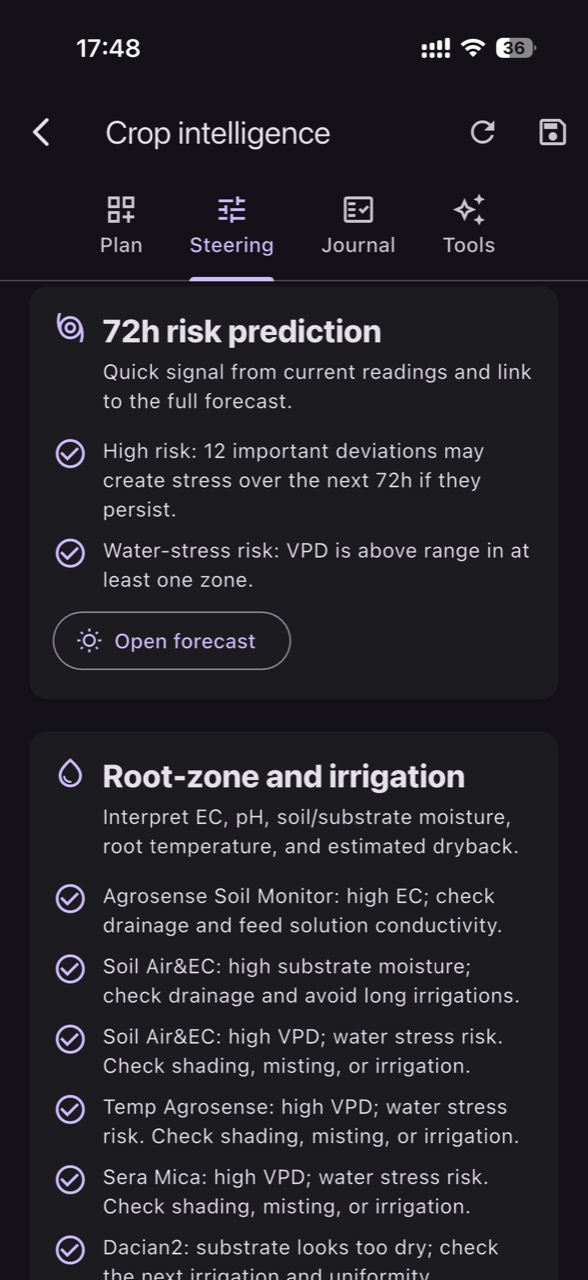
Alerts should reflect the risk mechanism: “moisture stays high too long when VPD is low and the root zone is cold.” In GrowGuard, you build this in practice via zone-specific thresholds and alerts that send you to verify, not to intervene blindly. A useful alert helps you catch duration, not just an instant: for example, high moisture persisting after watering while root-zone temperature sits low.
What to verify when an alert fires: (a) is it one sensor or the whole zone? (b) was there recent irrigation, or a leak/fault? (c) did VPD truly remain low, or is the air sensor badly positioned (over a heater, in a doorway draft)? Decision: if it is local, adjust distribution or reduce the pulse only for that sector. Result check: after the change, alerts should become less frequent without visible water-stress symptoms in the crop.
7) When the real suspect is “difficult water” or solution imbalance—not just watering frequency
Sometimes rot or root weakening is aggravated by water quality and by how you interpret pH/EC. A pH/EC measurement in the tank is not the same as what happens at bulb depth; and EC does not tell you which element is missing—it indicates total dissolved salts. Proper evaluation starts by separating measurement media: source water, fertigation solution, substrate extract, and drain, each with a different agronomic meaning.
What to observe: if plants look dehydrated at midday while the substrate is wet and EC at the root zone is high (measured in the substrate using a consistent method), the issue can be osmotic/salinity stress rather than “thirst.” Verify independently: run periodic water analysis, and use on-site pH/EC checks as monitoring, not as a replacement for lab work. Decision: before increasing irrigation, confirm you are not pushing more salts into the bulb zone. Then watch whether the crop’s water-use rhythm returns.
8) The control loop: confirm on plants, not only on charts
No matter how good the protocol looks, the final confirmation is biological. In freesia, monitor growth uniformity, stem firmness, leaf emergence rhythm, and the stem-base appearance. If you reduce irrigation during low-VPD and cold-root windows but you start seeing tip burn, narrower leaves, or a marked slowdown, you likely cut water availability too far at times when the plant still needed it.
How to verify change: keep an internal “control” patch (a small zone where you change nothing) and compare progress over days or weeks depending on crop stage. Hypothetical examples: the new protocol zone shows fewer plants that “collapse” after irrigation and a substrate that re-aerates sooner. At the same time, check bulbs by sampling: firmer tissue and whiter roots. If you see no difference, go back to sensor placement and irrigation uniformity first.
Conclusion
Fusarium-associated bulb rot in freesia is rarely solved by “less water” or “more ventilation” alone—it is solved by timing: how much water sits at bulb depth when the plant can transpire it away and when roots can absorb it. Linking irrigation decisions to VPD and root-zone temperature targets the long, stagnant wet periods that leave bulbs vulnerable.
To apply the method without guesswork, work by zones, independently spot-check a few points with manual measurements, and track drying duration after irrigation—not just peak wetness. In GrowGuard, start with correctly placed monitoring and alerts tuned to “duration + context,” then adjust gradually and confirm on plants. If you want, invite the team to follow the same graphs and on-bench observations together.