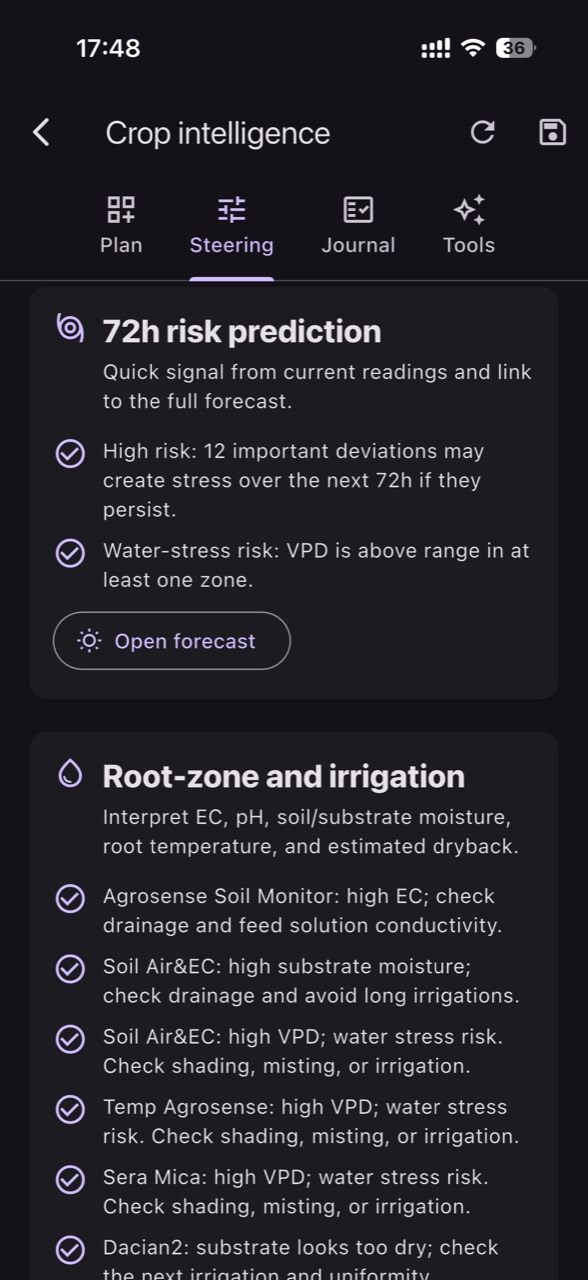
“By the clock” irrigation only works as long as weather, crop demand, and the irrigation system behave predictably. In practice, water demand shifts day to day, and roots respond to wet–dry swings, salinity, and soil aeration. That’s why a good protocol starts from what happens in the root zone—not from fixed hours on a schedule.
A data-driven workflow has three goals: reduce surprises (water stress, root suffocation, salt buildup), distinguish “plant” problems from “system” problems (drippers, pressure, filtration, mixing), and produce repeatable evidence. Data does not replace crop walking; it complements it and imposes discipline on decisions that otherwise become guesswork.
The key is commissioning: choosing appropriate sensors, installing them correctly, confirming they measure the intended medium, and ensuring the data is fresh enough for operational decisions. Then you connect interpretation to simple actions: start/stop irrigations, adjust duration, verify EC/pH in solutions, and watch VPD as an indicator of atmospheric demand. Forecast provides context, not “orders.”
1) Why schedules fail: the mechanism in soil and plant
Roots do not consume water linearly, and soil/substrate does not recharge evenly. On high-radiation days with high VPD, transpiration increases and the plant draws water faster; on humid days, demand drops, but clock-based irrigations can keep the root zone saturated. At the same time, fertilization increases dissolved salts; if water evaporates faster than salts are leached, root-zone EC can rise even when you “water a lot.”
What to observe: variability between rows/sectors, midday leaf softness, burnt margins or stalled growth, plus the smell or color of overly anaerobic soil. What to verify independently: irrigation uniformity (pressure, filters, flow), infiltration, and the real wetting depth. Practical decision: move from fixed hours to triggers based on trends (moisture falling/rising) and atmospheric demand. Result check: steadier moisture curves, coherent drainage (where present), and fewer symptoms on comparable days.
2) What you measure—and what you don’t: moisture, EC, pH, VPD, and forecast
Soil/substrate moisture tells you whether the root zone is drying or staying saturated; you interpret it as a dynamic pattern, not a single “good number.” EC and pH are different: EC indicates total salinity (it does not tell you which ion is missing), while pH influences nutrient availability and water chemistry. Important: EC depends on the measurement medium (source water, fertigation solution, substrate extract, bulk soil) and is not directly comparable unless you record the method.
VPD is calculated from air temperature and relative humidity; it is an estimate of the atmosphere’s “thirst,” but leaves can be warmer or cooler than air, so leaf-level VPD can differ. Forecast helps you anticipate demand shifts (heat, wind, rain), but must be validated against local sensors. Practical decision: define which parameter triggers which action (moisture for “what’s in the root zone,” VPD for “what the air will pull,” EC/pH for “what the roots receive”). Verification: always write down units and measurement medium so you don’t “correct” something that isn’t comparable.
3) Sensor choice and installation: avoid errors that break the workflow
For soil moisture, choose dedicated sensors (often capacitive, TDR, or FDR depending on budget and crop) and decide up front which depths represent your active root zone. For EC/pH you need dedicated probes for solutions (in-line or in a tank) or a sampling protocol with a handheld meter; a temperature sensor does not measure EC/pH. For air: temperature and humidity at leaf height, protected from direct radiation and from localized air jets that distort the average.
What to observe during installation: “flat” curves (stuck values), impossible jumps, or long delays between irrigation and sensor response. What to verify independently: physical placement (good soil contact, no air gaps), position relative to the dripper, radiation shielding for air sensors, and consistency between similar points. Practical decision: install at least two points in a critical zone (hypothetically, row end and mid-row) to separate a local issue from a general trend. Result check: after an irrigation, moisture should rise within a realistic time window for your texture—neither “instant” nor “never.”
4) Commissioning in 7 days: from “signal” to usable data
Day 1–2: confirm data freshness (time of last reading) and select a reporting interval that matches how quickly you need to react; if data arrives too rarely, you can’t correct fast. Day 3–4: run a controlled test—one short irrigation, then one longer one (hypothetical)—and observe the response at two depths. Day 5: compare graphs with a physical check (probe, spade, soil sample) to confirm that a “rise on the chart” means real moisture in the root zone.
Day 6–7: commission EC/pH on solutions. The distinction matters: measuring at the water source, in the fertigation solution, and in the root zone (via sampling/extraction) are different measurements; on-site pH/EC monitoring complements, not replaces, laboratory water analysis. Practical decision: establish operational “reference pictures,” not universal targets—what a good moisture curve looks like, what correctly mixed solution EC/pH looks like, and how fast values change after adjustments. Verification: keep an intervention log so you can attribute effect to cause, not coincidence.
5) Soil moisture as a trigger: events, not hours
Good irrigation control starts from observable “events”: gradual decline from crop use, a rise after irrigation, and sometimes a delayed second rise if water percolates downward. What to track: the drying slope between irrigations and how high moisture climbs after each pulse. In heavy soils, the rise can be slow and the risk is anoxia if you recharge too often; in light soils/substrates, the risk is fast deficits and large swings.
What to verify independently: whether irrigation actually reaches root depth (time, flow, dripper spacing) and whether there are leaks or bypasses. Practical decision: convert the timetable into rules—start irrigation when the trend indicates approaching an internally defined threshold (established locally) and stop when you have recharged enough without pushing excess. Result check: on similar days, manual corrections decrease and variability between points in the same zone shrinks; if not, the limiting factor may be hydraulic, not agronomic.
6) EC/pH in the workflow: separate water chemistry from root-zone chemistry
EC/pH only help if you know where you are measuring. EC in a tank or in-line shows what you prepared; EC in a substrate/soil extract shows what remains in the root zone after uptake and evaporation. High root-zone EC can occur even with normal input EC if drainage is insufficient or if irrigations are too short to move salts. pH can drift due to water alkalinity, acidification, fertilizer reactions, and soil processes; it should not be interpreted without that context.
What to verify independently: periodic water analysis (pH, alkalinity, soluble salts) and, when needed, soil/substrate analysis; field measurements are for operational control, not a complete diagnosis. Practical decision: if you observe a gradual rise in root-zone EC (hypothetical), test a water-management adjustment first (longer pulses or a planned leaching irrigation) before changing the fertilizer recipe. Result check: watch whether EC returns toward your references and whether the crop regains pace; if not, investigate flow restrictions, dosing/mixing errors, or the possibility you measured a different medium than you assumed.
7) VPD as the “metronome” of demand: linking irrigation and ventilation
VPD indicates how aggressively the air pulls water from leaves. As VPD rises, transpiration can increase and water flow through xylem accelerates; if the root system cannot keep up (insufficient moisture, high salinity, damaged roots), midday symptoms and stress risk increase. Conversely, very low VPD can mean slow drying; irrigating on a rigid schedule can leave soil too wet, reducing oxygen in the rhizosphere.
What to verify independently: air sensor placement (leaf height, shielded), differences between zones, and the fact that calculated VPD is not the same as leaf-level VPD. Practical decision: use VPD as an anticipatory signal—before hours with high VPD, ensure the root zone does not start “in deficit”; before humid periods, reduce oversaturation and disease risk by adjusting irrigation pulses and ventilation. Result check: compare days with similar VPD and see whether soil moisture and plant response are more stable; if not, look for system bottlenecks or root limitations.
8) Forecast and validation: plan, execute, then prove
Forecast is most useful for planning: heat waves, cold nights, rain, or wind can change evaporation and your workable window. But forecast is probabilistic; validate it with local sensors and history. A hypothetical example: two very hot days ahead does not mean “double the water,” but “monitor more frequently and prepare the system” (clean filters, adequate tank volume, pressure check). In protected cropping, forecast also helps anticipate ventilation/shading changes that shift water demand.
What to verify independently: after the event, compare moisture and VPD curves with what you expected, and mark where you intervened. Practical decision: set trend- and threshold-based alerts by zone in a monitoring platform such as GrowGuard so the team can quickly see if soil response to irrigation has changed or if one zone lags. Result check: after 2–3 weeks, look for consistency—the same intervention produces a similar response; when it doesn’t, you have a clue (clogging, sensor drift, texture change, roots) and can investigate specifically.
Conclusion
Data-driven irrigation is not an irrigation “template,” but a working method: measure the right things, commission rigorously, and make small decisions you can verify. Soil moisture shows water dynamics, EC/pH shows what goes in and what accumulates (in the measured medium), and VPD explains why the same irrigation can be enough today and insufficient tomorrow. Forecast completes the picture, but never replaces it.
If you want these signals to become a team routine, use one shared map of zones, the same references, and an intervention journal; otherwise, data stays as “nice graphs.” In GrowGuard you can monitor soil moisture, EC/pH, and VPD by zone and receive alerts when trends deviate from normal. Final invitation: start with one pilot zone and validate the protocol before scaling it farm-wide.