If alerts don’t lead to action, the problem usually isn’t the sensor—it’s the threshold. In horticulture and agriculture, “one threshold for the whole farm” ignores critical differences: varieties, rootstocks, canopy density, soil type, exposure, substrate volume, irrigation layout, ventilation, shading, heating, and even how your team operates day to day.
A useful threshold is an operational decision: when X happens in zone Y, the team does Z. In GrowGuard, thresholds become valuable when they’re tied to a crop zone, a specific risk (frost, heatwave, water stress, VPD stress, salinity, pH drift, low battery) and a verifiable response (start irrigation, adjust dosing, open vents, deploy thermal screens, check valves, inspect drainage, dispatch a field visit).
Below is a practical way to set thresholds for temperature, humidity, VPD, soil moisture, EC/pH, and battery/sensor status—by crop zone—for greenhouses, flower farms, vegetable operations, orchards, vineyards, and for sensor distributors deploying systems for customers.
1) Start with zoning: why global thresholds fail
A crop zone isn’t just a label on a map; it’s a set of conditions that changes plant biology and system behavior. In a greenhouse you can see major differences between ends of bays, near doors, close to screens, in front of fans, under different drip lines, or across separate compartments. Outdoors, an orchard includes slopes, cold pockets, varying soil textures, shade patterns, and wind exposure. A vineyard shifts stress peaks by row orientation, trellis system, and aspect.
Global thresholds create two bad outcomes: they either trigger too often (alert fatigue) or they don’t trigger when they should (you miss the intervention window). That’s why thresholds must be tied to the zone that matters and the specific risk in that zone.
In GrowGuard, zoning becomes straightforward via the sensor map and organization by farms, blocks/compartments, crops, and teams. With live data by zone and comparable reports across zones, thresholds stop being guesses—they become testable, adjustable rules. For deployments, LoRaWAN or NB-IoT connectivity helps cover both greenhouses and field blocks, and for integrations you can import data through MQTT or TTN API imports.
2) Define the action first—then pick the number
A good alert answers three questions: What is happening? Where is it happening? What do we do now? If there’s no clear action, the threshold is either too tight or you’re measuring something that isn’t decision-grade at that point.
Examples of actions: for frost, start anti-frost sprinklers or heating; for heatwaves, deploy shading and increase ventilation; for excessive VPD, adjust fogging/humidification or vent strategy; for low soil moisture, run a short irrigation pulse and check uniformity; for high EC, dilute the recipe or perform a flush; for pH out of range, check acid/base dosing and probe calibration; for low battery, schedule service before data loss.
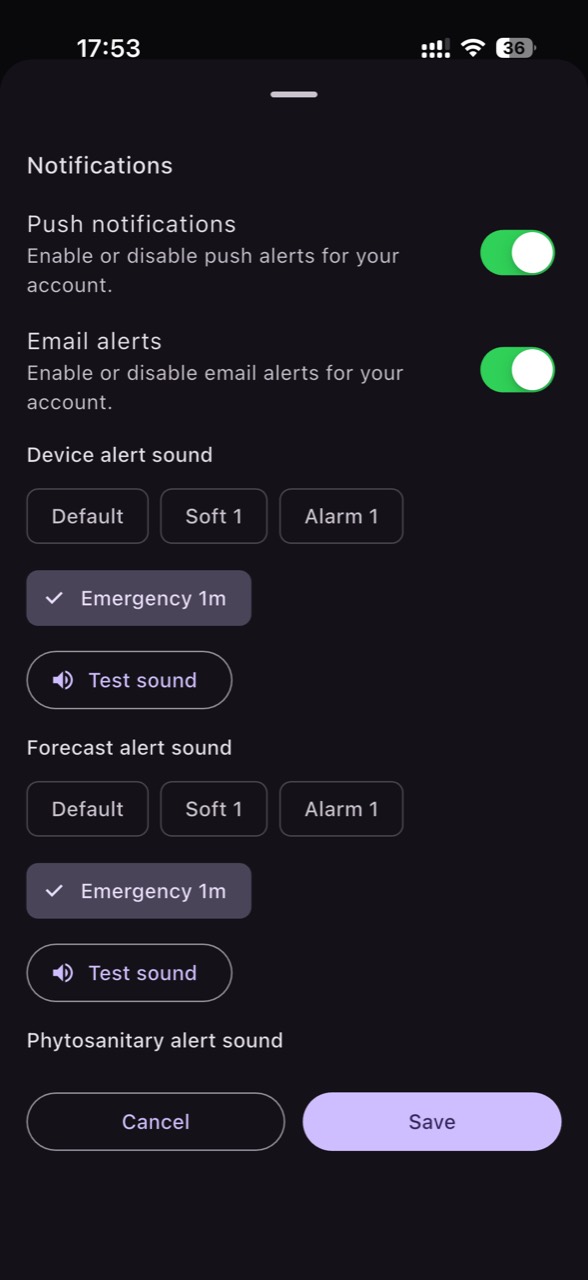
In GrowGuard, you set alerts by zone, define who receives them (team access), and use reports to verify whether the action worked (for example, VPD returns into band, soil moisture stabilizes, drain EC drops). AI-assisted phytosanitary alerts and the forecast add context to thresholds: they don’t replace field decisions, but they help you notice when conditions become favorable for diseases/pests and prioritize scouting. AI Plant ID supports fast identification of weeds or observed symptoms as part of the decision workflow—not as a “hands-off” automatic diagnosis.
3) Temperature: thresholds for frost, heat stress, and climate control
Temperature is the variable most teams understand immediately, which is exactly why it’s often oversimplified. Thresholds should be separated by risk type: frost (night), heat stress (day), and rapid swings (thermal shock). Also, thresholds differ between air at crop level, air near the roof, and fruit/plant temperature (if you measure it).
For frost/heatwave alerts: create different thresholds for cold zones (low spots, greenhouse edges, row ends) versus “average” zones. In orchards and vineyards, a warning threshold may start several degrees before the critical point for the current phenological stage (swollen buds, budbreak, bloom). In greenhouses, thresholds must match your heating/ventilation strategy and the thermal inertia of the structure.
Practically: set two levels—warning (when you start preparing) and critical (when you execute procedures). For example, warning when temperature is dropping fast and approaching risk; critical when it reaches the value tied to your SOP. If your platform/integration supports it, add rate-of-change rules; otherwise approximate with different thresholds for night vs day. In GrowGuard you can combine live data with the forecast to judge whether a drop is likely to continue—reducing unnecessary alerts while still mobilizing the team early enough to act.
4) Relative humidity (RH): useful thresholds without the “RH high = disease” trap
Relative humidity alone can drive the wrong decisions because it depends on temperature. Still, RH is useful in two scenarios: condensation risk (very high RH near saturation) and overly dry air (very low RH).
In greenhouses, RH thresholds must match crop and growth stage: seedlings and cuttings often tolerate or require higher RH, while during flowering/fruiting you typically want to avoid long periods of high RH that promote leaf wetness and condensation. Outdoors, extremely low RH combined with wind can accelerate water stress even if soil still holds water.
A practical approach: set a “condensation likely” alert when RH stays above a high threshold for a sustained period (for example, 30–60 minutes), especially at night, and a “too dry” alert when RH drops below a low threshold during peak hours. But don’t stop there: use VPD as the primary comfort/stress metric and RH as a secondary indicator. In GrowGuard, you can view RH across the sensor map to spot compartments with weak ventilation or unexpected moisture sources (leaks, excessive fogging, uneven heating).
5) VPD: greenhouse VPD threshold by zone—with bands and durations (not one number)
VPD (vapor pressure deficit) links temperature and humidity and is closer to what the plant “feels” in transpiration. That’s why VPD thresholds are often more actionable than raw RH thresholds.
The common mistake is using one VPD threshold for the whole greenhouse and the whole day. In reality, target VPD shifts with growth stage (propagation vs production), light intensity, canopy density, variety, irrigation strategy, and the goal (more vegetative vs more generative). Different compartments also create distinct microclimates.
Set a band: VPD too low (air too humid, condensation risk, reduced transpiration) and VPD too high (air too dry, stress, stomatal closure, tip burn risk in some crops). Then add duration: a 2–5 minute excursion can be noise; 20–30 minutes is an operational signal. Some zones need tighter bands (propagation areas), others can be wider (mature crops).
6) Soil/substrate moisture: alerts that reflect water availability, not just “percentages”
Soil/substrate moisture sensors are extremely valuable—but only when thresholds are calibrated to soil type, substrate volume, and installation depth. A “20%” in coco coir does not mean the same thing as “20%” in a loamy soil. That’s why thresholds must be defined for zones sharing the same texture/structure and the same irrigation strategy.
In substrate-grown greenhouses, thresholds must align with irrigation windows (pulses) and drainage. In the field, thresholds must align with root depth and phenological stage; a young vine doesn’t tolerate the same depletion as a mature vine. In orchards, lighter soils dry faster and deserve a higher warning threshold (so you intervene earlier).
Practically: establish three reference points per zone: post-irrigation (operational “full”), pre-next irrigation (minimum acceptable), and critical (stress). Use the first 1–2 weeks to observe the dry-down curve and the response to irrigation, then refine. In GrowGuard, the sensor map and period reports help you compare zones: if one zone hits critical more often, you may have an irrigation uniformity issue (emitters, pressure, clogging) or a real soil difference worth managing separately.
7) EC and pH in fertigation: thresholds for recipe, drain, and slow drift
EC and pH are the language of fertigation. Thresholds should differentiate between: (1) EC/pH at the source or in the irrigation solution (what you deliver), (2) EC/pH in the drain (what remains/accumulates), and (3) slow trends (drift) that signal upcoming issues. One fixed threshold without context causes either panic or complacency.
For EC: define a target range by zone (crop/variety/substrate) and warning thresholds when you exit the band. In substrates, track the difference between irrigation and drain: if drain EC rises steadily, salts are accumulating; if drain EC is much lower than irrigation, you may have excessive leaching or different uptake dynamics. For pH: thresholds should be tight enough to reduce nutrient lockout risk, but not so tight that small oscillations trigger constant alerts.
An operational recommendation: set high/low exceedance alerts plus drift alerts (for example, pH moving in one direction for several hours). When an alert fires, typical steps are: verify probe calibration, check acid/base stock, check injector performance, then adjust the recipe. In GrowGuard, you can integrate existing systems via MQTT and centralize TTN API imports so EC/pH sits alongside climate and soil moisture—because sometimes “EC increased” is the effect of a very hot day (transpiration), not a dosing fault.
8) Battery and sensor status: alerts that protect data continuity
Data is only useful if it’s continuous. That’s why sensor battery alerts and status alerts (offline, weak signal, frozen values) are as important as agronomic thresholds. Many operations only notice data loss when it’s too late: during a frost night or a critical fertigation period.
Set battery thresholds with a realistic response window: a warning level that lets you plan (service within 1–2 weeks) and a critical level that triggers fast intervention. On LoRaWAN/NB-IoT, monitor link-quality indicators where available. For integrations, ensure MQTT streams include “last seen”/timestamps, not just measurement values.
In GrowGuard, device and battery status is visible in live monitoring and on the sensor map, and reports help distributors and managers demonstrate maintenance: which sensors were offline, for how long, and how issues were resolved. Good status thresholds also reduce “ghost alerts”: for example, don’t alert on the first missed packet—alert on a confirmed absence (duration) and only for sensors that are critical in the current growth stage.
9) Assign thresholds by role and channel: who gets the alert and what must be confirmed
An alert is not for everyone. Managers want exceptions and trends, technicians want precise actionable triggers, and distributors/installers want status and maintenance signals. If everyone gets everything, nobody responds consistently.
Define roles: (1) operations (irrigation, climate, fertigation), (2) maintenance (battery, offline, EC/pH calibration), (3) management (reports, zone comparisons, energy/cost perspective). In GrowGuard, team access lets you allocate permissions by farm/zone and route alerts to the right groups. For multi-site projects, this is the difference between a platform that’s used daily and one that’s merely installed.
Add a simple confirmation rule: for critical alerts, someone verifies and records the action (even informally). Then use reports to see whether the threshold was too sensitive or too permissive.
10) Refine thresholds after the first 2–4 weeks: from settings to standard operating procedure
Thresholds are not set-and-forget. The first weeks are when you learn each zone’s signature: how fast it cools, how quickly it dries, how VPD responds when vents open, what EC/pH does after a correction.
A practical improvement loop: (1) list alerts that triggered useful action, (2) list alerts that were ignored for good reasons, (3) adjust either the threshold, the duration, the zone, or the recipient. Often the fix isn’t “raise the threshold”—it’s adding duration or splitting a cold pocket zone from a warmer zone.
Use the forecast to apply seasonal thresholds (spring/fall frost, summer heatwaves) and use AI-assisted phytosanitary alerts as a prioritization layer: when disease-favorable conditions appear, RH/VPD thresholds matter more on those days. AI Plant ID can support team training: when symptoms appear, fast identification helps you correlate with historical conditions (for example, repeated condensation periods or stress events).
Conclusion
Effective thresholds are zone-specific, tied to an action, and validated over time. Temperature and RH are useful, but VPD is often more actionable in greenhouses; soil moisture becomes decision-grade only when calibrated to soil/substrate and depth; EC/pH must be tracked with context (source vs drain, trends), and battery/status thresholds protect data continuity.
GrowGuard helps you manage these thresholds through live monitoring, a sensor map, reports, forecast, team access, and integrations (LoRaWAN, NB-IoT, MQTT, TTN API imports). The result isn’t “more alerts”—it’s alerts that drive faster, more consistent interventions in each crop zone, exactly when it matters.