In commercial orchards and vineyards, the same day can look very different from one block to the next: a low area develops a cold-air inversion and freezes, a slope dries faster, and a heavy-soil parcel stays wet long after rain. That is why a “weather station by the yard” can be a useful reference, but not a decision tool for blocks with distinct microclimates.
Sensors do not “solve” risks, but they can reduce the time to a correct intervention: you start frost protection when temperature actually drops at the critical height, you irrigate when the root zone enters stress, and you intensify phytosanitary checks when the canopy stays wet long enough. The key is to follow the mechanism, not just a number.
A functional system starts with a commissioning protocol: choose the right parameters, measure them in the right place, independently verify that the sensor is telling the truth, set alerts by phenological stage, and then confirm after each event that the decision produced the intended effect. Below is a practical workflow applicable both in orchards (apple, pear, plum, etc.) and in vineyards.
1) Start from real phenology-based risks, not from a “sensor shopping list”
In fruit growing and viticulture, sensitivity shifts quickly: from budbreak to bloom, cold and wind-driven drying can affect fruit set; during fruit/berry growth you need enough water but not excess; toward ripening, prolonged humidity increases pressure from certain diseases and can affect quality. The mechanisms differ: frost is a short threshold event, water stress is cumulative, and disease risk depends on wetness duration and temperature.
What to observe: your own block-by-block history of problems (areas that freeze, rows that dry out, hotspots after rainy spells). What to verify independently: field notes after episodes (frost traces, wet leaves at sunrise, ponding zones), plus spot checks with a handheld thermometer/hygrometer or a tensiometer to calibrate expectations. Practical decision: define 3–5 scenarios (frost, drought, excess moisture, prolonged wet leaf) and link each to actions. How to check results: after the event, compare blocks and confirm the intervention was timely and proportionate.
2) Choose sensor types by mechanism: air, leaf, soil
For frost and heat, what matters is air temperature at the height relevant to buds/flowers, plus relative humidity to understand drying and inversion potential. For wet periods, a leaf-wetness sensor (or a wetness estimate at canopy level) helps you capture hours when surfaces stay wet, not just “it rained.” For water management, you need dedicated soil-moisture sensors and, ideally, soil temperature to interpret root activity and the timing of uptake.
What to observe: units and measurement medium. Temperature is °C, relative humidity is %, soil moisture depends on sensor type (often volumetric), and leaf wetness indicates water presence on a surface. What to verify independently: that each sensor measures what you think it measures; a temperature sensor does not measure EC/pH, and EC/pH require separate probes used in the correct medium (water, fertigation solution, substrate extract, or bulk soil). Practical decision: buy fewer types, but the correct ones. How to check results: after the first 2–3 weeks, confirm each parameter actually changes a decision; if not, re-scope it.
3) Placement: an “average” station cannot replace a sensor at a critical point
Orchard and vineyard microclimate is dominated by topography and wind: low zones collect cold air, wind-exposed rows lose water faster, and proximity to woodland or open water changes nighttime humidity. That is why a frost-temperature sensor should be placed in the prone point (often the low area) at a height comparable to the sensitive organs. In parallel, a sensor in a “normal” area gives you the block-to-block difference you can manage.
What to observe: differences between parcels and between row ends. What to verify independently: on clear nights, walk the blocks 30–60 minutes after sunrise and see where frost persists; note whether your “cold” sensor aligns with reality. Practical decision: choose placements that protect you against the worst-case block, not the farm average. How to check results: when a hypothetical cold episode occurs, compare temperature curves between the critical point and the reference; if the gap is consistent, you have a working risk map.
4) Commissioning soil sensors: depth, contact, and the active root zone
With localized irrigation in orchards, the active root zone is not “the whole soil,” but the repeatedly wetted volume where fine roots do most work. In vineyards, this volume can be narrow, and the relevant depth shifts with vine age and soil texture. Soil-moisture sensors must be installed with good soil–probe contact; air gaps or stones produce false readings. Often you use one probe shallower (fast response) and one deeper (reserve/drainage), across blocks with different soil behavior.
What to observe: the sensor response after an irrigation event and after rain. A correctly installed sensor should rise after irrigation and then decline gradually; if it stays “stuck” or jumps unrealistically, suspect installation or failure. What to verify independently: a control pit or soil auger check to see the wetting front and whether moisture reaches where you think it does. Practical decision: adjust irrigation duration and frequency based on the difference between shallow and deeper layers. How to check results: after several cycles, confirm the deeper layer stabilizes (no persistent accumulation) and plants show fewer stress symptoms.
5) Fresh data and typical errors: when the “problem” is actually the sensor
For frost risk, latency matters: if readings arrive infrequently or delayed, you can miss the critical moment. Likewise, for leaf wetness, missing nighttime data can break the interpretation of wetness duration. During commissioning, define what “fresh data” means for your operations and verify communication stability. You also need to distinguish a real field change (cold front, wind shift, rain) from an error (low battery, accidental shading, a loose cable, or a moved sensor).
What to observe: failure signals such as identical values for hours while conditions change, physically impossible jumps, or exaggerated differences from a nearby point with no plausible explanation. What to verify independently: a temporary comparison with a handheld instrument plus a physical inspection (mounting, exposure, contamination on the leaf-wetness surface). Practical decision: before changing irrigation or scheduling treatments, confirm the anomaly is agronomic, not technical. How to check results: after correction (repositioning/cleaning), verify the time series returns to a pattern consistent with weather and neighboring points.
6) Thresholds and alerts: building them without “false alarms”
Useful thresholds are not universal because they depend on species, phenological stage, exposure, and even orchard/vineyard infrastructure (frost protection, nets, irrigation design). Instead of chasing a “magic number,” start with operational thresholds: when you want to be woken up, when you want a field check, and when you only want a heads-up. For frost, a threshold can be paired with conditions (downward trend, clear night). For irrigation, thresholds should follow sensor dynamics, not an isolated value.
What to observe: rate of change and forecast context. Alerts can be set by zone so the prone block triggers earlier than the rest. What to verify independently: treat the first alerts as learning events—confirm in the field and record whether the intervention would have been justified. Practical decision: refine thresholds after 2–4 weeks of season using real episodes. How to check results: the share of “useful” alerts rises and “useless” ones falls; if not, the fix may require changing placement, not just the number.
7) Disease risk: wetness, temperature, and verification by scouting
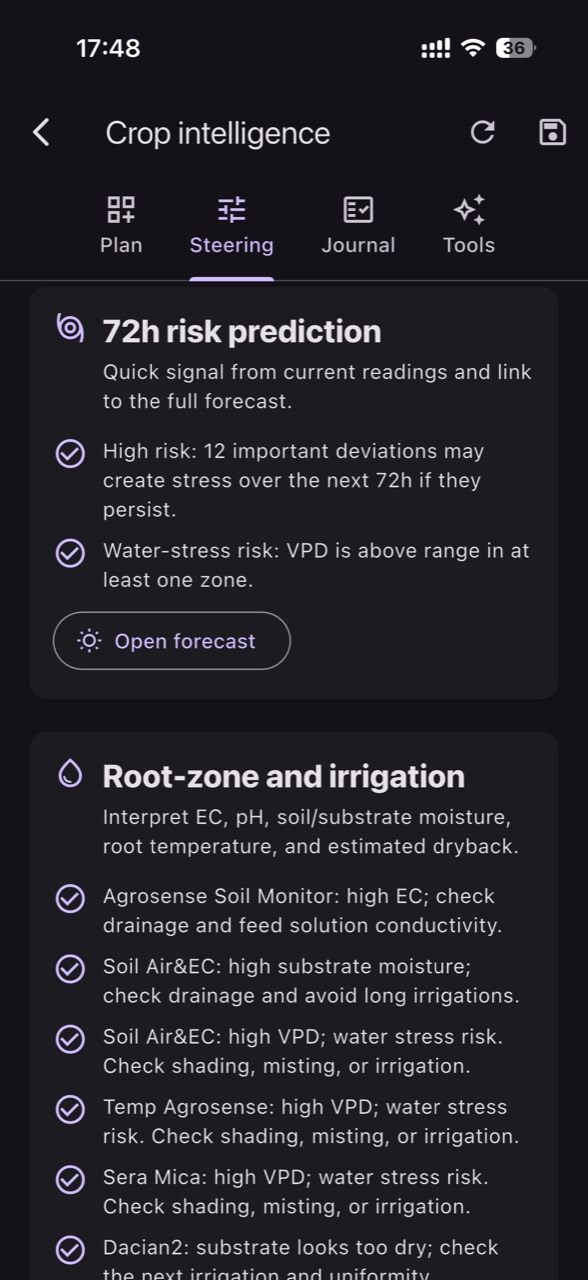
In many foliar and fruit/berry diseases, the common driver is a water film on plant organs and how long it lasts. High relative humidity does not automatically mean wet leaves, and wet leaves can occur from dew even without rain. That is why combining air temperature, humidity, and leaf-wetness periods creates a risk context, not pathogen confirmation. Risk alerts (including those produced in platforms such as GrowGuard) are not pathogen detection and should be treated as a way to prioritize field checks.
What to observe: hypothetical windows of prolonged wetness (for example, several nights in a row with persistent dew in the block near a tree line). What to verify independently: targeted scouting in that zone, focusing on sensitive organs and more vulnerable varieties; record phenological stage and any early symptoms. Practical decision: adjust inspection timing and, if needed, coordinate interventions with a drier window for better field performance. How to check results: track whether observed pressure declines in the targeted zone compared with reference areas, without confusing correlation with causation.
8) Close the loop: irrigation, frost protection, and post-intervention audit
Data becomes valuable when you can say “we did X, and sensors and crop responded with Y.” For irrigation, the expected response is an increase in moisture in the active layer and reduced stress in subsequent days, without the deeper layer showing constant accumulation (a sign of percolation or over-application). For frost, after an intervention (for example, starting an existing frost-protection system), you want to know whether temperature at the critical height stayed above your operational threshold during the coldest period.
What to observe: the before/after difference within the same zone, not just an absolute number. What to verify independently: physically check soil and canopy condition in a few points, and after cold episodes assess the share of damaged flowers or browned tips using a simple, consistent method. Practical decision: adjust strategy by block—more water where drawdown is fast, less where the wetting front remains high. How to check results: compare blocks and keep a short intervention log to build your own thresholds for next season. In GrowGuard you can follow these time series over time and set zone alerts, but the protocol is the same regardless of platform.
Conclusion
Orchard and vineyard monitoring with sensors works when you follow three rules: measure where risk actually happens, choose the right sensor for the mechanism, and confirm in the field before costly decisions. Do not aim for perfection in week one; aim for coherent data and a clear observation–intervention–verification loop repeated across phenological stages.
If you want to structure commissioning by blocks and quickly compare microclimates, a monitoring platform like GrowGuard can help with zone-based visualization and alerts, but value comes from how you define checks and success criteria. Start with one critical block, validate, then expand.