In a greenhouse or plastic tunnel, CO₂ can be either the invisible limiter of photosynthesis or an expensive input wasted through ventilation. The real problem isn’t only “how much CO₂ do I have?”, but “in which zone, in which time window, and under what temperature and VPD conditions can plants actually use it?”.
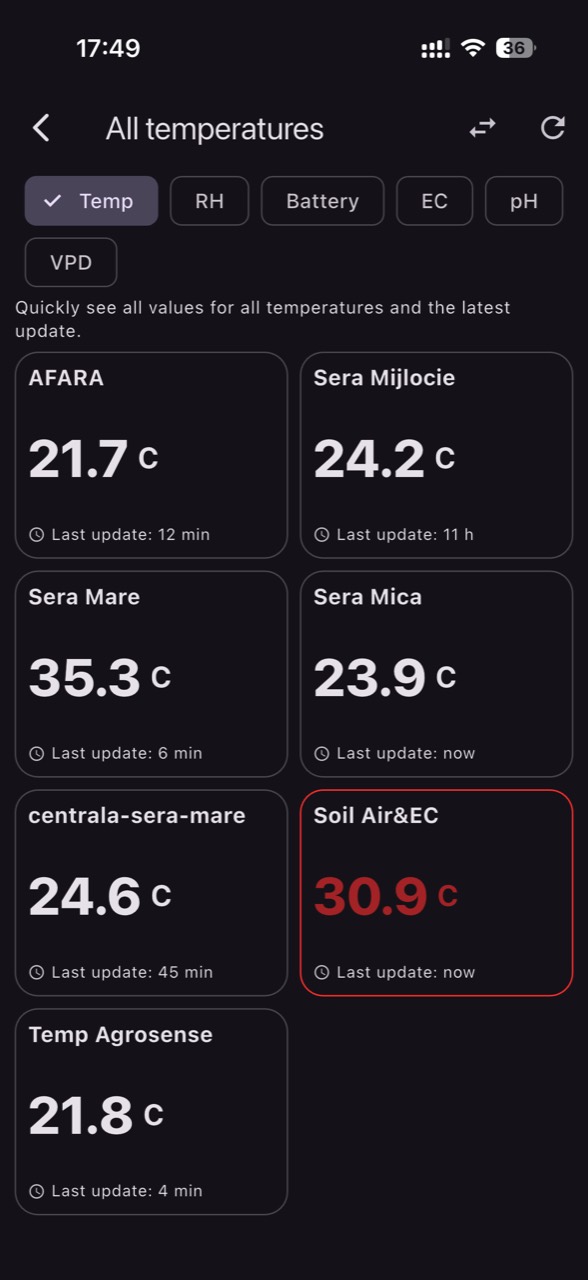
This article proposes a zone-based workflow with thresholds and alerts that links CO₂ monitoring to ventilation, VPD and temperature, so you can quickly spot photosynthesis losses and CO₂ enrichment waste. You’ll also see how GrowGuard supports this with live monitoring, a sensor map, reports, history views, team access, and integrations (LoRaWAN, NB-IoT, MQTT, TTN API imports).
Whether you manage vegetables, flowers, nurseries, vineyards, orchards with protective tunnels, or you distribute sensors and horticulture solutions, the approach below helps translate data into action: ventilation settings, enrichment time windows, uniformity checks, and well-tuned alerts.
1) Why CO₂ must be considered together with ventilation, VPD and temperature
Photosynthesis depends at the same time on light, CO₂, temperature, and how open stomata are (which is strongly influenced by VPD and plant stress). In practice, three common loss patterns show up:
1) CO₂ too low during good light: plants could fix more carbon but are limited by concentration. This is typical early morning on sunny days, after a night with ventilation, or during high consumption when canopy mass is large.
2) CO₂ high, but stomata partly closed: if VPD is too high (air too dry relative to leaf temperature), plants reduce transpiration, stomata close partly, and CO₂ uptake becomes inefficient. You “have CO₂, but can’t use it”. At the same time, high temperatures can increase respiration and reduce net photosynthesis efficiency for some crops, especially when water and humidity control are weak.
2) What to measure: the minimum sensor set and what adds value
For greenhouse CO2 monitoring, the useful minimum is: CO₂ (ppm), air temperature (°C), and relative humidity (%), so VPD can be calculated. Ideally you measure these by zones (for example: end bays, center, near doors, near fans, shaded areas, heated areas).
In GrowGuard you can use a sensor map and define operational zones: propagation area, production area, packing/transition area, zones under different screens or films. This matters because CO₂ and VPD vary spatially, and decisions made from a single point often drive the wrong control strategy.
If you run CO2 enrichment in the greenhouse, equipment visibility matters too: battery and sensor status, plus basic data-quality checks. GrowGuard helps you spot when a sensor reports intermittently, when batteries drop, or when a sensor drifts compared to other comparable points.
3) Zone-based workflow: how to define the zones that matter for CO₂
Start by defining 3–6 zones that match how you actually make decisions. Examples: (A) near vents/roof openings, (B) greenhouse center, (C) near heating pipes, (D) end zone with doors or curtains, (E) high canopy density area.
Zones become valuable in GrowGuard when you use them for: (1) different thresholds, (2) different alerts, (3) different team responsibilities. For example, the climate manager gets “low CO₂ under light” alerts, while a technician gets “sensor offline” or “low battery” alerts.
For distributors and integrators, zones also help demonstrate climate uniformity and justify sensor placement: near airflow sources, at canopy-relevant height, avoiding dead corners or direct exposure to a CO₂ jet.
4) Day/night CO₂ thresholds: time windows that reduce useless alerts
CO₂ behaves differently during the day and at night. If you use the same threshold 24/7, you’ll get noisy alerts and end up ignoring the good ones. Set day night co2 thresholds based on your light program (natural or supplemental) and your ventilation routine.
Practical starting point (adjust by crop and technology):
“Day” window: from before sunrise until late afternoon (or as long as light is productive). Here you care about a minimum threshold (for instance 450–600 ppm to avoid strong limitation; higher if you enrich). With enrichment, set a target range and a maximum threshold to reduce waste during strong ventilation or excessive temperature. Don’t chase a single number; prioritize stability and zone uniformity.
5) CO₂ and ventilation: how to recognize waste and when ventilation is unavoidable
CO₂ and ventilation are often in conflict: you ventilate to manage temperature and humidity, but you lose CO₂. The goal isn’t “don’t ventilate”; it’s to choose smart time windows where enrichment makes sense and to detect moments when you spend money without real plant benefit.
Typical waste signal: CO₂ rises fast after injection, then drops sharply exactly when temperature climbs and vents open. If this pattern repeats in history, you are likely enriching too early or too late relative to the thermal dynamics. In GrowGuard you can compare CO₂, temperature and (if available) controller signals via MQTT/TTN API imports, linking ventilation events to CO₂ drops.
When ventilation is unavoidable (temperature exceeds stress thresholds or humidity becomes critical), don’t force enrichment. Instead, use GrowGuard to mark periods when injection was paused and later verify whether the decision was correct (for example, VPD returned to a workable range and CO₂ stabilized at an acceptable level after airing).
6) CO₂ and VPD: when CO₂ is sufficient but photosynthesis still drops
VPD (vapor pressure deficit) is the practical indicator of “how hard the plant is pulling water”. When VPD is too high, stomata partly close to reduce water loss, and CO₂ entry drops. This means enrichment may have low return in hot, very dry air.
Control workflow: (1) check zone VPD; (2) if VPD is too high, prioritize humidity/temperature actions (fogging/misting, screening, irrigation timing, reducing air heating, ventilation management); (3) only then push higher CO₂. In GrowGuard, overlay charts help you see whether a photosynthesis limitation is more likely driven by water-stress conditions (VPD) than by CO₂ shortage.
Conversely, when VPD is too low (air too humid), stomata may remain open but disease and condensation risks rise. This is not something to “solve” with CO₂. Use alerts and reports to manage humidity and reduce long low-VPD periods, especially at night and early morning.
7) CO₂ and temperature: avoid wrong conclusions from a single average
Temperature changes both CO₂ demand (through faster metabolism) and the need for ventilation. Two common issues are: (a) higher temperatures in the upper layer with lower CO₂ at canopy level, and (b) large zone differences that lead to “average-based” control decisions that don’t protect the critical zones.
In practice, track: (1) temperature spread across zones, (2) how CO₂ moves as temperature rises, (3) whether VPD jumps out of range. If a zone heats up quickly and CO₂ drops at the same time, it’s a strong hint that local ventilation or airflow is washing CO₂ out.
GrowGuard supports this with live monitoring and zone-based alerts, so you don’t rely on a single value. For teams, role-based access (team access) means the climate lead can immediately see the problematic area on the map, while a technician checks for a stuck curtain, a stopped fan, or a door left open.
8) Zone-based thresholds and alerts: a practical starter rule set
A good alerting system shouldn’t be “sensitive to everything”; it should be operationally useful. Start with simple rules, then refine by crop, season, and greenhouse/tunnel type.
Starter rules (example):
A) “Low CO₂ during the day window”: if CO₂ < minimum threshold for X minutes in at least Y critical zones. This flags photosynthesis limitation or high uptake; you then check ventilation behavior, canopy density, enrichment schedule, and leakage. For farms without enrichment, the alert helps you identify when it may be worth reducing ventilation (if temperature/VPD allow) or improving airflow so outside CO₂ enters more evenly.
9) Time windows and routines: what a good CO₂ control day looks like
To avoid reactive decisions, set a simple daily routine around three moments: before peak light, at peak light, and before evening.
Morning: check whether CO₂ starts at an adequate level in production zones. If you start enrichment, do it while ventilation is still moderate and VPD is in range; otherwise you will waste CO₂ quickly.
Midday: watch the CO₂–temperature–VPD linkage. If temperature climbs and vents open, accept that CO₂ will drop and decide whether to pause injection. Reduce or stop enrichment when the curves show you can’t maintain levels without heavy losses.
10) History checks in GrowGuard: how to confirm the cause, not just the effect
After a difficult day, the most valuable step is confirming the cause. In GrowGuard history, look for repeatable patterns: sharp CO₂ drops associated with temperature rises and VPD shifts. If it happens in the same time window across multiple days, it’s a program issue (enrichment too early, ventilation thresholds too aggressive, insufficient screening).
Compare zones to each other: if only the door-side zone shows big drops, the cause is local. If all zones drop together, it’s a global ventilation event or weather-driven regime change. This is where GrowGuard forecast helps: if wind/heat is expected, you plan shorter enrichment windows and focus on climate stability.
Use weekly reports: hours below the minimum CO₂ threshold in the day window, hours with VPD above limit, and the number of “unstable CO₂” events. These reports are also valuable for distributors and consultants: they clearly show where photosynthesis opportunities are lost and where control infrastructure needs adjustment.
Conclusion
CO₂ control in greenhouses and tunnels is not a standalone slider—it’s continuous alignment with ventilation, VPD and temperature, by zones and by time windows. When decisions are based on correlated data, you reduce enrichment waste, avoid periods where photosynthesis is limited, and build a repeatable climate-management routine.
GrowGuard makes this practical: live monitoring, a zone-based sensor map, configurable day/night alerts, history checks, reports, team access, and integrations (LoRaWAN, NB-IoT, MQTT, TTN API). In the same ecosystem you can track pH, EC, soil moisture, air humidity, temperature, VPD, plus battery and sensor status, while AI-assisted phytosanitary alerts and AI Plant ID add context for faster, better-supported decisions.
Next practical step: define zones, set day/night windows, start with conservative thresholds, then use 2–3 weeks of history to tune. You’re not chasing perfection in a day—you’re building a system that alerts correctly and helps you act before you lose valuable hours of photosynthesis.