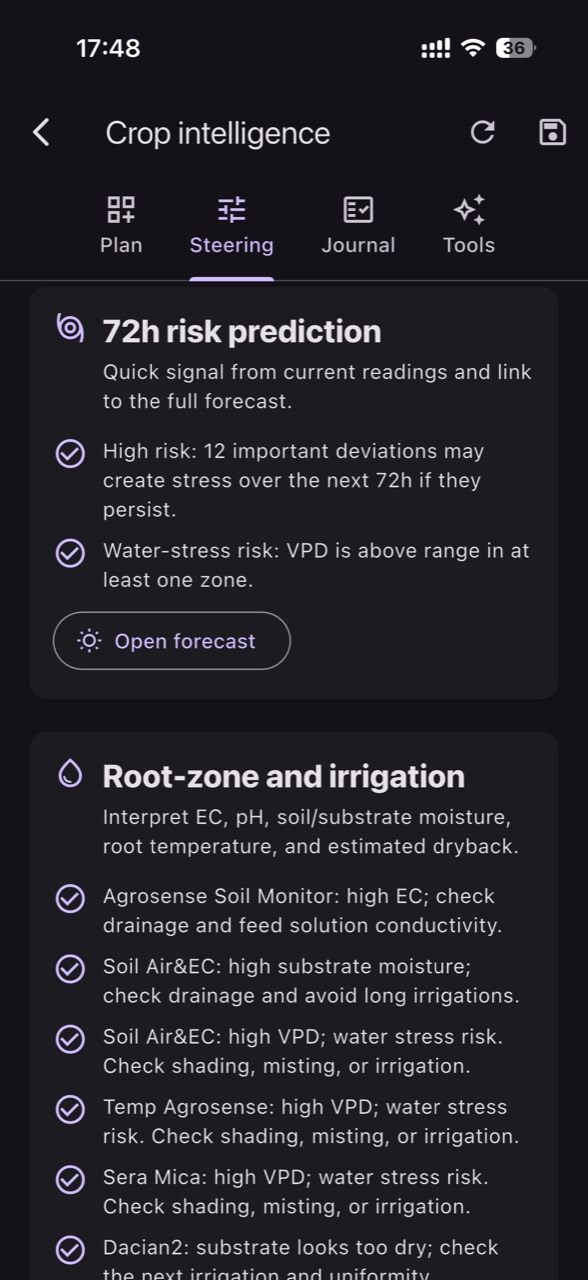
Effective fertigation is not only about how much you apply, but under what conditions the nutrient solution reaches the root zone. Two numbers sit at the center of daily decisions: pH (which drives nutrient availability) and EC (which indicates salt concentration and osmotic stress risk).
In real operations, pH/EC varies by zone (sectors, blocks, rows, irrigation sublines) and changes before/after irrigation, depending on soil moisture, temperature, substrate type, and water quality. Without a monitoring workflow, it’s easy to end up with nutrient lockout, salinity spikes, and symptoms that are hard to distinguish from disease.
Below is a workflow you can apply across greenhouses, vegetable and flower farms, orchards, vineyards, and for sensor distributors who need a repeatable method: zone thresholds, alerts, soil-moisture correlation, and history checks in GrowGuard.
1) What to measure and why: pH, EC, and soil moisture in one picture
pH influences the chemical form and mobility of nutrients. At an unsuitable pH, plants can look “hungry” even when you fertilize correctly: induced deficiencies (lockouts) can appear, for example affecting iron, manganese, phosphorus, or calcium depending on crop and substrate.
EC (electrical conductivity) reflects dissolved salts. Excessive EC increases osmotic pressure, making it harder for roots to take up water and nutrients, leading to salinity stress: midday wilting, leaf edge burn, slow growth, smaller fruit, and generally higher sensitivity to stress.
Soil moisture is the context without which pH/EC can be misread. High EC in dry soil often means salts are concentrated in the root zone; the same EC after an irrigation or leaching event can mean something different. That’s why pH/EC should be correlated with soil moisture and with irrigation timing (before, during, and after events).
2) Where to measure: zones, depths, and critical points for fast decisions
For greenhouse and farm managers, the most useful approach is to think in operational zones: each zone with the same water/fertigation source, the same crop, the same soil/substrate type, and the same irrigation schedule should have its own thresholds.
In greenhouses, drainage and temperature differences create micro-zones: row ends, near doors, along sidewalls, under different drip lines. In orchards and vineyards, slope, soil texture, distance from the water source, and rootstock/cultivar differences can separate zones with very different responses.
Depth matters: the surface layer may show high EC after evaporation while the active roots sit deeper. A common setup places one sensor in the active root zone and another deeper to see whether salts are migrating or accumulating. Sensor distributors can standardize “zone kits” and guide installation so data stays comparable across sites.
3) Setting zone thresholds: how to choose realistic pH and EC limits
Thresholds should not be copied blindly from generic tables. In GrowGuard, the recommended approach is: start with an indicative target range for your crop and substrate, then refine it after 2–4 weeks of data and observed/analytical feedback (water tests, soil/substrate tests, leaf analysis).
For pH, define a target band plus two intervention thresholds: a warning level (when you start investigating) and a critical level (when you change the recipe or apply corrections). For EC, set different thresholds by growth stage (vegetative vs flowering/fruiting) and by crop salt tolerance.
In a zone-based workflow, keep the logic consistent: the same rule structure for every zone, but limits calibrated to local conditions. In GrowGuard you can organize zones on the sensor map so thresholds and alerts are easy for the team and technicians to review.
4) Alerts that lead to action: how to configure notifications that aren’t just noise
Useful alerts flag meaningful deviations that persist long enough to justify action. If alerts are too sensitive, the team stops trusting them; if they’re too loose, you find out too late.
A practical alert set includes: pH below/above min/max in zone X for a defined duration, EC above max in zone X, rapid EC rise over a short interval (often a sign of concentration via evapotranspiration), and combined alerts (high EC together with low soil moisture).
GrowGuard supports live monitoring, so after an intervention (corrective irrigation, dosing adjustment, leaching) you can confirm whether pH/EC returns to range. For distributors, zone alerts are also a support tool: they can set baseline rules with the customer and tune them seasonally.
5) Correlating with soil moisture: the difference between “salinity” and “temporary concentration”
The most common misinterpretation is treating any high EC as “salty water trouble.” In reality, EC often rises when soil moisture drops: the same amount of salts is held in less water, so concentration increases.
A practical workflow: first check soil moisture and irrigation dynamics. If EC is high and moisture is below target, the first step may be an irrigation that brings moisture back into range (without increasing fertilizer concentration), followed by re-checking. If EC stays high after moisture recovers, you likely have true salt accumulation or an overly concentrated recipe.
In GrowGuard, correlation is quick using overlaid charts and zone history. If you also track temperature, air humidity, and VPD, you can interpret high-demand days better—when plants pull more water and the risk of concentration increases.
6) History checks: how to spot patterns that drive nutrient lockout
Nutrient lockout rarely happens from a single day. More often there’s a pattern: pH drifts gradually out of range, EC peaks repeat after certain irrigation hours, and soil moisture swings widely between events.
In history, look for: pH drift (7–14 day trend), repeated EC spikes after fertigation, zones responding differently to the same recipe (a sign of poor uniformity or soil differences), and periods where EC rises while battery/sensor status indicates issues (to rule out artifacts).
GrowGuard provides reports and exports for technical discussions: with your agronomist, your fertilizer supplier, or your irrigation maintenance team. A history review before making major recipe changes helps prevent “over-corrections.”
7) Intervention steps: what to do when pH moves out of range
When pH is too high or too low, the most effective actions start with root cause—not just the symptom. First check: source water pH, alkalinity (if available from lab tests), acid dosing, equipment calibration, and any changes in fertilizer batch or formulation.
In greenhouse and automated fertigation systems, small dosing changes can have big effects. That’s why GrowGuard live monitoring is valuable for same-day validation: if pH returns and stays stable after a few irrigation cycles, you’ve confirmed the correction is working.
If pH remains unstable, check zone uniformity (filters, pressure, emitters), solution mixing, and potential chemical interactions (precipitation) that can shift both pH and nutrient availability.
8) Intervention steps: what to do when EC climbs and salinity risk increases
When EC rises above threshold, the key question is whether plants are already under osmotic stress or you’re seeing a temporary spike. Correlate with soil moisture, VPD (transpiration demand), and temperatures: hot, dry days can amplify the effect of even moderate EC.
Typical interventions include: adjusting nutrient solution concentration, increasing leaching fraction where appropriate, irrigating more frequently with smaller doses to avoid between-event concentration, and checking water quality (source water EC).
In chronically risky areas, GrowGuard zone thresholds help you separate a sector that needs scheduling changes from one that needs maintenance (for example, drip non-uniformity). Monitoring battery and sensor status reduces the chance of making decisions on incomplete data.
9) Integrating with your team and operations: access, responsibilities, reports
Controlled fertigation requires operational discipline: who reviews alerts, who validates in the field, who adjusts the recipe, and who documents the intervention. GrowGuard supports team access so the manager, agronomist, and irrigation technician work from the same “version of truth.”
Regular reports (weekly/monthly) are useful for management and for distributors: they show zones with deviations, time spent out of range, interventions, and outcomes. History also enables training: why an EC spike happened, what worked, what didn’t.
For sensitive crops, combine these reports with field observations and complementary tools: for example AI Plant ID for quick triage of visual symptoms, and AI-assisted phytosanitary alerts to help differentiate abiotic stress (salinity/pH) from disease pressure—without mixing up causes.
10) Connectivity and ecosystem: LoRaWAN, NB-IoT, and imports for a complete picture
In farms with scattered zones (orchards, vineyards) or mixed infrastructure, connectivity determines how “live” monitoring truly is. GrowGuard supports deployments via LoRaWAN and NB-IoT depending on coverage and operational model.
For distributors and integrators, importing data via MQTT and TTN API (The Things Network) simplifies multi-vendor projects and connections to existing gateways. This lets you aggregate pH, EC, soil moisture, temperature, air humidity, VPD, and device status (battery/sensor) into one dashboard.
Once data is unified, zone thresholds and alerts become far more powerful: you’re not reacting to a single number, but to full context. For example, high EC in a zone with high VPD and low moisture may trigger a different action than the same EC in a cool, humid zone.
Conclusion
Good fertigation control starts with consistent measurement and ends with documented decisions: zone thresholds, meaningful alerts, pH/EC correlation with soil moisture, and history checks before major corrections.
GrowGuard helps you see what’s changing, where it’s changing, and whether the intervention worked—through live monitoring, a sensor map, alerts, reports, team access, and device status. Combined with microclimate data (temperature, air humidity, VPD) and AI-assisted tools (phytosanitary alerts, AI Plant ID), the workflow becomes safer and easier to standardize in a greenhouse, open field, orchard, or vineyard.
If you want to reduce nutrient lockout risk and salinity stress without complicating operations, start by defining zones, setting realistic thresholds, and using history as a learning tool season after season.