Watermelon seedlings stretch in greenhouse nurseries almost always because energy (light), temperature, and water are out of balance. When days are warm, light is insufficient or too diffuse, and the substrate stays constantly wet, plants “search” for light: longer internodes, fragile stems, bigger leaves, and softer tissues that break easily during handling.
Transplanting adds another stress layer: you temporarily interrupt fine-root continuity and abruptly change the conditions around roots (aeration, temperature, moisture, salinity). If in the first 48–72 hours after transplanting you run a VPD that is too high (air too “dry” for the temperature), the seedling loses water faster than it can absorb it, and stress shows as wilting, stalling, and dull-looking leaves.
In practice, most problems are not “recipe problems” but uniformity problems: one bench near a door, a colder corner, a partially clogged irrigation line, a different substrate batch, or a nutrient solution with unsuitable pH/EC. That is why the right approach is zone-based: measure, compare, verify independently, adjust locally, then confirm the effect back on the crop.
1) Why seedlings stretch: the light–temperature–water ratio
Watermelon, as a warmth- and light-loving crop, reacts quickly to a lack of useful radiation by elongating. The mechanism is straightforward: under low light energy, the plant invests in stem extension to gain a competitive advantage, and when temperature is high the growth rate accelerates. If the substrate remains continuously wet, roots get less oxygen, stems become “softer,” and stretching worsens further rather than correcting itself with time.
What to observe: thin stems, wider spacing between leaves, plants leaning toward the main light source, and clear differences between benches. What to verify independently: light intensity at canopy height (even a comparative check with a lux meter or quantum meter if available), air temperature at multiple points, and tray weight before/after irrigation. Practical decision: reduce drivers that increase “speed” without energy (excess temperature, constant water) and improve light uniformity; confirm within 3–5 days through shorter internodes and firmer plants.
2) Zone irrigation: avoiding both drought and chronic wetness
In nurseries, the same irrigation duration can mean very different outcomes: finer versus coarser substrate, trays more exposed to drafts, uneven nozzle distribution, or pressure variation along a line. This creates two dangerous patterns: zones that stay wet all the time (encouraging stretching and shallow rooting) and zones that swing abruptly between dry and wet (repeated water stress). Watermelon often responds with growth pauses—or, paradoxically, “stretched” growth after rewetting.
What to observe: color differences (darker green under excess moisture), leaf sheen changes, seedlings with roots spiraling along the plug edge, or an anaerobic smell in trays. What to verify independently: a simple uniformity test by weighing a few trays per zone (hypothetically, three trays/zone) and manually checking moisture at different depths in the cell. Practical decision: split irrigation into sectors and adjust duration/frequency locally rather than globally; confirm the next day by closer tray weights between zones and by fading “patches” of uneven growth.
3) EC and pH: measurement differences that can mislead you
EC and pH are only useful if you know what you are measuring and where. EC in source water or in the fertigation tank is not the same as EC in the substrate; likewise, water pH does not automatically describe root-zone pH. Water quality must be judged separately: pH, alkalinity, and soluble salts (EC) have different roles, and quick on-site pH/EC checks complement—never replace—laboratory analysis when you face lockout or hard-to-explain variation. Also, EC does not identify individual nutrient concentrations.
What to observe: pale leaves or scorched margins, slow growth after transplanting, seedlings that “sit still” even though the substrate is moist. What to verify independently: pH/EC in the reservoir solution and a substrate extraction (choose a method and keep it consistent) to see whether salts are accumulating in cells. Practical decision: first correct the source of error (high alkalinity/hard water, inconsistent dosing, incomplete mixing), then adjust fertigation and irrigation gradually to avoid sudden jumps; confirm via restored uniform growth and white, active roots.
4) VPD before and after transplanting: the invisible transpiration stress
VPD (vapor pressure deficit) is derived from air temperature and relative humidity, so it estimates how strongly the air pulls water from leaves. After transplanting, root uptake capacity is temporarily reduced, and if VPD rises sharply (warm, relatively dry air), water loss can exceed uptake. Note: leaves can be cooler or warmer than air, so calculated VPD is not identical to the plant’s true stress, but it is a strong indicator of trends and of differences between zones.
What to observe: slight midday wilt, marginal leaf curl, a 1–3 day stall without obvious disease signs. What to verify independently: temperature at canopy level, draft sources (doors, fans, curtains), and a quick early-morning turgor check (plants should be fully turgid then). Practical decision: on transplant day reduce shock factors (temporary shading, avoid aggressive ventilation swings, keep microclimate stable) without creating prolonged condensation; confirm by firm leaves throughout the day and the start of new growth.
5) A transplanting protocol that reduces root shock and later stretching
Successful watermelon transplanting means roots become functional quickly and stems stay “short and tough.” The mechanism: planting too deep or over-compacting reduces aeration; planting too shallow increases drying risk. If you irrigate heavily right away and keep the substrate saturated for days, oxygen drops, and the plant either stalls or “runs” into elongation. The target is good root–substrate contact while preserving porosity so oxygen and water can both move appropriately.
What to observe: seedlings that recover within 24–48 hours versus batches that remain “down,” then stretch. What to verify independently: container drainage performance, planting depth uniformity, and whether irrigation actually reaches every cell (a simple test with a few check trays). Practical decision: transplant into uniformly pre-moistened substrate, then apply a settling irrigation sufficient for contact, not for pooling; afterward move to short pulses guided by observation. Confirm by new roots visible near edges and stems that do not thin out.
6) Choosing sensors and placing them on benches: microclimate is the point
In a greenhouse, differences over 5–10 meters can be larger than differences between two days. For stretching and transplanting, the priority measurements are air temperature and humidity at plant height (from which you derive VPD), plus a root-zone moisture sensor for each relevant zone. If you track EC/pH, you need dedicated probes and you must define the medium clearly: fertigation solution, runoff/drain, or substrate extract. A temperature sensor does not measure EC or pH.
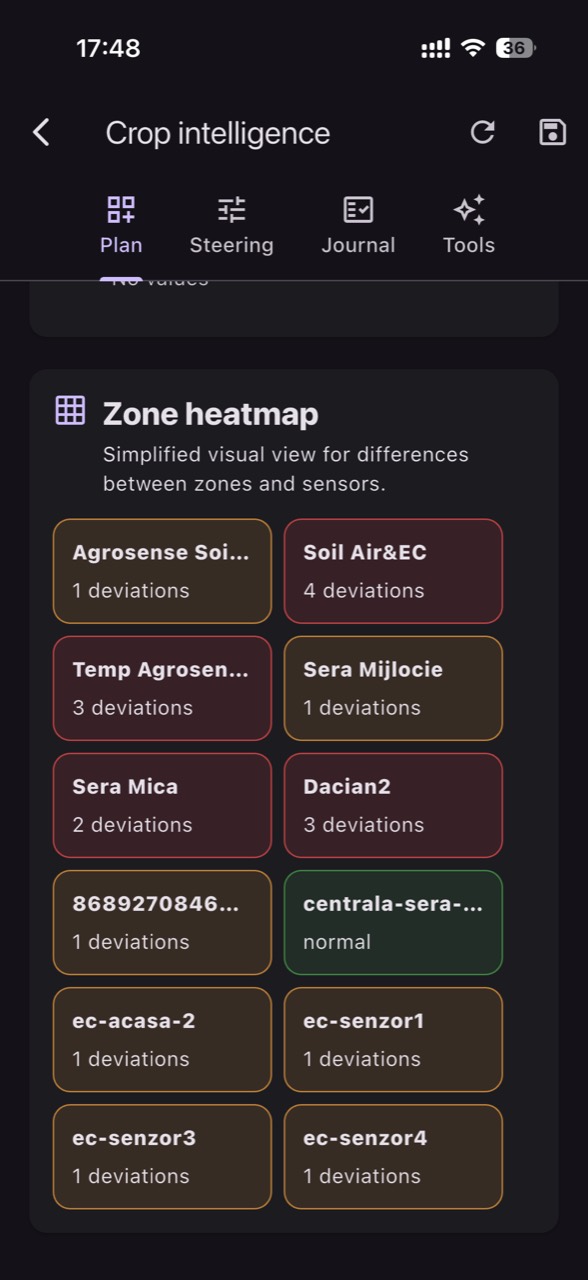
What to observe: cold-air pockets near sidewalls, drafty zones that dry fast, and central benches that stay wetter. What to verify independently: basic calibration sanity checks (co-locate two identical probes for a few hours), placement (not against hot/cold pipes, not in direct spray), and reported units (°C, %RH, mS/cm, etc.). Practical decision: define 2–4 seedling zones (hypothetically: near door, center, north side, south side) and interpret them separately; confirm reduced non-uniformity when zone curves move closer after adjustments.
7) Commissioning and useful alerts: fresh data, robust thresholds, no “panic”
Good data is fresh and comparable. Before making decisions, check latency: if updates are rare or intermittent, you can end up reacting to a past event. Then define thresholds as risk bands rather than “magic numbers.” With seedlings, thresholds should be built from crop observation: when stretching starts, what is happening in the temperature/VPD/substrate-moisture graphs? Tune thresholds until alerts correspond to moments when intervention is genuinely needed, not to harmless minute-to-minute noise.
What to observe: frequent alerts that do not match crop reality—or the opposite, crop problems with no alert. What to verify independently: a short operations log (irrigation, venting, shading, transplanting) and a daily inspection of 10–20 “check” trays across zones. Practical decision: in GrowGuard, set zone-based alerts for persistent deviations (for example, one zone staying much wetter than others, or VPD rising sharply right after transplanting), not for brief fluctuations; confirm usefulness when an alert leads to an action and to a measurable correction within hours.
8) The verification loop: from decision back to plants, not just charts
Every intervention must be “closed” by checking the outcome on the crop. If you reduce irrigation in a zone to slow stretching, check after 24–48 hours not only average moisture but distribution: did some cells become excessively dry? If you change ventilation to lower VPD, also check for side effects: increased morning condensation or extended wet-leaf periods. With watermelon seedlings, stress shows quickly in growth rhythm and turgor, so feedback should be fast and practical.
What to observe: stem firmness, leaf color, leaf angle, and the speed at which new leaves appear after transplanting. What to verify independently: occasional destructive checks (hypothetically one plug per zone) to see whether roots colonize uniformly and whether anaerobic patches exist. Practical decision: keep one “reference zone” stable as a baseline, and adjust only one variable at a time in problem zones. Confirm by convergence of plant appearance across zones and reduced growth gaps without pushing the crop.
Conclusion
Stretching and transplant stress in greenhouse watermelon seedlings drop when you treat the nursery as a set of microclimates, not a single space. Understand the mechanism (too little energy relative to temperature, overly constant water, unsuitable VPD after transplanting), observe early symptoms, verify independently through tray weights, substrate extracts, and zone comparisons, then make local decisions and confirm effects on plants.
If you use GrowGuard, use it to compare zones and receive alerts only where deviation persists and has consequences for seedlings—not to chase “perfect numbers.” A short invitation: start with 2–4 zones, keep an operations log, and run one week of consistent checks; you will quickly see what triggers stretching in your greenhouse and how to correct it without moving stress elsewhere.