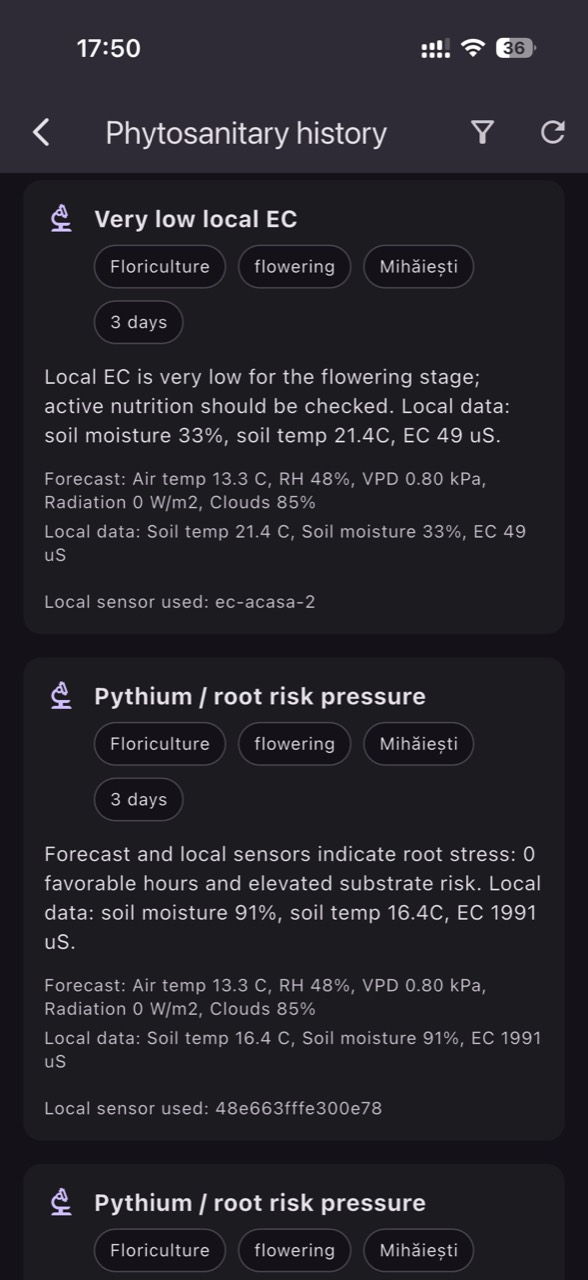
In berry and fruit shrub plantations (blackberry, currant, gooseberry, aronia, sea buckthorn), differences between zones are often larger than they look from the row end. Mulched rows, drip irrigation, variable soil textures, and wind exposure create “islands” of moisture or stress. Alternating dry–wet periods hits growth, fruit size, and disease sensitivity directly.
Microclimate matters as much as water. Dense canopies, high relative humidity, and extended wet-leaf periods can lengthen the window in which pathogens can establish. A sensor does not see a pathogen, but it can show whether conditions were conducive. In the field, the difference between a night with persistent dew and a dry night can justify a completely different scouting strategy.
The article below explains fundamentals and a commissioning workflow: how to divide the plantation into zones, what sensors to choose, how to install them so they don’t mislead you, how to set useful alerts, and how to independently verify what the data suggests. Examples are explicitly hypothetical, to illustrate practical decisions without imposing fixed recipes.
1) Why “by zone” is the rule in shrubs, not the exception
In shrubs, roots are relatively shallow and active in the layer where aeration changes quickly. In mulched rows, evaporation drops, but infiltration can become uneven if mulch thickness varies or if soil is compacted along machinery tracks. With drip irrigation, a single low-flow segment can enter stress fast even if the rest of the plantation still looks “fine” at a glance.
What to observe: uneven vigor, foliage color differences, smaller fruit in specific segments, ponding after rains. What to verify independently: irrigation uniformity (flow/sector, filters, row ends), soil texture, and local slope. Practical decision: define 3–4 representative zones (good vigor, weak vigor, fast water loss, water accumulation). How to check results: compare soil moisture and soil temperature evolution between zones after the same irrigations and rainfall events.
2) Choosing sensors: what each one measures—and what it cannot tell you
For shrub irrigation and microclimate, value comes from combinations: soil moisture (volumetric or tension, depending on sensor type), soil temperature, air temperature and relative humidity (from which VPD can be estimated), plus a leaf-wetness sensor where dew and fog are frequent. Important boundary: a temperature sensor does not measure EC or pH; those require dedicated probes and a clearly defined sampling method.
What to observe: trends, not isolated numbers—how the soil responds to irrigation and how it dries between events. What to verify independently: the EC measurement method (irrigation water/fertigation solution, substrate extract, soil extract, or bulk soil) and that you are not comparing unlike measurements. Practical decision: pick sensors based on the problem you need to solve (irrigation uniformity, ponding risk, heat stress, wet-leaf duration). How to check results: correlate charts with field observations and a spot manual check of soil moisture at the sensor location.
3) Correct placement in mulched rows: depth, distance, and typical errors
In shrubs, the “active root zone” is not a fixed point, and drip irrigation creates a wetting bulb. A sensor placed too close to a dripper can read “good” almost all the time, while one placed in the alley can read “bad” almost all the time. A useful protocol is to choose a representative distance from the drip line and set depths based on where roots actually function, not only on planting depth.
What to observe: after irrigation, moisture should rise quickly in the upper depth and more slowly deeper down; if it does not rise at all, either water is not reaching the point or installation is wrong. What to verify independently: firm sensor–soil contact (no air gaps), position relative to mulch, and documented burial location. Practical decision: install paired depths in the same zone (for example, shallow and deeper) to see whether you irrigate “only the surface” or achieve real recharge. How to check results: dig a small verification pit after a hypothetical irrigation and confirm the moisture profile.
4) Commissioning: validate the data before changing irrigation
Commissioning means proving that sensors respond logically to real events and that the data is fresh. For shrubs, the best tests are a controlled irrigation (short, then longer) and a rainfall event, followed over 24–48 hours. You look for delay, amplitude, and recovery. If a zone reports the same values for hours, it may be an installation, battery, or connectivity issue—not a “perfectly stable” soil.
What to observe: the “irrigation signature”—a rise followed by a gradual decline; the “rain signature”—often more uniform and sometimes slower under mulch. What to verify independently: reporting time (data freshness), displayed units, and correct sensor-to-zone assignment. Practical decision: before setting thresholds, establish a baseline—7–14 days of history to see each zone’s drying rhythm. How to check results: repeat the test after an intervention (for example, cleaning a filter) and confirm the signature returns to normal.
5) Irrigation workflow: turning graphs into decisions without an irrigation “template”
In shrubs, the practical goal is to avoid large swings: roots that are alternately suffocated and thirsty. Instead of imposing a fixed schedule, use data to decide timing and duration so recharge is sufficient while aeration is maintained. Mechanism: on heavier soils, excess water persists and reduces oxygen; on lighter soils, water is lost quickly and heat stress and water stress can appear in the same day.
What to observe: how fast moisture drops after irrigation and whether the deeper depth recharges; if not, very short irrigations may only “touch” the surface. What to verify independently: real sector flow, possible clogging, and whether mulch hides leaks or line breaks. Practical decision: adjust duration first, then frequency, and only in the zones that need it (for example, the zone that enters stress first). How to check results: compare two consecutive hypothetical cycles and track whether swing amplitude decreases and whether plants recover turgor during critical hours.
6) Canopy microclimate: VPD, humidity, and heat stress
Berry shrubs often form a “tight” microclimate between rows, especially when the canopy is dense. High humidity and moderate temperatures can reduce evapotranspiration, but they can also increase wet-leaf duration (dew, fog, light rains). VPD calculated from air temperature and RH is an estimate; the leaf can be cooler or warmer than the air, especially under direct sun or during clear nights.
What to observe: nights near saturation, mornings with slow drying, and days with high VPD that accelerate water use. What to verify independently: local conditions—wind exposure, shading, proximity to shelterbelts, and edge-versus-interior differences. Practical decision: if the microclimate signals heat stress risk (high temperature with dry air), prioritize irrigation windows when plants can use water efficiently; if it signals persistent moisture, reduce factors that keep leaves wet (for example, canopy density and air circulation management). How to check results: monitor whether extreme-humidity periods shorten and whether canopy temperature variation becomes less aggressive.
7) Disease-risk alerts: how to use them without confusing them with diagnosis
Foliar diseases and fruit problems are influenced by combinations of humidity, temperature, and wet-leaf periods. Microclimate-based alerts indicate “favorable conditions,” not the presence of a pathogen, and they do not replace diagnosis. Pathogens can be introduced or maintained by plant debris, planting material, or irrigation water, so you can have favorable conditions without disease—or disease that appears later after a risk window.
What to observe: repeated wet-leaf episodes, persistent night humidity, and high foliage density in vigorous zones. What to verify independently: targeted scouting (leaf undersides, inside the bush), work history, and potential inoculum sources (debris, weeds, ditches). Practical decision: use the alert to trigger a routine—zone-based inspection, comparative photos, and phenology notes; in GrowGuard you can correlate microclimate history with field observations, and a hypothetical example is prioritizing the zone with the slowest drying. How to check results: after cultural interventions (airflow via pruning, debris removal), track whether wet-leaf duration decreases in that zone.
8) Linking water quality and nutrition: EC/pH limits and avoiding wrong conclusions
In fertigation plantations, it is tempting to draw conclusions from EC/pH alone, but the measurement medium matters. Irrigation-water EC is not the same as fertigation-solution EC, and neither is the same as a soil extract; each describes salts and availability differently. EC does not identify individual nutrient concentrations, and a single-point pH does not describe the whole profile. On-site monitoring complements, not replaces, laboratory water analysis and its interpretation.
What to observe: gradual EC drift in one zone, differences between row start and row end, or different plant responses to the same fertigation program. What to verify independently: correct sampling (water, solution, extract) and consistent method, plus checking dosing equipment and filtration. Practical decision: if you suspect salt accumulation in a zone (hypothetically, on heavier soil), investigate irrigation uniformity and drainage before changing the recipe; only calibrate alert thresholds after you have comparable history. How to check results: confirm with a second measurement using the same method and by plant response (vigor, foliage, uniformity).
Conclusion
A monitoring system becomes useful when you treat it as a verification instrument: mechanism (water–air–root), field observations, independent checks, and a decision followed by confirmation in the data. In berry shrubs, the key is zoning: where stress appears first or where water stagnates is what drives quality and disease pressure, not the plantation “average.”
If you want to bring order to installation, commissioning, and zone-based alerts for shrub plantations, you can use GrowGuard as a single place to visualize sensors alongside history and forecast, then validate every conclusion in the field. Invite your team to work with the same zones and the same checks so decisions stay consistent season after season.