Blueberries are a “sensitive” crop not because they need constant interventions, but because their shallow root system reacts immediately to small mistakes: pH drifting too high, water that carries too many dissolved salts, repeated dry-downs, or—on the other end—cold, saturated pockets. The effects show up in growth uniformity, vigor, and ultimately fruit quality.
In blueberry plantations in field soil, containers, or mulched rows with acidic substrate, the main challenge is stability: keeping an aerated, acidic root environment that stays evenly moist without turning stagnant. That means treating soil or substrate as a living “root volume” that changes day by day, not a block you irrigate on a calendar.
A sensor-based monitoring system helps only when it is commissioned correctly: you choose what to measure (and in which medium), place probes in the actual root volume, and set alerts based on how your site behaves. The article below explains the mechanisms, independent checks, and a practical commissioning workflow, with hypothetical examples.
1) Why pH controls blueberry nutrition—and how to confirm the real cause
Blueberries favor an acidic environment because soil chemistry and root activity in low pH conditions support nutrient availability and uptake. When pH drifts upward, certain elements become less accessible, and the plant may show deficiency-like symptoms even when fertilizer has been applied. What to observe: paler leaves, weak new growth, and uneven development between zones. What to verify independently: a soil test before planting and, during production, periodic pH measurements in the root zone—not only in irrigation water.
The practical decision is not “add more fertilizer,” but to confirm whether the issue is reaction (pH) or supply (nutrient input). Keep measurement media clearly separated: irrigation-water pH, fertigation-solution pH, and substrate/soil pH are not the same measurement. After a management correction (for example, fertigation adjustments or maintaining substrate acidity), verify results through trends: pH stabilizing in the root zone and more even growth over the following weeks, not a dramatic overnight shift.
2) Constant moisture without waterlogging: mechanism, symptoms, and zone control
Blueberry roots sit shallow and need oxygen in the root zone; that is why both drying and excess water are harmful. A “dry–then overly wet” cycle stresses the plant and reduces uniformity. What to observe: shoot tips stalling after a hot day, midday wilting despite irrigation, or—conversely—slow growth and darker foliage in cooler, wetter patches. What to verify independently: quick field checks of soil/substrate condition (structure, smell, aeration) and drainage confirmation in containers or along mulched rows.
The practical decision is to move from calendar irrigation to irrigation based on moisture dynamics in the root volume. A soil/substrate moisture sensor shows depletion and recovery after irrigation, but only if it sits in the active root zone, not pressed next to the dripper just to “see fresh water.” Verify the result by comparing: (1) how fast moisture drops between irrigations, (2) how it rises after irrigation, and (3) whether it stabilizes without sharp peaks that suggest localized overwatering or pockets that stay cold and saturated.
3) EC and salinity: what EC measures, what it doesn’t, and why blueberries care
EC (electrical conductivity) indicates dissolved salts and is useful for tracking salinity risk, but it does not tell you which nutrient is lacking or excessive. In blueberries, elevated root-zone EC can make water uptake harder and intensify stress on hot days. What to observe: leaf-edge burn, slowed growth, plants that “don’t pull” even when moisture looks acceptable. What to verify independently: a water-quality analysis (including pH, alkalinity, and soluble salts) and strict separation of EC measurements—EC in source water, in fertigation solution, in a substrate extract, or in bulk soil are different measurements and are not directly comparable.
The practical decision is to identify where salts accumulate: incoming water, the fertigation system, or the root zone due to insufficient irrigation/difficult drainage. Monitoring EC with a dedicated soil/substrate probe, interpreted alongside moisture, helps you see whether EC spikes follow fertigation events or develop during dry-down periods. Verify results after adjustments (for example, changing water strategy, irrigation scheduling, or fertilizer application method) through trends: a more stable EC pattern and the disappearance of persistent increases in the root zone. Remember: a temperature sensor cannot measure EC or pH—those require dedicated probes.
4) Soil temperature and “cold spots”: why they happen and how to catch them early
In blueberry plantings—especially with mulch layers or variable soil textures—“cold spots” can develop where water moves slowly and roots stay longer in a cool, wet environment. That increases root stress and can open the door to rot issues and higher disease pressure without any obvious flooding. What to observe: delayed spring start in certain stretches, smaller plants, foliage that stays wet longer in the morning. What to verify independently: inspect the mulch layer, soil structure, possible compaction, and exposure differences (wind, shade, sun).
The practical decision is to manage by microzones rather than averages. A soil-temperature sensor paired with moisture helps separate causes: the same moisture level at different temperatures can have different impacts on roots. Verify results after interventions (for example, improving local drainage, adjusting mulch, or changing irrigation duration/interval) by comparing curves: the cold/wet zone should return faster to a more aerated pattern, and the temperature gap versus the representative zone should shrink during critical periods.
5) Sensor selection and placement: three points that can save a season
In blueberries, the most useful starter configuration is three locations: one “representative” point, one that dries first (often lighter soil, a more exposed area, or the end of a line), and one that is cooler/wetter (a depression, heavier texture, or shaded zone). The mechanism is simple: the crop reacts to extremes, not averages. What to observe: differences between rows or even within a single row. What to verify independently: your real irrigation distribution (pressure, uniformity), not only the design plan, plus a manual check of the active root volume at each point.
The practical decision is to place probes in the “real root volume”: at the depth and distance where roots are active, not where installation is merely convenient. In containers, that means where roots actually colonize the substrate—avoiding pot walls where heating/drying differs. In field soil, avoid fixing the probe right beside the dripper just to get a fast response. Correct placement shows up in data: after irrigation, moisture rises in a plausible way and then declines naturally, rather than staying artificially high or oscillating erratically.
6) Commissioning workflow: from “installed” to “data that decides” in 7 steps
Commissioning means proving sensors measure the right thing, in the right place, at a useful interval. Step 1: define units and the measurement medium for each parameter (moisture in soil/substrate, pH/EC in the root zone, air/soil temperature). Step 2: record an initial field reference (a manual spot check or standardized observation). Step 3: check data freshness and “plateaus” (stuck values). Step 4: run a controlled irrigation test—start a short cycle and watch moisture respond; a poorly placed sensor either barely reacts or overreacts.
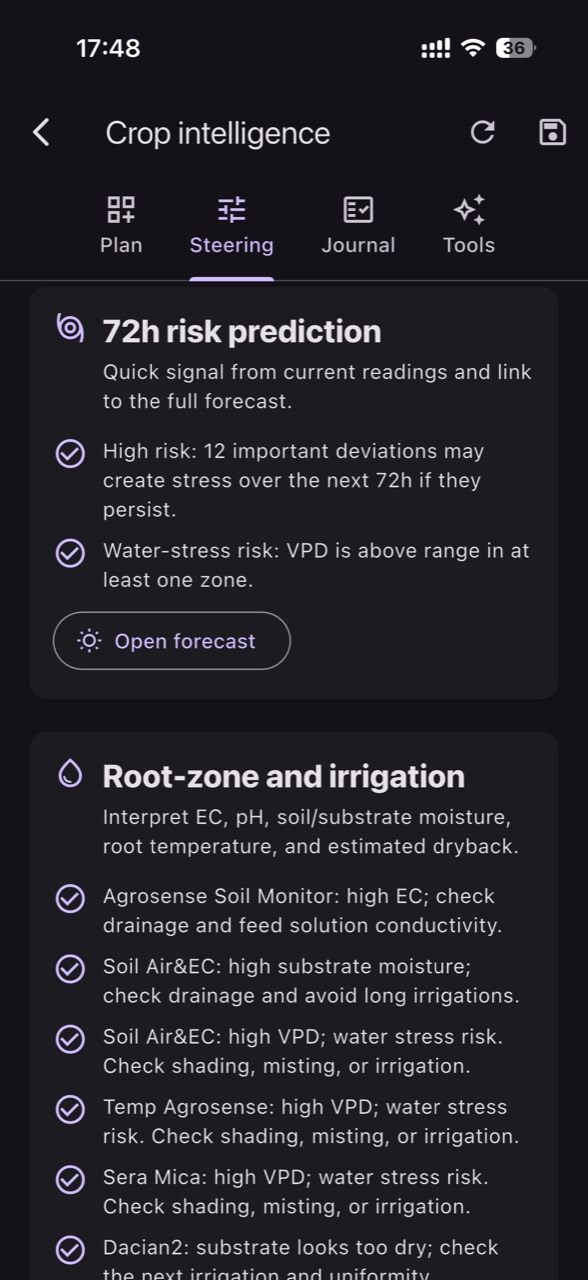
Step 5: correlate parameters: when moisture rises, EC may temporarily drop by dilution; when moisture falls, EC may rise by concentration. Step 6: set alert thresholds from your local history, not from “universal values”—for blueberries, avoiding repeated departures from a stable root environment matters, and thresholds must be field-validated. Step 7: define a response protocol: who checks, what they verify independently, and what decision they make. In GrowGuard, alerts can be set by zone to support consistent reactions; you verify success when you see fewer “false” alerts and more field-confirmed interventions.
7) Useful alerts for blueberries: frost, heat waves, and critical periods
In blueberries, weather risks amplify root-zone problems: a heat wave increases water demand, while a cold night prolongs wetness and soil cooling. What to observe: afternoon wilting on hot days even if the plant looked fine in the morning, or stagnation after cold nights in wetter zones. What to verify independently: local forecast and plantation microclimate differences (edges, depressions, exposed areas). An air temperature and humidity sensor lets you estimate VPD, but keep in mind VPD is calculated from air temperature and relative humidity; leaf temperature can differ, so use it as an indicator, not an absolute truth.
The practical decision is to tie each alert to a verifiable action: for frost risk, check low-lying zones and decide targeted measures; for heat, check whether root-zone moisture depletion accelerates and adjust irrigation timing/intervals. In GrowGuard, forecast context plus history helps you see whether a weather event coincided with deviations in moisture or EC. Verify the result after the event: compare zone curves and note where intervention reduced stress amplitude (for example, moisture declining more slowly in the zone that typically dries first). Disease-risk alerts, where used, indicate favorable conditions—they are not pathogen detection.
8) Common failure cases: separating a crop problem from a measurement problem
In practice, many wrong decisions start with non-comparable measurements or poorly installed sensors. A typical case: you irrigate “by calendar,” then see a moisture value that looks good, but the probe sits beside the dripper and does not represent the root volume; plants still suffer between events. Another case: you compare EC in source water with EC in soil and wrongly conclude “there is no salinity issue.” What to observe: data that looks perfect while plants do not. What to verify independently: physical field checks (dig, assess drainage and root condition), a spot measurement with a handheld instrument, and laboratory water testing for pH, alkalinity, and salts as a baseline. On-site pH/EC monitoring complements lab analysis; it does not replace it.
The practical decision is to introduce a short audit routine: (1) confirm data is fresh and shows real variation, (2) compare the three sensors (representative/dry-first/cold-wet) and look for plausible divergence, and (3) validate an alert in the field before changing a fertigation recipe or irrigation strategy. If an alert repeats without confirmation, treat it as a potential installation problem or sensor drift. In GrowGuard you can also set status/battery alerts, useful so missing data isn’t mistaken for “stability.” Verify the audit by fewer unnecessary interventions and tighter correlation between sensor trends and field observations.
Conclusion
Blueberries reward consistency: an acidic pH maintained in the root zone, stable moisture without waterlogging, and salinity kept under control. The key is separating measurement media correctly (water, solution, soil/substrate), placing probes in the actual root volume, and validating each alert with an independent check. That is how you avoid reflex reactions and build a more uniform crop.
If you want an orderly start, treat the first weeks as commissioning: controlled irrigation tests, thresholds derived from your own history, and a simple audit routine. A monitoring platform such as GrowGuard can make zone-based alerts more consistent, but the real value comes from your interpretation and verification protocol. If you’re planning a new deployment, a short project discussion can clarify which sensors matter and where to place them.