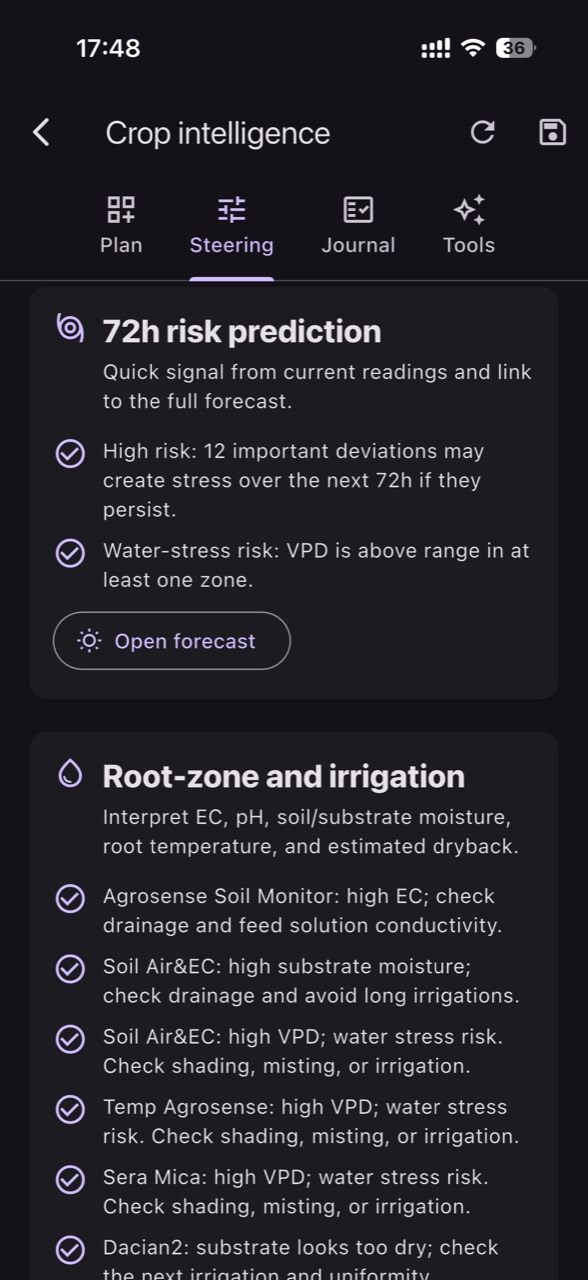
Cabbage, cauliflower, broccoli and other brassicas have a relatively short window in which they “build” size and quality. That’s why small differences in microclimate or root-zone moisture can change crop rhythm: slowing down, uneven growth, cracking, higher disease risk, and a harvest that no longer matches the plan.
Sensors help, but brassicas often produce misleading readings: a probe installed next to a dripper or in compacted soil can report “too wet” or “too dry” without representing the active roots. On top of that, the same number can mean something different in another soil type, another bed, or a wind-exposed area.
This article is a diagnostic guide: how to choose measurement points, define crop zones, and compare microclimates correctly, so you can distinguish a real problem (water, drainage, irrigation distribution, stress) from an issue of placement, units, or equipment function. The examples are hypothetical and must be adapted to your farm.
1) Why brassicas amplify soil-reading errors
Brassicas demand continuity in uptake: repeated wet–dry swings can break growth rhythm and create uneven stands. Their roots are also sensitive to low oxygen; a soil that looks “fine on moisture” can still be too compacted or poorly drained. That is the trap: a sensor may indicate adequate water while the plant is stressed because aeration is poor, not because moisture is low.
What to observe: midday wilting, slow evening recovery, “stepwise” growth, heads that stay small, or cracks after heavier irrigations. What to verify independently: dig with a spade to inspect structure (porosity and any anaerobic smell), check infiltration after irrigation, and assess irrigation uniformity. Practical decision: adjust irrigation points or drainage, then confirm within 24–72 hours through steadier trends and a more uniform look in new leaves.
2) Correct sensor placement: depth, distance, and the “root volume”
In cabbage and brassicas, the sensor must represent the active root zone, not a convenient corner of the bed. A common mistake is installing too close to the drip tape: water pulses locally saturate soil and readings look “perfect,” while roots between rows may still struggle. Another mistake is installing too deep, where water arrives less often and values suggest “drought” even when the explored layer is moist.
What to observe: readings that swing sharply after irrigation but plants don’t change accordingly—or the opposite. What to verify independently: mark the wetted zone after an irrigation (a small side profile cut), compare it with root architecture, and place the probe near the edge of the wetting bulb, not at its center. Practical decision: relocate the sensor or add a second “control” point; success shows up as better correlation between the trend and crop condition.
3) Crop zones and microclimates: comparing without fooling yourself
In open field or tunnels, brassicas live in different microclimates: row ends, wind-exposed edges, shaded portions, and areas with different soil texture. One “average” probe can hide extremes that later become non-uniformity at harvest. Proper comparison starts with zoning: same variety, same planting date, same irrigation scheme, but distinct soil conditions or exposure that justify separate interpretation.
What to observe: one zone lags behind; smaller plants appear near field margins or close to a drainage channel. What to verify independently: check topography (a small slope changes runoff), texture differences (sandier versus heavier soil), and traffic history (compaction on equipment paths). Practical decision: manage the zone, not the field average (for example, sector irrigation or improve drainage). Check the result: the gap between zones narrows in both sensor trend and plant uniformity.
4) Misleading moisture readings: contact errors, salts, and heterogeneous soil
Soil moisture sensors require good contact with soil. If air gaps remain around the probe, readings can appear “drier” than reality, especially after recent cultivation. In brassicas—where beds are frequently worked and hoeing is common—this failure mode is frequent. In addition, salinity (salts from soil or fertigation solution) can influence certain measurement technologies, making interpretation harder if you don’t know the sensor’s limitations.
What to observe: values that don’t rebound after irrigation, readings that appear “stuck,” or large differences between two nearby probes. What to verify independently: remove the probe, reinstall into uniformly reconsolidated soil, check whether the area is cracked or gravelly, and compare with a hands-on moisture assessment (clod behavior, sheen, consistency) at the same profile. Decision: fix installation before changing irrigation practice; confirm by the return of expected dynamics after watering.
5) Heat stress versus water stress: avoiding the wrong diagnosis
At midday, cabbage can wilt temporarily even with moist soil, due to atmospheric demand (temperature, wind, radiation). If you interpret only soil moisture, you may overwater—raising the risk of root hypoxia. An air temperature and humidity sensor helps describe demand; VPD computed from air temperature and relative humidity is an estimate, and leaf temperature can differ from air temperature, especially under strong radiation or ventilation patterns.
What to observe: wilting at predictable hours and recovery by evening, without signs of persistent dryness. What to verify independently: measure surface soil temperature, note wind conditions, and inspect whether wilting is uniform or concentrated in exposed zones. Practical decision: prioritize microclimate actions (for example, reducing heat load in a tunnel through ventilation) rather than automatically adding water. Check the result: reduced daily wilting amplitude without an increase of excessive moisture in the profile.
6) Crop rhythm: linking trends to phenology, not to “ideal values”
In brassicas, crop rhythm shows in leaf expansion, row closure, and head/curd formation. Sensors become useful when tied to phenology: the same soil moisture status may be adequate early on but insufficient once leaf mass increases and transpiration accelerates. Conversely, near harvest, excess water can increase cracking risk in cabbage or reduce harvest quality, depending on conditions. The point is not a universal target number, but a consistent local response pattern.
What to observe: a 7–10 day development pause in one zone even though “values” look similar to another. What to verify independently: compare plant density, the effective rooting depth, and whether there is a restrictive compacted layer. Decision: set thresholds and alerts based on local history and crop response, not templates. With GrowGuard you can follow zone-based trends and events (irrigation, rain, ventilation) to confirm whether the intervention restored rhythm.
7) When the problem is irrigation, not the crop: clogging, dead sector, pressure
A “dry” reading at one point may indicate a sector that is not irrigating: clogged drippers, insufficient pressure, a valve that doesn’t fully open, or end-of-line losses. In brassicas—where uniformity is critical—such faults quickly translate into size differences. The trap is placement: if the sensor sits too close to the supply point, it can mask problems elsewhere on the bed, giving confidence while plants are already diverging.
What to observe: one row or corner stays smaller; soil feels drier to touch there; a “good” sensor elsewhere shows nothing. What to verify independently: do a line wetting/flow check (visual observation of wetting uniformity), and inspect filters and line ends. Decision: correct the mechanical cause before changing irrigation “recipes.” Check the result: after the fix, moisture trends rise in the affected zone and vigor differences gradually diminish.
8) EC/pH and “invisible” stress: what you measure, in which medium, and how you compare
Brassicas can suffer from both deficiency and salinity, and symptoms can resemble water stress. Here it is essential not to mix measurement media: EC/pH in source water or fertigation solution is not the same as EC in a soil extract or in bulk soil; these are different methods and do not translate directly. EC does not tell you which nutrient is missing—only the level of dissolved salts. A temperature sensor does not measure EC or pH; those require dedicated probes.
What to observe: leaf edge burn, slow growth, even when moisture seems adequate. What to verify independently: measure pH and EC separately with dedicated probes and record the medium explicitly (water, fertigation solution, soil extract). A laboratory analysis remains the reference for water and soil; on-site pH/EC monitoring complements it, not replaces it, and water, fertigation solution, substrate extraction and bulk-soil EC are different measurements. Decision: adjust fertigation practices only after confirmation, then watch 3–7 days for steadier trends and healthier new leaves; in GrowGuard you can compare risk zones to avoid general conclusions.
Conclusion
Sensors make the biggest difference in cabbage and brassicas when treated as diagnostic instruments, not as an oracle. Correct placement in the root zone, zoning by microclimate, and independent checks (soil profile, irrigation uniformity, phenology observation) sharply reduce the risk of wrong interventions. When hunting causes, start from mechanism: water, aeration, atmospheric demand, distribution, or salinity.
After every correction, confirm the outcome: sensor trends should align with crop response, not merely look “better” on a graph. If you want to track differences between zones and compare microclimates using sensor history, GrowGuard can help you ask the same questions consistently from one crop cycle to the next.