Greenhouse eggplants run on a tight “rhythm” driven by warmth and by how active the root system remains. That is why confusion is common: the air can look “fine,” yet the crop slows; or you receive humidity alerts even though leaves seem dry. Often, the answer is the gap between microclimates inside the same tunnel.
The most misleading situations are those where the sensor sees something different from what the plant experiences. A sensor mounted too high can report warmer, drier air than what surrounds the leaves, while a sensor fixed to a post near a door will “feel” cold drafts. In eggplants, these differences translate into stress, flower drop, heavy leaves, and higher condensation risk.
This guide is diagnostic by design: how to separate a real problem (microclimate, root activity, ventilation) from a wrong reading or poor installation. You will see where to place sensors by crop zone, what to verify independently, what practical decision to take, and how to confirm afterward—using both data and plant observations—that the intervention actually worked.
1) Why “good air” does not guarantee a stable eggplant crop
The core mechanism is simple: eggplants respond strongly to low temperatures in the root zone even when the canopy air looks acceptable. In spring or after cold nights, soil/substrate warms slowly; roots stay sluggish, and the plant reduces growth and fruit set. You may notice shorter internodes, stiffer leaves, flowers dropping, and delayed setting—without any obvious “shock” in the measured air conditions.
What to verify independently: compare air temperature with soil/substrate temperature in representative points using a separate probe or contact thermometer, not just one sensor. Check whether the slowdown is uniform or concentrated in specific stretches (ends, near doors, near sidewalls). The practical decision is to treat air and roots as two different systems: local heating/insulation, ventilation corrections, and irrigation adapted to root activity. Confirm the result over the next 24–72 hours: more stable root-zone temperature and morning turgor returning without a midday “collapse.”
2) Sensor placement: the difference between “measuring” and “representing”
A perfectly functional sensor can still be useless if it is poorly placed. Protected spaces develop air layers: warmer near the roof, cooler near the ground, plus localized drafts from vents and fans. For eggplants, read the microclimate in two planes: the leaf zone (canopy height) and the root zone (soil/substrate). If an air sensor sits in direct sun, on metal, or too close to film, it can overestimate temperature and underestimate relative humidity.
Checks to perform: look for abrupt jumps when a door opens, a fan starts, or sun hits a wall—signs of local influence. Confirm with a quick “walk-through” measurement using a handheld meter at 3–5 points; if differences are large, you have either real microclimates or an unrepresentative position. The decision is to move the sensor into the crop’s “breathing zone,” shielded from direct radiation, away from heating pipes, and not in contact with the structure. After relocation, track 2–3 days: curves should become smoother, and differences between points should be explainable by zones rather than random spikes.
3) Crop zones: how to define the microclimates that truly matter
In practice, a tunnel is not one climatic volume. The ends (near entrances), edge rows, areas under vents, and corners with different shading behave differently. For eggplants, small temperature and humidity differences can shift transpiration and foliar disease pressure. The mechanism is contrasting: a cooler, wetter evening zone increases leaf-condensation risk; a hotter, drier midday zone increases water stress and marginal scorch.
What to observe and verify: compare two hypothetical zones in parallel—for example “center of the tunnel” versus “north end.” Record row-level symptoms: vigor differences, glossier versus duller leaves, aborted flowers, foliar spots. Verify independently with early-morning leaf inspection: if one zone’s leaf feels wet/cold to the touch, you have a risk-prone microclimate. The practical decision is to manage zones separately: targeted ventilation, local screens/shading, or sectional opening strategies. Confirmation comes when zone differences shrink and symptom distribution no longer consistently “tracks” the same area.
4) Relative humidity vs. condensation: why alerts can feel contradictory
High relative humidity does not automatically mean water on leaves, but it increases the chance that cooling will reach the dew point and produce condensation. Eggplants have large leaves and a dense canopy that can trap humid air inside, even if aisle-level air feels drier. The mechanism is evening dynamics: temperature can drop faster than absolute moisture content, and if canopy air is not refreshed, a thin water film forms on leaves and flowers.
What to verify independently: very early in the morning, inspect the underside of leaves and the flower area; look for fine droplets, not only obvious wetness. Also check the film/structure: condensation on the cover is a clue that dew point is being reached somewhere. The practical decision is to manage transitions, not just numeric values—brief, controlled ventilation before the night cool-down can reduce condensation if it does not crash root-zone temperature. Confirm by a shorter visible wetting period and fewer persistent-humidity alerts, without a slowdown in growth.
5) VPD: useful for diagnosis, but it is an estimate (and the leaf may “tell a different story”)
VPD calculated from air temperature and relative humidity is a strong indicator of stress direction (air too dry versus too humid), but it does not directly measure leaf temperature. In eggplants, sun-exposed leaves can warm above air temperature, while inner leaves can stay cooler; this changes local transpiration and can explain why a VPD alarm doesn’t match the feeling that “the tunnel is okay.” The mechanism: air VPD may look moderate, yet an exposed leaf can transpire hard and pull water from a slow root system.
What to observe and verify: if leaves curl slightly at midday, show edge scorch, or lose turgor temporarily—and VPD seems high—check soil/substrate moisture and root-zone temperature separately. If VPD seems low (humid air) but spots and mold appear, verify real condensation inside the canopy. The decision is to use VPD as a traffic light, not a verdict—correlate it with soil temperature, soil moisture, and scouting notes. Confirmation: after adjusting ventilation/shading, VPD becomes more stable through the day and stress symptoms appear less often at the same hours. In GrowGuard, VPD can be tracked as a derived indicator specifically to compare zones over the same time window.
6) When the chart shows a “temperature drop”: real microclimate or sensor problem?
A sudden, step-like drop can be a real event (venting, a cold draft), but it can also be an artifact: the sensor got wet, sits directly in an air jet, is mounted on a support that cools radiatively, or is nearing battery end-of-life. The error mechanism is thermal coupling: the sensor housing heats/cools faster than the surrounding air mass, so the reading reflects the mounting situation more than the crop air. You typically see rapid swings that do not match other points in the tunnel.
Verification protocol: (1) compare with a second sensor in another zone; (2) check whether the jump aligns with operations (doors, fans, vents); (3) do a spot-check with an independent thermometer next to the sensor; (4) physically inspect placement (direct sun, metal contact, moisture). The decision: if only one point “drops,” treat it as a measurement issue and fix mounting before changing climate strategy. Confirmation: after correction, the sensor curve aligns with the dynamics of other points and temperature alerts no longer appear in isolation. In GrowGuard, status/battery alerts can help separate “crop” from “equipment.”
7) Soil/substrate moisture: avoiding the trap of confusing a wet zone with a “just cold” zone
Eggplants need air in the root zone, not only water. A cold substrate can reduce uptake even if moisture appears correct; conversely, an over-wet substrate can keep roots hypoxic, and the plant may paradoxically wilt during warm hours. The mechanism is a mismatch: daytime transpiration rises, but roots cannot keep up—either due to low temperature or lack of oxygen. This often triggers the wrong response: “irrigate more,” when the real need is root-zone warming and better aeration/drainage.
What to verify independently: use a dedicated soil/substrate moisture sensor (in the units specific to that sensor) plus a hands-on check (texture, smell, and if feasible, root appearance from a sacrificed plant). Check distribution by zone: one row may receive more water or drain differently. The practical decision: if moisture is high and plants still show stress, investigate root-zone temperature and drainage before automatically increasing irrigation. Confirmation: after adjustment, moisture returns to a more pulsed, uniform pattern and plants hold turgor better at midday. If you monitor in GrowGuard, zone-to-zone differences help flag abnormal sectors before they become visually obvious.
8) Useful alerts, not noise: calibrating them to your own farm
A good alert should signal a deviation worth acting on and should be comparable across zones. With eggplants, “generic” thresholds ignore season, leaf density, the type of protected structure, and soil thermal inertia. The false-alarm mechanism is common: overly tight settings or infrequent reporting can turn normal fluctuations (for example, short venting events) into “incidents.” On the other hand, overly wide thresholds miss the short windows when condensation forms or when roots stay too cold after a night.
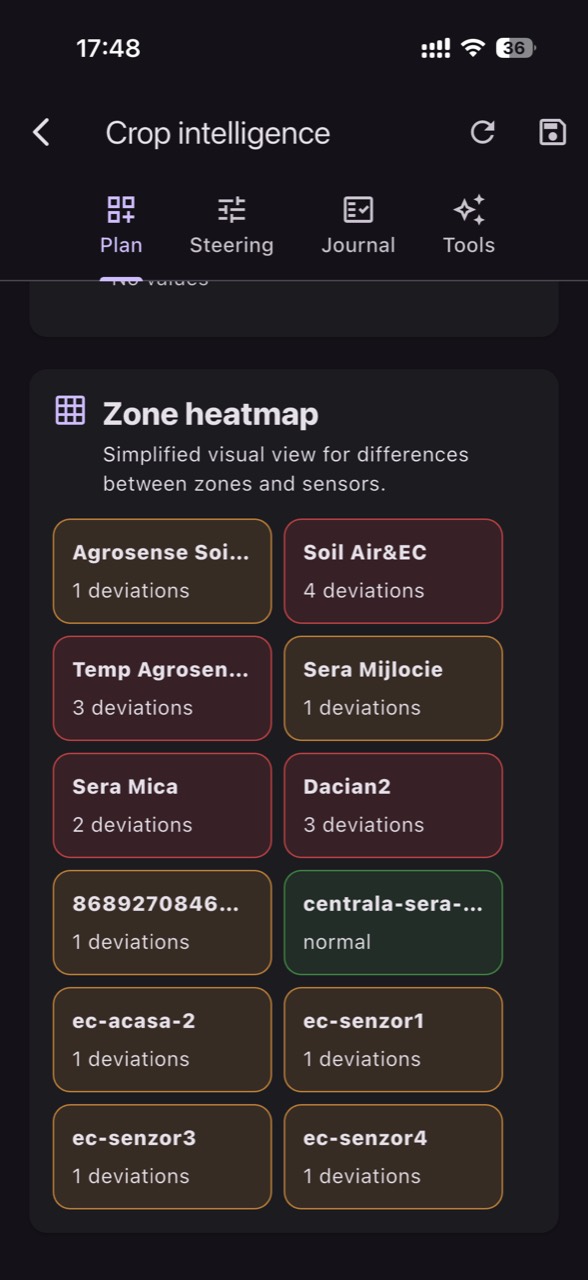
A practical protocol: first establish a reference period (for example, 7–14 days) during which you correlate charts with crop observations—wet leaves in the morning, midday wilt, flower abortion, end-of-tunnel differences. Then set thresholds by zone, not just per structure, and verify data freshness (when the sensor last reported) so you don’t react to delayed information. The decision: when an alert appears, apply one clear intervention (ventilation, shading, a work-timing change), then track the effect over the next 24–48 hours. In GrowGuard, alerts on temperature/humidity/VPD and zone comparison support this discipline, but they do not replace in-crop inspection.
Conclusion
Eggplant stability comes from measuring what matters, where it matters: air at leaf level, roots in soil/substrate, and the real differences between crop zones. Most confusion happens when a single value is treated as “the truth” and microclimate inside the canopy—or the soil’s thermal inertia—is ignored. Once the mechanism is clear, interventions become smaller, faster, and easier to verify.
If you want fewer misleading alerts, start with a simple routine: independent confirmation, zone-to-zone comparison, one change at a time, and checking the result in both data and plants. For teams running multiple tunnels, zone-based monitoring and history in GrowGuard can make it easier to see where the microclimate is truly problematic and where the issue is simply an unrepresentative reading. If you’d like, I can help outline a zone-and-sensor check plan specific to your tunnel layout.