In greenhouse or tunnel eggplant production, growth rhythm shows up in leaves and flowers, but it starts with physics: how much heat the plant receives and how easily it can transpire. When temperature drops, the root system slows down and uptake declines. When air is too dry or too hot, stress rises and the plant effectively “closes the tap.”
Humidity is not just a number on a screen. It decides whether the leaf loses water in a controlled way or whether condensation forms on foliage, especially in the morning and evening. Repeated condensation, combined with weak ventilation, can increase foliar disease pressure and disrupt uniformity across the crop. That’s why humidity must be read together with temperature and greenhouse dynamics.
A usable workflow starts with correct measurements and alerts set on phenomena, not on “perfect values.” For eggplants, it pays to separate: canopy air, the root zone, and the weather context. Then define what you observe in the crop, what you verify independently (thermometer checks, condensation scouting, substrate feel), what decision you take (ventilation, heating, shading, irrigation), and how you confirm the result in both data and plants.
1) Temperature: the crop engine and the hidden brake in the root zone
In eggplants, air temperature influences photosynthesis and growth, but root-zone temperature determines how quickly the plant can respond to water and nutrients. In spring, after cold nights, you may see a “reasonable” air temperature by day while soil/substrate remains cold and the crop still moves slowly: stiffer leaves, delayed growth, uneven fruit set. The mechanism is straightforward: cold roots reduce uptake and can amplify stress when daytime temperatures rise abruptly.
What to watch: the gap between canopy air temperature and soil/substrate temperature, plus how fast the root zone warms after sunrise. What to verify independently: a contact thermometer in the substrate and a daily morning check of plant turgor. A practical decision may be to reduce oscillations (a minimum night temperature, gradual ventilation), not just to “raise the average.” Check the result by seeing the air–root temperature gap shrink and by a steadier response after irrigation (turgor returns without delay).
2) Humidity and VPD: why two houses with the same RH behave differently
Relative humidity (RH) describes how “full” the air is with water vapor compared with its capacity at the current temperature. That is why the same 70% RH can mean an air mass that pulls water rapidly at high temperature or an air mass close to saturation at low temperature. VPD (vapor pressure deficit) summarizes this relationship and helps you estimate transpiration driving force. In eggplants, very low VPD can indicate condensation risk and slow gas exchange; high VPD can signal dry air with water stress and, in extreme scenarios, flower abortion.
What to watch: fast transitions (after opening vents, after shading, after a cold rain outside) and periods when VPD stays “stuck” low at dawn. What to verify independently: droplets on leaves or mulch film and a “stale air” smell as a practical indicator of insufficient air exchange. The decision is to manage VPD through the temperature–ventilation combination, not only by “lowering humidity.” Check results within 24–48 hours: less morning condensation and a smoother VPD curve without repeated drops toward saturation. Note: VPD computed from air temperature and RH is an estimate; leaf temperature can differ.
3) Condensation: a microclimate problem, not simply “too much watering”
Condensation forms when surfaces (leaves, wires, plastic) are cooler than the air’s dew point. In tunnels, this often happens late in the day: the air remains humid, the film cools, water deposits, and can drip locally onto plants. In eggplants, dense canopy structure and leaf angles can hold droplets, prolonging leaf wetness. The important mechanism is that persistent leaf wetness plus weak ventilation can raise foliar disease pressure and can affect quality (spots, downgraded appearance).
What to watch: hours of high RH coinciding with temperature drops and closed vents/doors, plus differences between the ends of a tunnel. What to verify independently: an early-morning flashlight inspection for a water film on leaves and a check for dripping from structure. Decision: controlled “drying” through air exchange and/or a short heating period before cooling, and avoiding total ventilation shutoff at night. Check results by comparing how many mornings start with dry leaves and by reducing the daily duration of RH near saturation. In GrowGuard, humidity/VPD alerts can be set as condensation warnings, but they do not detect a pathogen—only a favorable context.
4) Sensor placement in eggplants: canopy air and roots can tell different stories
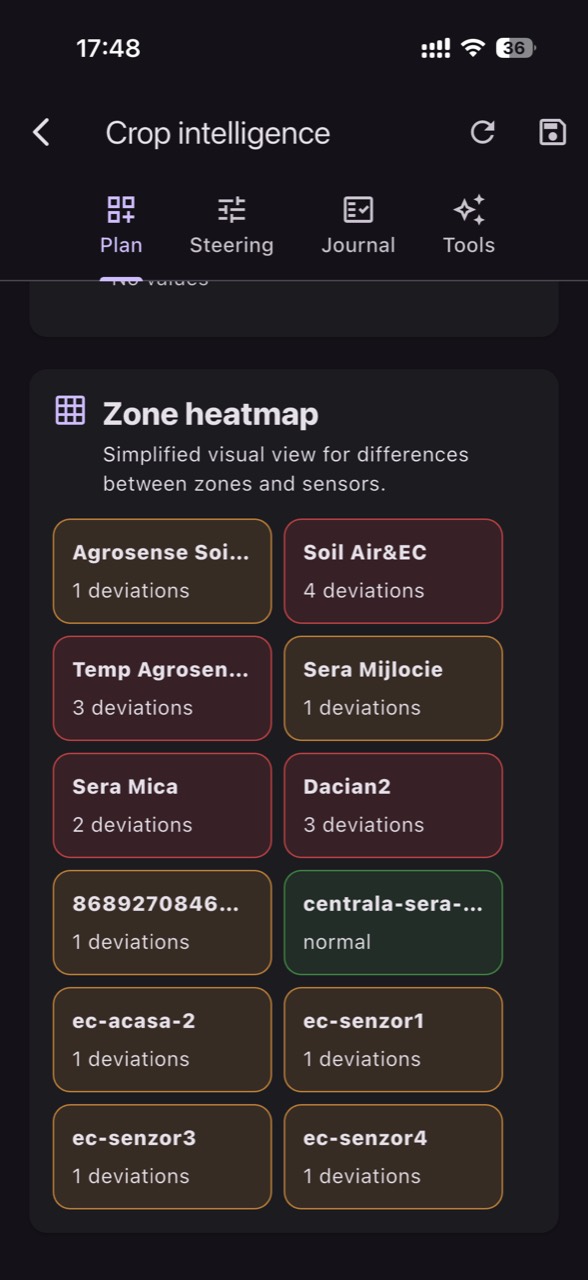
In eggplant crops, zone differences are common: near doors, along sidewalls, under vents, or in shaded strips. For that reason, a single measurement point can “look fine” and still miss a cold corner or a corridor with persistent humidity. A useful minimum sensor plan includes: air temperature, air humidity (for RH and VPD), soil/substrate temperature, and soil/substrate moisture. The emphasis for eggplants is an active root zone: if you don’t measure there, you can misread a slowed crop as an “air problem” only.
What to watch: coherence between sensors and logic (for example, if RH rises, VPD should fall at the same temperature) and stable differences between zones. What to verify independently: a weekly walk-through with a handheld thermometer/hygrometer at 3–5 points to confirm microclimates. Decision: place at least one set of sensors in the canopy at leaf level and one set in the root zone (substrate/soil), ideally in two contrasting zones. Check results in the data by identifying zones that are consistently cooler in the morning or more humid in the evening, then adapting ventilation or management by sector.
5) Sensor choice and data “freshness”: when a pretty chart can still mislead you
For day-to-day decisions, it matters how often you receive measurements and how quickly you can see changes after an intervention. In protected cropping, microclimate can shift within minutes when you open vents, start heating, or a cloud passes. If reporting intervals are too slow, alerts may come late or miss short peaks (for example, a brief episode of very dry air at midday). Units also must be understood: temperature in °C, RH in %, and VPD in kPa (or equivalent), calculated from air temperature and RH.
What to watch: “frozen” values (the same reading for too long), unrealistic jumps, and time lags between zones at moments when they should move together. What to verify independently: a handheld reading and a placement check (not pressed against plastic, not in direct sun, not in the direct blast of a heater or fan jet). Decision: choose sensors suited to the environment (air shielded from radiation, soil/substrate probes tolerant of moisture) and set a measurement frequency appropriate for climate control. Check results with a simple commissioning test: open vents for 10–15 minutes (hypothetically) and confirm temperature/RH/VPD respond coherently and promptly. In GrowGuard you can follow readings live and receive alerts, but decision quality still depends on installation and reporting interval.
6) Useful alerts for eggplants: build them around events, not “ideal values”
The most useful alerts describe an operational risk: a prolonged cold night, a sudden transition to dry air, a long period of near-saturated air, or large differences between zones. For eggplants, thresholds are best designed with duration (for example “below X for Y time”) and combinations (temperature + RH → VPD, or canopy temperature versus root-zone temperature). Avoid alerts that trigger on every normal fluctuation; otherwise the team ignores them and you lose the rare, important signal.
What to watch: alerts that coincide with early symptoms (soft leaves at midday, slow growth after a cold night, morning condensation) and alerts that appear with no visible effect (possible “false alarms”). What to verify independently: an intervention log (when you ventilated/heated/watered) and a short inspection of the flagged zone. Decision: adjust thresholds based on your own greenhouse history and technical guidance for your cultivar and system—don’t copy universal settings. Check results after 2–3 weeks: fewer useless alerts, but a higher share of alerts that lead to justified action and improved crop uniformity.
7) A commissioning workflow: from installation to repeatable first decisions
A practical commissioning protocol has four steps. (1) Position validation: the air sensor at leaf level, protected from direct sun and strong jets; the soil/substrate sensor in a representative volume, not beside a dripper and not at the edge. (2) Plausibility validation: similar values among nearby sensors and logical responses to interventions. (3) Zone definition: at least “cool/wet zone” versus “warm/dry zone.” (4) Event-based alerts (cold night, condensation risk, dry air) with a minimum duration filter.
What to watch: the first 7–10 days of data to capture the day/night cycle and 1–2 distinct weather situations. What to verify independently: a “map” of drafts (where you feel airflow near vents) and cold surfaces (structure, film). Decision: before optimizing irrigation or fertilization, fix climate consistency by zones; otherwise you will compensate for climate with water and create new risks. Check results with a short audit: compare zone curves, see whether differences shrink after ventilation/shading tweaks, and confirm in plants—fewer midday stress peaks and a more uniform morning start. GrowGuard can support this via zone visualization and history, but commissioning remains a technical step you cannot skip.
8) Linking microclimate with irrigation and salinity: don’t confuse media and measurements
In eggplants, an unbalanced microclimate can push growers to “repair” with irrigation: under dry air, transpiration rises and it seems the plant demands water; under very humid air, transpiration drops and substrate stays wet longer. That’s why irrigation must be read together with substrate moisture and root-zone temperatures. If you also use EC/pH, keep measurement differences clear: EC in water, EC in fertigation solution, EC from a substrate extract, and bulk-soil EC are different measurements and are not directly comparable. A temperature sensor does not measure EC/pH; dedicated probes are required.
What to watch: whether substrate moisture drops rapidly after a high-VPD day, and whether after a humid period the substrate remains excessively saturated. What to verify independently: irrigation uniformity across rows (drip consistency) and, when relevant, water analysis or on-site pH/EC checks as complementary monitoring rather than a replacement for laboratory analysis. Decision: adjust climate first (shading/ventilation/temperature), then refine irrigation in response to real demand, by zones. Check results by stabilizing substrate moisture curves and reducing episodes of midday wilting or “lazy roots” after cold nights. In GrowGuard you can set separate alerts for substrate moisture and for VPD so you can see clearly whether the driver is “demand” (air) or “supply” (root zone).
Conclusion
A stable eggplant crop in protected spaces is built by controlling variation, not by chasing a single number. Air temperature, humidity, VPD, and root-zone temperature together explain why the plant accelerates, stalls, or enters stress. The key is to understand the mechanism, verify independently (condensation, turgor, substrate condition), and link every alert to a clear decision and a check of the effect.
If you want to turn data into a team routine, start with well-placed sensors, then event-based alerts with duration filters, and review them after the first weeks. A platform like GrowGuard can support this flow with zone-based monitoring, history, and alerts, but the difference is made by your commissioning protocol and the discipline of in-greenhouse checks. For your own installation plan, begin with two contrasting zones and validate everything with a practical ventilation response test.