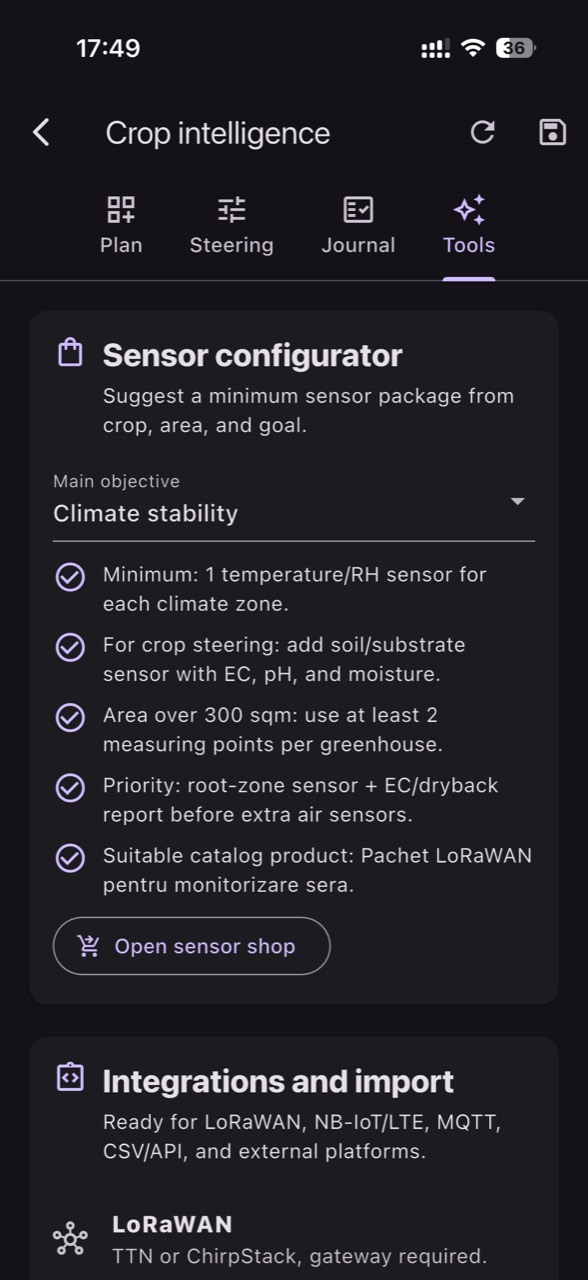
A grower who has already invested in sensors does not want to start from zero just to use a better monitoring app. Many greenhouses, orchards, vineyards and mixed farms already have LoRaWAN gateways, NB-IoT devices, MQTT controllers, soil probes or climate sensors. The right question is not whether everything must be replaced, but what can be used correctly.
Real compatibility means more than a protocol printed on a datasheet. A sensor may transmit through LoRaWAN, but its payload may contain unclear fields. An MQTT device may publish to the broker, but without consistent units. An NB-IoT sensor may work in the field, but report rarely when signal is weak. These details directly affect agricultural decisions.
GrowGuard is designed to bring useful data into one place: map, history, status, forecast and alerts. For the integration to be reliable, each device must be checked as a measurement source, not just as a product name. This guide explains how to evaluate existing sensors and decide what should be connected, corrected or replaced.
Start with the decisions you want to make
Before discussing protocols, start with the decision. Do you want to know when to irrigate, when to ventilate, where root stress appears, whether one zone remains too humid at night or whether frost risk needs inspection? Each decision needs specific measurements, suitable frequency and correct placement. A technically compatible sensor is not automatically useful for crop management.
For a vegetable greenhouse, a minimal setup may monitor air temperature and humidity, soil or substrate moisture, root-zone temperature and, when fertigation matters, pH and EC with dedicated probes. For orchards or vineyards, microclimate, soil moisture, frost and block-to-block differences may matter more. The app should serve these questions, not the other way around.
Check the protocol, but do not stop there
LoRaWAN fits situations where long battery life and wide coverage are needed, especially with a local gateway or available network. NB-IoT can work well where cellular coverage is stable and the farm does not want its own radio infrastructure. MQTT is common in automation projects, gateways, custom systems and equipment that sends data through the internet to a broker.
The protocol explains how data travels, not what the data means. That is why the payload must be checked: which field is temperature, which field is humidity, whether values are scaled, what units are used and whether the timestamp belongs to the measurement or to message reception. Without this information, an integration can display numbers correctly while interpreting them badly.
The payload is the contract between sensor and app
When integrating an existing sensor, the payload is the most important document. It shows how data is packed and how it should be decoded. Sometimes the manufacturer provides a clear decoder; sometimes the integrator must read documentation, test real messages and confirm each channel. A small decoding error can turn a useful measurement into a false alert.
For example, a sensor may send temperature as an integer multiplied by ten. If the app does not know this, 235 can be read incorrectly instead of 23.5 degrees. With EC and pH, the issue is even more sensitive because the measured medium, method and unit must be known. Good compatibility means verified mapping, not assumption.
Units and measured medium must be explicit
A moisture reading is incomplete if you do not know whether it refers to air, soil, substrate or the sensor manufacturer’s own scale. Likewise, EC may be measured in solution, drainage, substrate or soil, and values are only comparable when the method is the same. pH requires the right sample, calibration and interpretation within the crop context.
In GrowGuard, centralised data becomes useful when each channel has the correct label. Air temperature should not be mixed with soil temperature, and a climate sensor should not be presented as a pH or EC sensor. This discipline also improves alerts: a good notification should say which measurement changed, where it changed and under what conditions.
Data frequency changes decision quality
A sensor that reports every five minutes gives a different picture from one that transmits twice a day. For ventilation, frost, relative humidity or estimated VPD, reporting interval can strongly influence response. For soil moisture, the rhythm can be slower, but it still has to capture irrigation events, drying trends and differences between zones.
When checking compatibility, look at time: when the measurement was taken, when it reached the platform and how often packets are missing. A sensor that appears stable may simply be stuck on the last value. A device with rare transmissions may be good for trends but weak for fast alerts. The decision must match the real frequency of the data.
Placement remains more important than brand
Even a good sensor can produce weak conclusions when installed poorly. In a greenhouse, the edge, centre, door, fan, plastic cover and shading create different microclimates. In orchards and vineyards, slope, soil texture, wind and exposure change water and temperature patterns. A correct integration should include the exact sensor position on the map.
For soil or substrate sensors, the probe should sit in the root zone you want to understand. If it is placed too close to the dripper, it may detect the water pulse rather than root-zone availability. If it sits in an unrepresentative area, the charts may be true for that point but irrelevant for the farm decision.
Alerts should be tested before they are trusted
After a sensor is connected, the next step is alert testing. Thresholds should not be copied mechanically from one crop to another. They should be built from observation, history, technical guidance and the farm’s tolerance for risk. A temperature alert may be urgent in one context and only informative in another. A moisture alert should be read together with duration and time of day.
Phytosanitary alerts should be treated as risk signals, not as disease diagnosis. They can indicate that temperature, humidity, condensation or forecast conditions are favourable, but confirmation happens through field inspection and agronomic expertise. This difference matters for trust: monitoring should support decisions, not promise certainty that the data cannot provide.
How to run a pilot with existing sensors
A good pilot starts with few devices and clear questions. Choose a representative zone, a problem zone and, if possible, a reference point. Connect the existing sensors, check payloads, units, last transmission time and connection stability. Follow for several days how values move in relation to irrigation, ventilation, weather and visual crop observation.
At the end, classify each sensor into three groups: ready to use, usable after corrections or unsuitable for the intended decision. Sometimes the sensor does not need replacement; the decoder, position or reporting frequency needs correction. Other times it is better to add a dedicated pH, EC or root-zone moisture probe. The goal is a coherent system, not a large collection of values.
Conclusion
Compatibility with existing sensors should be treated as a verification process, not a broad promise. Protocol, payload, units, data freshness, placement and alert logic determine whether a device really helps the crop. When these pieces are clear, sensors that are already installed can become far more valuable.
For farms using LoRaWAN, NB-IoT, MQTT or their own gateways, GrowGuard can be the place where data becomes a map, history, forecast and practical alerts. The best start is a small audit of existing sensors and an integration tested against the real decisions of the crop.