In a greenhouse, “spray timing” is not a calendar date but a short window when leaves are as dry as possible, the product can reach its target, and infection pressure will not explode a few hours after application. That is why VPD and condensation risk are often more useful than relative humidity alone when you want prevention in tomatoes, cucumbers, or peppers.
A common mistake is spraying in the evening “because it’s cooler,” then entering the night with saturated air, wet foliage, and minimal ventilation. In that scenario, many foliar pathogens get exactly what they need: a water film on the leaf and enough time. Microclimate data does not confirm a pathogen is present, but it does show when conditions are favorable for infection.
If you have air temperature and humidity sensors in relevant zones, you can anticipate when condensation is likely and choose an application that is followed by a true drying period. Alerts (including in GrowGuard) become valuable when they are commissioned to reflect real, zone-based risk—not a single point that happens to look “average.”
1) Why VPD and dry leaves matter more than “high humidity”
Relative humidity (RH) alone can mislead you: 90% RH at 16°C is not the same situation as 90% RH at 24°C. VPD (vapor pressure deficit) combines air temperature with RH to describe how “thirsty” the air is for water vapor. When VPD is low, the air cannot pull moisture off the leaf, stomata respond, and water films persist—exactly what supports foliar infection and reduces the practical value of a protective spray layer.
What to observe in practice: leaves stuck together early morning, a glossy sheen on the blade, droplets on film or wires, then scattered lesions in cooler sectors. What to verify independently: differences between zones (corners, ends, near doors, along walls), accidental wetting of foliage from irrigation or leaks, and whether airflow is real inside the canopy. Decision: plan sprays so you have hours of “drying mode” afterward. Check the result by tracking shorter periods near saturation and fewer repeated condensation events after application.
2) Condensation: mechanism, signs, and how it ruins a correct application
Condensation forms when leaf or surface temperature drops below the air’s dew point. In greenhouses, this frequently happens at night: the cover radiates to the sky, cools, cools the nearby air layer, and water vapor deposits. In tomatoes, cucumbers, and peppers, wet leaves plus time equals risk—especially as canopy density increases and air stagnates within the crop architecture, where droplets can persist long after “the greenhouse looks dry.”
What to observe: droplets on the film, dripping onto plants, visible “fog” at sunrise, leaves that feel cool to the touch in peripheral zones. What to verify: whether heating/ventilation prevents stratification (warm above, cool below), and whether late irrigation sharply increases night humidity. Decision: avoid spraying ahead of a night when your in-house trend indicates dew point close to air temperature and no post-spray drying window. Check the result by comparing condensation duration before/after changes and inspecting inner foliage—not only the crop top.
3) Choosing the spray window: step logic, not a fixed hour
A useful protocol starts with three questions: (1) When does the last wet-leaf period end? (2) How long until the next likely condensation episode? (3) Can you maintain gradual drying after spraying without creating heat stress? In practice, the best window is often after plants have started daytime transpiration, but before the greenhouse enters temperature peaks that force you to close up or reduce ventilation—conditions that can trap moisture and shorten drying time.
What to observe on graphs: the shift from high RH to steadily decreasing RH, a moderate rise in temperature, and VPD moving from a “near saturation” zone toward a “drying” zone. What to verify independently: whether leaves are actually dry within the canopy; VPD calculated from air temperature/RH is an estimate, and leaf temperature can be lower than air, especially at night. Decision: define a minimum post-spray drying time (in hours) based on the product label guidance and your conditions. Check the result via uniform deposit (visible coverage without heavy runoff) and by avoiding early-night condensation in the following cycle.
4) Tomato vs cucumber vs pepper: crop differences that change timing
Tomatoes build a canopy that can be opened through pruning and leaf removal, but they are sensitive to alternations: after a warm day with higher VPD, a night with condensation can trigger issues in lower leaf layers. Cucumbers have large leaves and strong transpiration; rapid canopy thickening creates cold, humid “pockets.” Peppers can be more open at times, yet still develop local microclimates in the bush and respond to humidity/temperature stress with flower drop and abortion—raising the cost of getting timing wrong.
What to observe: in cucumbers, first symptoms often show where leaves overlap; in tomatoes, on older leaves and in areas with weak air movement; in peppers, inside the bush and on leaves closer to the substrate/soil. What to verify: canopy density, the level of aging leaves, and whether crop operations (pruning, tying) created wounds or changed aeration. Decision: synchronize sprays with crop work so you do not spray immediately after operations that increase sensitivity (wounding, stress). Check the result by seeing fewer “permanently wet” pockets and slower symptom progression in historically risky spots.
5) Sensors and placement that produce a trustworthy disease-risk signal
For spray timing, the minimum useful setup is air temperature and RH measured in multiple points, close enough to the canopy to represent the leaf environment, yet shielded from direct water jets and direct radiation effects. VPD is calculated from these two parameters, but it remains an approximation because leaf temperature can differ. This is why microclimate-based placement (cool/wet zone versus warm/dry zone) matters more than one central sensor that averages away the risk you are trying to manage.
What to observe: consistent differences between greenhouse ends, along walls, near doors, under heaters, and under the cover. What to verify independently: whether the sensor sits in an artificial “bubble” (fan stream, stuck to a cold structure, too high above leaves). Decision: use at least one representative point and one risk point (cool/wet). If you also monitor substrate/soil, do not confuse climate with root-zone chemistry: a temperature sensor does not measure pH or EC; those require dedicated probes in the correct medium (fertigation solution, substrate extract, or bulk soil). Check the result through stable, repeatable zone differences; if today the “cold” zone reads warm without a real operational change, suspect placement or airflow artifacts.
6) Alerts that help: zone thresholds, duration, and post-event validation
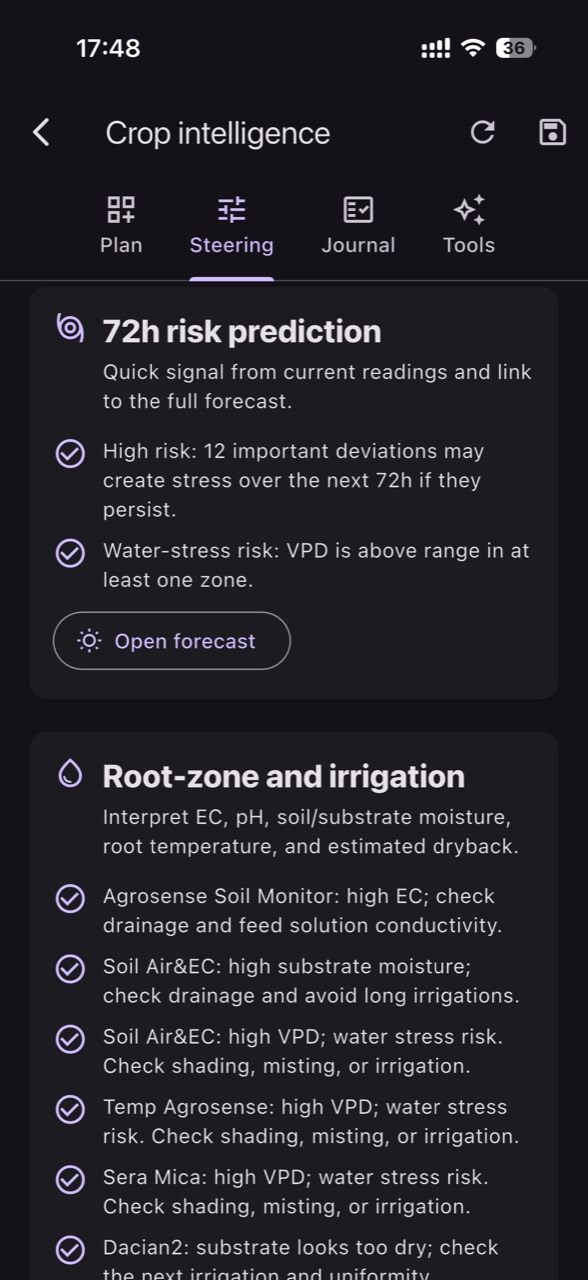
A helpful prevention alert is not a ping for every fluctuation; it is a signal that you have entered a risky combination for long enough to matter. For condensation and foliar disease risk, duration matters: a short RH spike may be less relevant than several hours close to saturation, especially inside the canopy. In GrowGuard you can set zone-based alerts for temperature, humidity, and VPD; their value comes from separating zones, not from chasing a universal setpoint that may not fit your structure, crop stage, and ventilation strategy.
What to observe: repeated alerts at the same time windows (often pre-sunrise) or in the same zones (for example, a north end). What to verify independently: physically go to the zone during the first meaningful alert and confirm—condensation on film, wet leaves, stagnant air. Decision: tune thresholds so they capture observable events (actual condensation, wet leaf) rather than “noise.” Check the result with a simple log: date–alert–observation–action, then review whether long saturation episodes decrease after changes (venting, heating patterns, shifting irrigation timing).
7) Interaction with irrigation and fertigation: avoiding “making humidity” before night
In many greenhouses, the night humidity peak is not only climate-driven; it is also water-driven. Late irrigation and insufficient drainage increase evaporation from soil/substrate exactly when ventilation drops. In tomatoes grown in substrate or soil with drip irrigation and fertigation, dry–wet alternation affects uptake and can push plants into unstable transpiration; meanwhile, the air becomes wetter and VPD drops. That can ruin your spray window by prolonging leaf wetness or keeping the canopy humid long after spraying.
What to observe: after the last irrigation, RH rises and stays high, and VPD stays low until morning; sometimes row-to-row differences appear depending on drip uniformity. What to verify independently: check for over-wet sectors, clogged emitters, and flow differences; and do not compare EC numbers taken from different media as if they were the same measurement. EC in the fertigation solution is not the same as EC in a substrate extract or in soil; interpretation must match the method. Decision: move the last irrigation earlier or reduce the “humidity tail” into night without inducing water stress. Check the result by shorter near-saturation periods after sunset and more stable root-zone moisture/drainage patterns.
8) After spraying: confirming you hit the window—and what to do if you didn’t
Validation is not “we sprayed, done,” but checking whether the microclimate supported the treatment: deposition, drying, then a night without prolonged condensation. A hypothetical example: you spray at midday, but at 17:00 you close up due to cold wind, RH rises, and condensation forms overnight. In that case, the problem is not necessarily the product; it is the chain of conditions that removed the advantage of correct timing and re-created a wet-leaf environment soon after application.
What to observe: runoff streaks or poorly covered zones, followed by fast symptom appearance in historical hotspots. What to verify independently: inspect inner-canopy leaves 2–4 hours after application and again the next morning; compare between zones. Decision: if you missed the window, do not automatically compensate with rapid repeats; first correct the condensation drivers (controlled night ventilation, heat/air mixing, irrigation timing, reducing excess canopy). Check the result through fewer consecutive “wet nights” and more stable VPD during critical windows, confirmed by visual observation—not graphs alone.
Conclusion
When you choose spray timing in a greenhouse, the practical question is: “Can I ensure hours of drying before and after application, in my risk zones?” VPD and condensation risk help you answer without guessing. Microclimate indicates favorable or unfavorable conditions, not the presence of a pathogen; that is why the realistic prevention toolkit is sensors plus in-crop observation plus operational adjustments that remove persistent wet-leaf periods.
If you use zone-based alerts (including in GrowGuard), commission them around observable events: long enough periods of near-saturated air, consistent zone differences, and night-time windows that match where condensation actually forms. Properly tuned alerts do not tell you “which disease you have”; they indicate when you are creating the environment in which foliar disease becomes hard to avoid. For a quick review of settings in your greenhouse, start with a few weeks of history and a short, disciplined scouting log.