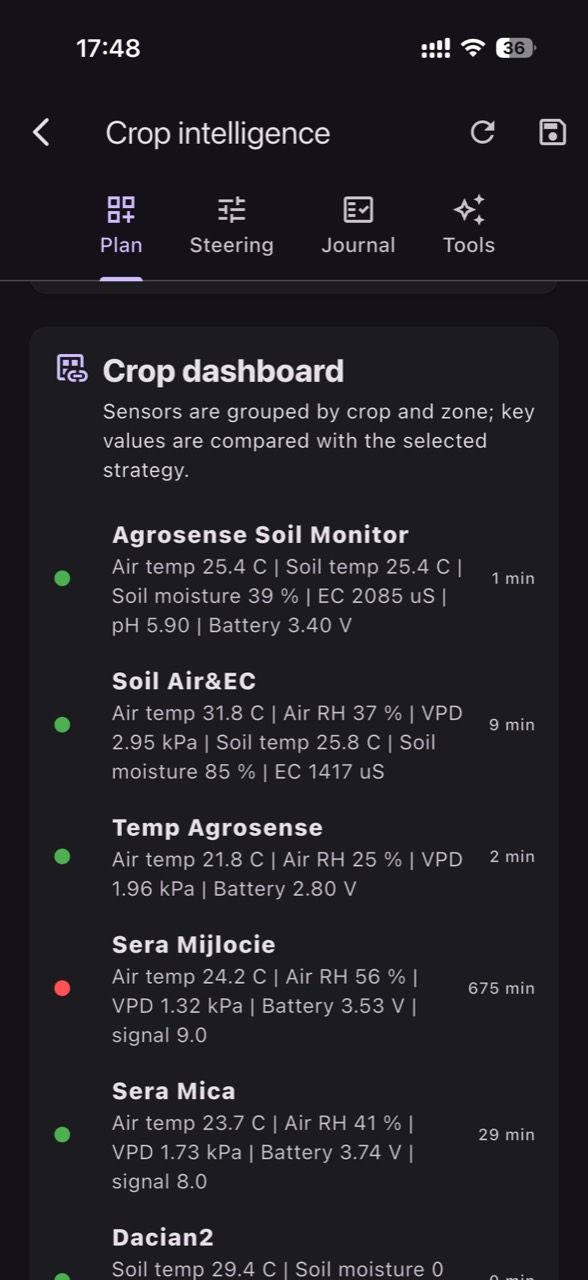
In a greenhouse or tunnel, the same intervention can produce different outcomes from one zone to another: one end cools faster, one row dries faster, one corner stays wet after irrigation. That is why “I saw on the phone that it’s fine” is not enough. To turn measurements into decisions, you must know exactly what each sensor measures—and what it does not.
The real problem is not a lack of data, but a lack of trust in it: jumpy values, mixed units, poorly installed sensors, stale data, or interpretations that go straight to action without independent checks. In production, a false alarm teaches you to ignore alerts; a missed alarm catches you after plants are already stressed. The correct flow starts with commissioning.
The article below explains the technical fundamentals and a usable workflow: how to define the decision you want to make, what signal you need, how to confirm the sensor is measuring the right medium, how to validate with observations and simple tests, and then how to track whether your intervention truly changed the microclimate and root zone. The examples are hypothetical and should be adapted to your crop and technology.
1) Start from the decision, not the sensor
In protected crops, the typical decisions are operational: when to ventilate, when to shade, whether to heat at night, when to start irrigation, or when to pause fertigation to avoid salt buildup. The mechanism behind them is physiological: transpiration depends on air temperature, humidity, and air movement; roots respond to oxygen availability in soil/substrate and to salinity; leaves respond to VPD as an indicator of atmospheric demand.
What to observe to connect data to decisions: early symptoms (slight midday wilting, slowed tip growth, morning condensation), but also process signals (differences between rows, changes after irrigation, the effect of opening sidewalls). Independent verification can be a simple intervention log plus scouting at the same time, in the same zones. Phrase the decision as a hypothesis: “If I ventilate earlier, I shorten the condensation period.” Check the result by comparing before/after under similar weather conditions.
2) Data quality: freshness, units, and continuity
“Good data” first means fresh, consistent data. In greenhouses, a graph with gaps or long delays can push you into the wrong action: you ventilate for humidity that was high an hour ago, or you ignore a temperature peak that already passed. The failure mechanism is straightforward: crop pace is fast and microclimate can change in minutes, not days. Continuity and timestamp matter as much as the number itself.
What to observe: reporting interval, repeated identical values for long periods (a stuck sensor or transmission problem), abrupt jumps that contradict physical reality (for example, humidity instantly switching from very low to very high). Independent verification can be a spot-check with a handheld thermometer/hygrometer and a quick look at the crop when an alert arrives. The practical decision is to define upfront what “on-time data” means for you and treat missing data as an operational incident. Check impact by fewer “ghost” alerts and stronger correlation with in-house observations.
3) Measurement distinctions: air, leaf, soil/substrate, water
Most costly mistakes come from comparing quantities measured in different media. Air temperature is not leaf temperature; VPD calculated from air temperature and relative humidity is an estimate, and leaves can be cooler or warmer depending on radiation and transpiration. Likewise, EC and pH are not “in the air”: they require dedicated probes and depend on what medium you measure (irrigation water, fertigation solution, drain, substrate extract, or bulk soil). A temperature sensor does not measure EC or pH.
What to observe: EC measured in water can change immediately after mixing; EC in the root zone may respond more slowly and be influenced by moisture. Independent verification is critical: lab water tests for pH, alkalinity, and soluble salts, paired with on-site pH/EC checks for routine control; these complement each other rather than replace one another. Practical decision: whenever you compare EC, always label it “EC where?” and “by what method?”. Check the result by seeing interpretations become consistent instead of chasing a number from a different medium.
4) Field commissioning: installation, orientation, plausibility test
A useful commissioning workflow starts with correct installation and then a plausibility test. The mechanism: greenhouses contain microclimates; if a sensor sits near a heater, in a draft, in direct sun, or close to evaporation, it will measure “a corner,” not the zone you think you are managing. For soil/substrate, position relative to the dripper and depth determines whether you see true root-zone wetting or only a shallow wetting front.
What to observe right after installation: a logical day/night cycle (temperature drops at night and rises by day), a response to ventilation (relative humidity shifts), and a response to irrigation (substrate moisture increases and then declines gradually). Independent verification: compare with a portable instrument and inspect the environment (film condensation, surface wetness, drain flow if present). Practical decision: do not set alert thresholds before confirming plausibility. Check success by the disappearance of obvious anomalies and by predictable responses to actions.
5) Build a zone baseline before setting alerts
In protected structures, “normal” differs by zone: near doors, sidewalls, in the center, at row ends, under vents. The mechanism includes heat loss, drafts, shading patterns, pressure differences, and uneven water distribution. If you jump straight to generic thresholds, you will either get constant alarms or silence when risk is real. A baseline means collecting enough history to recognize daily patterns and how each zone reacts to interventions.
What to observe: daily (diurnal) variation, differences between zones at the same hour, and delays after irrigation or ventilation. Independent verification: inspect the “bad” zones at the same time for several days and note whether the difference is structural (always colder at one end) or accidental (a door left open). Practical decision: set different thresholds by zone or use alerts based on deviation from each zone’s own normal. Check the result when alerts align with real situations and the team considers them credible.
6) From microclimate to action: ventilation and humidity without universal setpoints
Ventilation decisions work when you connect mechanism to measurement: high humidity combined with suitable temperatures can extend leaf wetness and condensation time, raising the risk of physiological problems and phytosanitary pressure. Still, there is no universal threshold: the same relative humidity can be acceptable in one crop and problematic in another, and air-based VPD can underestimate stress if leaves warm under strong radiation. Anchor decisions to the objective: shorten leaf-wetness duration or avoid thermal shock.
What to observe: when you open vents, track whether relative humidity drops, whether temperature stabilizes, and whether cold local drafts appear. Independent verification: check leaves (wet/cool?), check for condensation on films, and confirm whether some zones respond differently. Practical decision: adjust the timing and intensity of ventilation, then observe the effect. Verify results by comparing similar days (hypothetically, two mornings with similar weather) to see whether high-humidity/condensation duration dropped in the problem zones, not only “on average.”
7) Root zone: moisture, EC, and pH as different signals
In soil/substrate, moisture, EC, and pH are three different signals. They influence each other, but they are not interchangeable. Mechanism: irrigating too infrequently can cause water stress even if EC looks “fine”; irrigating too much can reduce oxygen in the root zone even if the plant is not immediately wilted. EC does not identify individual nutrient concentrations; it reflects total soluble salts in the measured medium. pH is sensitive to water quality, alkalinity, fertilizers, and reactions within soil/substrate.
What to observe: after a fertigation event, moisture should rise, and root-zone EC may rise temporarily; if EC stays elevated for a long time, it can indicate accumulation or insufficient water relative to evaporation. Independent verification: distinguish EC in water/fertigation solution from EC in drain and EC in the root medium; when uncertain, confirm with a manual measurement or analysis—especially for water (pH, alkalinity, soluble salts). Practical decision: adjust irrigation frequency/duration or fertigation strategy, then verify by stabilized trends and visual crop response over a realistic window (hypothetically 24–72 hours, depending on crop and conditions).
8) Post-decision validation: short loop, logbook, and failure cases
Turning data into decisions requires a validation loop; otherwise you just “react to charts.” The control mechanism is simple: an intervention changes the environment (air or root zone), that change should appear in the sensor signal, and then an agronomic effect should follow (less stress, more uniform growth, reduced zone differences). If one link is missing, either the intervention was insufficient, the sensor is not measuring what you think, or there is an unmonitored limiting factor (for example, uneven water distribution).
What to observe: after acting, follow the same indicator that triggered the decision plus a secondary indicator (after ventilating, track temperature as well as humidity). Independent verification: record time and action in a log and confirm on-site within 10–30 minutes for air changes or within hours for soil/substrate changes, depending on the process. Practical decision: define “worked / didn’t work” criteria before acting, then verify and adjust. In GrowGuard this can be supported through history, alerts, and zone-based interpretation, but the validation discipline remains essential.
Conclusion
When sensor data is properly commissioned, it does not replace greenhouse experience—it disciplines it. You know what each sensor measures, in what unit and in what medium; you quickly recognize stale or implausible data; and you make decisions as testable hypotheses. Without that rigor, the same technology can generate confusion, unnecessary alarms, and contradictory interventions.
If you want to move from “monitoring” to “repeatable decisions,” start by establishing the loop: observation – independent verification – action – post-action check, for each relevant zone. For teams running multiple protected structures, GrowGuard can help maintain the same working logic and history so interventions are discussed from evidence, not impressions.