Greenhouse pepper crops react quickly to water and temperature stress: flower drop, misshapen fruit, “stop–go” growth, and uneven quality. In practice, many apparent “deficiencies” begin in the root zone: irregular irrigation, poor aeration, salt accumulation, or a pH that limits uptake. That’s why the right troubleshooting sequence starts with water and roots, not guesses about fertilizer.
EC, pH and moisture are useful indicators, but they are not laboratory tests for a specific element shortage. EC shows total dissolved salts; it does not tell you whether calcium or magnesium is lacking. pH signals lockout risk, but it does not confirm deficiency. Moisture indicates whether roots can function, but it does not “read” nutrition. Sensors reduce blind spots, yet diagnosis still requires correlation and independent checks.
In greenhouses and tunnels, heat and high VPD can increase water demand precisely when irrigation remains on a fixed clock. The result can be dry–wet cycling, EC swings in the root zone, and unstable uptake. This article focuses on mechanisms and protocol: what to measure, in which medium, how to verify samples, how to choose and commission sensors, and—most importantly—how to confirm that a decision truly resolved the issue.
1) What EC actually measures—and why it can’t “diagnose” deficiencies
EC (electrical conductivity) indicates the total concentration of dissolved salts, not a nutrient breakdown. In peppers, excessive root-zone EC can reduce water uptake (osmotic stress), and plants may look “hungry” even when the solution is concentrated. Very low EC can mean under-fertigation or heavy leaching, but similar symptoms can come from other causes (weak roots, unsuitable root-zone temperature). The mechanism to follow is the water–salt balance, not a single number.
Watch the crop: stalled shoot tips, leaf-edge scorch, fruit that stays small, or uneven ripening can appear both with salinity stress and with oscillating irrigation. Verify independently by separating EC of source water, EC of fertigation solution, and EC in the root zone (substrate/soil). A practical decision is to first investigate whether salts are accumulating locally (for example at row ends) before “raising the recipe.” Check the outcome by looking for a more stable root-zone EC trend and a return to more uniform growth rhythm observed on crop.
2) pH: a lockout-risk indicator, not a deficiency confirmation
pH affects nutrient availability and root activity, but a chlorotic leaf does not automatically mean “wrong pH.” In greenhouses, pH can drift due to irrigation-water alkalinity, shifts in nitrogen forms in fertilizers, precipitation/clogging in the irrigation system, or processes in the substrate. In peppers, lockout can mimic micronutrient shortage or induced imbalances: pale overall color, greener veins, sensitive growing points—without the total nutrient supply actually being low.
What to observe: if symptoms are stronger in certain zones (end bay versus center), suspect distribution issues (water delivery, fertilizer mixing, uniformity) before you assume a whole-house nutritional problem. What to verify: measure pH in the fertigation solution (inline or in a freshly collected sample), then assess pH in the root zone using a standardized extraction method appropriate to your system (substrate or soil). The practical decision is not “acidify immediately,” but to link pH readings to water history and to any signs of deposits/clogging. Confirm improvement through fewer new symptoms and through pH readings that remain consistent over time when measured by the same method at the same points.
3) Root-zone moisture: the factor that “opens” or “closes” nutrition
Peppers need an active root system; when the root zone cycles between dry and saturated, uptake becomes irregular even with a correct fertigation recipe. Under severe drying, salts concentrate locally, EC rises around the dripper, and marginal burn or halted fruit growth can follow. Under excess water, oxygen drops, roots lose function, and the crop may “look deficient” because it can no longer take up nutrients efficiently. The mechanism is root function first, chemistry second.
What to observe: plants drooping at different times than the rest of the greenhouse, growth in waves, sensitive shoot tips, flower drop in bursts. What to verify independently: physically inspect the root zone (smell, color, density), check irrigation uniformity, and look for sectors that stay consistently wetter or drier. A practical decision is to trigger irrigation based on real demand (affected by temperature/VPD) and by the substrate/soil response, not by a fixed hour. Confirm results by reduced moisture oscillation amplitude and a more uniform canopy appearance across zones.
4) Don’t mix measurement media: water, stock solution, drain, substrate extraction, or soil tests
The most expensive confusion is treating EC/pH values from different media as the same measurement. EC of raw water indicates baseline water quality; EC of fertigation solution shows what you prepared; EC in drain water or substrate extract shows what remains in the root zone after plant uptake and water evaporation. In soil, bulk-soil EC or saturated paste are different methods with different interpretation. Without keeping media distinct, “corrections” can overshoot and intensify stress.
What to observe: if the crop struggles while tank EC looks “fine,” the problem may be root-zone accumulation or uneven distribution. What to verify: standardize where and when you sample (same zones, same procedure), record units, and note temperature conditions (many meters compensate, but not all do it the same way). A practical decision is to choose one consistent farm method to follow trends, rather than chasing isolated values. Checking the result means seeing coherent trends and convergence between “what you apply,” “what remains,” and “what the crop shows,” not simply a tidy chart.
5) Sensor choice and commissioning: avoid “correct data, wrong installation”
EC and pH require dedicated probes; a temperature/humidity sensor cannot provide these measurements. In practice you have two broad approaches: “inline” measurement (in the fertigation system) or measurement in the root zone (probes in substrate/soil, or samples tested with a handheld meter). Commissioning starts with a clear question: do you want to control the delivered recipe, or do you want to see what the roots actually experience? In peppers, both can be valuable, but they answer different problems.
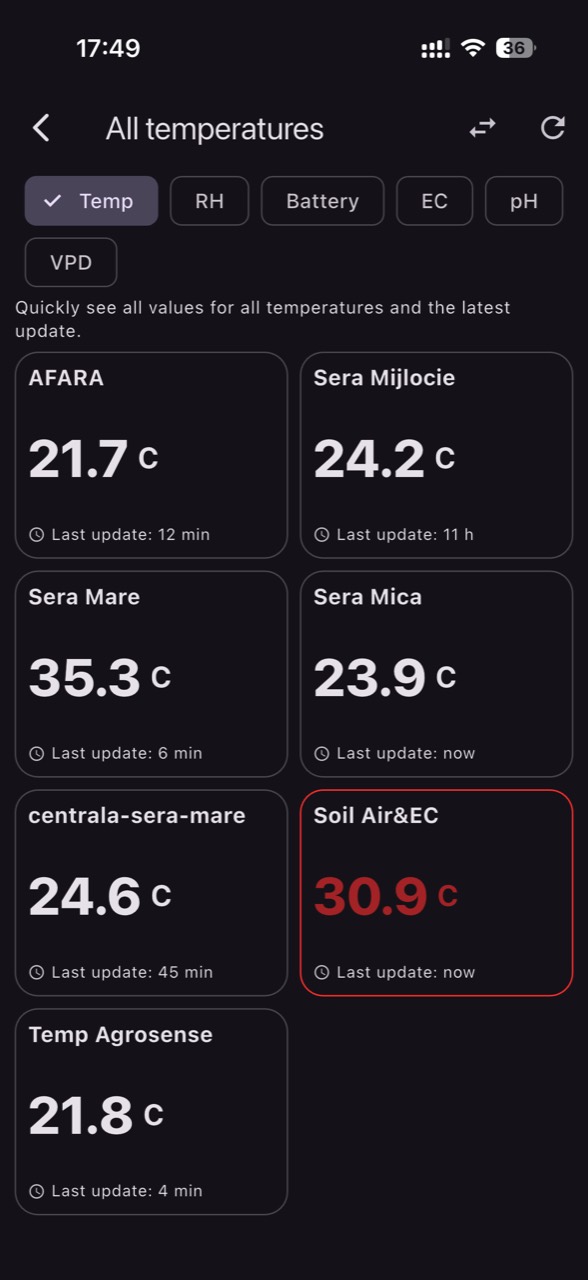
What to verify at startup: displayed units (mS/cm versus µS/cm), temperature compensation behavior, periodic calibration, and reading stability (drift). For substrate/soil moisture, verify installation: good contact, depth aligned with the main active roots, and avoiding placement right next to the dripper (which can overestimate local wetness). A practical decision is to create comparison points: greenhouse ends versus center, canopy-height climate versus root-zone conditions. In GrowGuard, zone mapping and sensor-status alerts can help you notice when one probe behaves abnormally relative to the rest—without automatically assuming a nutrition issue.
6) A diagnosis protocol: from symptom to cause, with steps that rule out errors
When a deficiency is suspected, start with a triad: microclimate (temperature/humidity/VPD), water (irrigation rhythm, uniformity, drain if applicable), and root-zone condition (moisture, smell, visual root health). Only then use EC/pH to confirm the chemical environment. In peppers, heat can trigger flower abortion and poor fruit quality even under correct nutrition; conversely, damaged roots can mimic “any deficiency.” The mechanism is that uptake depends on water flow and root function.
What to verify independently: map symptom distribution (by rows, sectors), compare with intervention history (water-source changes, filter events, fertilizer switches, acidification attempts), and check pressure and potential drip clogging. A practical decision is to avoid multiple simultaneous changes: correct the dominant factor first (for example, irregular irrigation), then reassess. Confirm results through a clear difference between corrected and unchanged zones (if you can isolate a sector), stabilization of indicators (moisture/EC/pH), and fewer new symptoms observed during routine crop walks.
7) Linking VPD and water demand to “induced deficiencies” risk
VPD calculated from air temperature and relative humidity is an estimate of evaporative demand; leaf temperature can differ, so don’t treat VPD as a verdict. Still, in peppers, high VPD generally means stronger transpiration and—if irrigation cannot keep up—fast root-zone drying, local EC increase, and induced imbalances (for example, transport to growing tips can be disrupted). Heat stress also reduces fruit set and can be mistaken for weak nutrition.
What to observe: on high-VPD days, symptoms often intensify during peak hours and ease later; fruit growth can lag and shoot tips can look more sensitive. What to verify: compare the root-zone moisture curve to the temperature/RH curve; if moisture drops sharply before the first scheduled irrigation, it suggests your fixed “start time” no longer matches demand. A practical decision is to adjust irrigation timing and frequency according to daily demand, then check results through a steadier moisture profile and less visible midday stress. In GrowGuard, you can track zone-by-zone moisture trends and use forecast context for heat waves to anticipate higher-risk days.
8) Verifying the effect: what “it worked” means without confusing coincidence for cause
After an adjustment (irrigation, recipe, pH), look for indicators moving in the expected direction and aligning across measurements and plant response. If you lower concentration but root-zone EC does not change, you may not have addressed accumulation (for example, uneven distribution or insufficient leaching where the system allows it). If you “correct pH” but symptoms persist in the same zones, suspect water distribution again or impaired roots. The mechanism is that crops respond to flows (water, salts, oxygen), not to a single reading.
What to verify independently: repeat measurements using the same method at the same points, and standardize crop observations (same plants, same leaves, similar time of day). A practical decision is to document the intervention and avoid stacking rapid successive changes that prevent a conclusion. Confirm outcomes through improved uniformity: smaller differences between greenhouse ends and center, fewer plants falling behind, and stabilized indicators without jumps explainable only by measurement error. If data looks “perfect” but plants disagree, treat it as a signal to audit sensors and sampling—not a reason to double fertilization.
Conclusion
In greenhouse peppers, many problems labeled as deficiencies are actually consequences of an unstable root zone: oscillating moisture, accumulated salts, pH conditions that promote lockout, and reduced root activity. EC, pH and moisture help quantify the environment, but they don’t replace crop inspection, distribution checks, and—when appropriate—water or substrate/soil analysis. The correct protocol is to keep measurement media distinct, standardize sampling, and track zone-based trends rather than isolated values.
If you want to turn these checks into an operational routine, use monitoring to ask better questions: where the problem is, when it appears, and which factor triggers it. A platform such as GrowGuard can support this with live monitoring, zoning, and alerts for moisture/EC/pH plus forecast context, but the decision remains agronomic: choose the minimum intervention that stabilizes the root zone, then confirm the effect on crop. To implement safely, start with a few well-chosen points and build trust in data through periodic verification.