In greenhouses, MQTT often becomes the “nervous system” connecting sensors, apps, and controllers. Problems start when signals are treated as reality: an alert is interpreted as a command, a command is treated as a successful action, and a transport acknowledgement is confused with physical confirmation. That confusion can trigger irrigation or ventilation based on stale or incomplete data.
A robust workflow separates three different things: alerting (someone or something detects a deviation), commanding (a request is made for an action), and physical confirmation (proof the action actually happened in the greenhouse). MQTT, as a broker-based publish/subscribe protocol with topics, can carry all three message types—but it does not guarantee operational meaning without rules and independent verification.
The right intent is not “automate everything,” but “automate only what you can verify.” In a greenhouse, thermal inertia, zone-to-zone variation, and actuator response time mean a command may have delayed effects, while a sensor may report something different than you assume. Before acting on any MQTT message, you need to check data freshness, units, equipment state, and an independent feedback signal.
1) An MQTT message is not a greenhouse event: three different objects
In MQTT, a payload published on a topic is simply information delivered through a broker. An alert means “a condition was detected/derived,” a command means “I request something to happen,” and physical confirmation means “something measurable actually happened on site.” Delivery mechanisms such as QoS can only confirm that the message reached its destination per the chosen level—not that a solenoid valve opened or a fan started.
What to observe: message type, topic structure, who publishes it, and what the timestamp actually represents. What to verify independently: actuator state (contact, current draw, position feedback) and the effect in the microclimate (for example, a gradual change in humidity/temperature, not an instant jump). Practical decision: treat every alert as a trigger for evaluation, not a direct trigger for action. Result check: compare post-action trends against a realistic time window for your greenhouse.
2) Alerts: how they are built and the validations needed before acting
An alert may come from a simple threshold (RH above a set value), a derived value (VPD calculated from air temperature plus relative humidity), or logic using history. The mechanism is sensitive to units and context: VPD is an estimate from air measurements; leaf temperature can differ, so real condensation or stress risk may be different. A temperature sensor does not measure EC/pH; those require dedicated probes, and EC depends on the measurement medium (soil, substrate, drain, or irrigation water).
What to observe: data freshness (timestamp and reporting interval), unit consistency, and source context (zone, mounting height, shielding). What to verify independently: a quick greenhouse inspection and a second indicator (another probe in the zone, or direct observation of condensation). Practical decision: if the alert is driven by a single sensor with a sudden jump, prefer verification before issuing a command. Result check: after intervention, confirm the alert wasn’t an artifact of placement, local airflow, or transient sensor behavior.
3) Commands: designing topics to avoid wrong execution
An MQTT command expresses intent, not execution. By design, it should be idempotent (repeating it does not create a new hazard), include an identifier (command_id), and carry explicit parameters (duration, mode, target). In a hypothetical example, “irrigation/valve1/set=ON” without a duration can leave the system running if the OFF command is missed. Similarly, a ventilation command without interlocks can conflict with a heating regime.
What to observe: whether you have application-level acknowledgement (not just QoS) and whether the receiving controller reports its state. What to verify independently: local interlocks (manual/auto status, protections, water pressure, fuses) and permissions (who is allowed to publish commands). Practical decision: implement safe defaults (OFF, timeout) and prefer duration-based commands or target-based commands with local control. Result check: look first for immediate state feedback, then for the expected climate or hydraulic effect in the affected zone.
4) Physical confirmation: defining it and instrumenting it
Physical confirmation does not mean “I received an ACK over MQTT.” It means you have an independent signal proving the action occurred: measured flow, pressure change, motor current, end-of-travel contact, damper position, or a coherent change in measurements (with delay considered). For irrigation, robust confirmation is typically a flow/pressure sensor or a digital status input—not substrate moisture alone, which can respond slowly and unevenly.
What to observe: keep “state reported” (what the controller claims) separate from “state measured” (what a dedicated sensor shows). What to verify independently: if a valve opened, confirm flow; if a fan started, confirm current draw or RPM, plus the temperature trend over time. Practical decision: define a minimum physical confirmation condition for each actuator before considering a command “executed.” Result check: log the command_id alongside confirmation signals and a short effect summary (trend) for later audit.
5) QoS, sessions and retained messages: delivery is not reality
MQTT offers QoS levels for delivering messages between client and broker, but they describe transport reliability, not physical process success. Higher QoS can reduce message loss, yet it cannot guarantee the pump started or that a valve is not stuck. Retained messages are useful for states, but dangerous if a new device connects and instantly receives an old “last command” as if it were current. That’s why retained messaging requires age and context checks.
What to observe: whether command messages are marked retained (as a rule, they should not be) and whether state messages are retained with timestamps. What to verify independently: an “age check” before execution (difference between local time and message timestamp) plus an arming condition (for example, a separate enable topic). Practical decision: use retained for “state/last known,” and use non-retained commands with expiry logic. Result check: run deliberate reconnection tests in a hypothetical scenario and see whether old messages can cause accidental execution.
6) Freshness, units and integrity: avoiding action on wrong data
In greenhouses, even “correct” data can be unsuitable for control if it is old, aggregated, or interpreted in the wrong units. The mechanism is simple: a sensor may report every 5–15 minutes; a gateway may retransmit; an app may compute averages. An irrigation command based on one soil-moisture value can be wrong if the probe sits in a wetter/drier pocket. EC measured in drain water is not the same as EC in the root zone; comparing them without stating the medium leads to flawed decisions.
What to observe: timestamp, sampling interval, missing fields, and discontinuities. What to verify independently: plausibility checks (air temperature rarely jumps abruptly without a cause) and zone validation (a nearby sensor, another point, or a quick inspection). Practical decision: require multiple conditions before issuing a command: freshness plus trend plus coherence across zones. Result check: after acting, confirm variables move in the expected direction without automatically assigning causality (correlation is not proof).
7) Operational commissioning: controlled tests and typical failure modes
Commissioning an MQTT workflow in a greenhouse means proving behavior in normal and abnormal states: internet loss, broker restart, low sensor battery, actuator jam, operator switching to manual. A hypothetical example: send a 2-minute irrigation command; physical confirmation is “flow > 0 within the first seconds,” otherwise mark the command failed and stop. Another example: a high-RH alert triggers only a “verification request” if data is older than an internal threshold you define.
What to observe: reconnection rates, duplicate messages, delivery order, and stuck states. What to verify independently: on the equipment itself, ensure protections and interlocks behave (pump does not run dry, fans have thermal protection, etc.). Practical decision: define a limited retry policy per command type and a safe fallback state. Result check: run a short scheduled test periodically and compare command logs with physical confirmations and measured effects.
8) The full loop: alert → decision → command → confirmation → audit
A mature workflow ties every stage together using identifiers and acceptance rules. Mechanism: an alert creates an internal event, an operator or logic decides, a command is issued with command_id, then the system waits for physical confirmation within a realistic time window. If confirmation never appears, the command is cancelled and an intervention is requested. In a greenhouse, audit matters: if ventilation ran, you later check whether RH/VPD moved as expected, accounting for weather and inertia.
What to observe: the difference between “state confirmation” and “physical confirmation,” and between local effect and zone-wide effect. What to verify independently: visually (equipment status) and with a relevant sensor (flow, pressure, contact, or a climate trend). Practical decision: don’t close the loop on MQTT alone; close it on measurable signals and safety rules. Result check: after each incident (false alert, failed command), update thresholds, time windows, and arming conditions.
Conclusion
The difference between an alert, a command, and physical confirmation is the difference between “knowing” and “controlling safely.” MQTT provides an efficient messaging channel with a broker, topics, and delivery options, but the responsibility for operational meaning remains with your design: freshness, units, zone context, interlocks, and independent feedback. In greenhouses, where effects are delayed and uneven, physical confirmation is the piece that prevents “optimistic” automation.
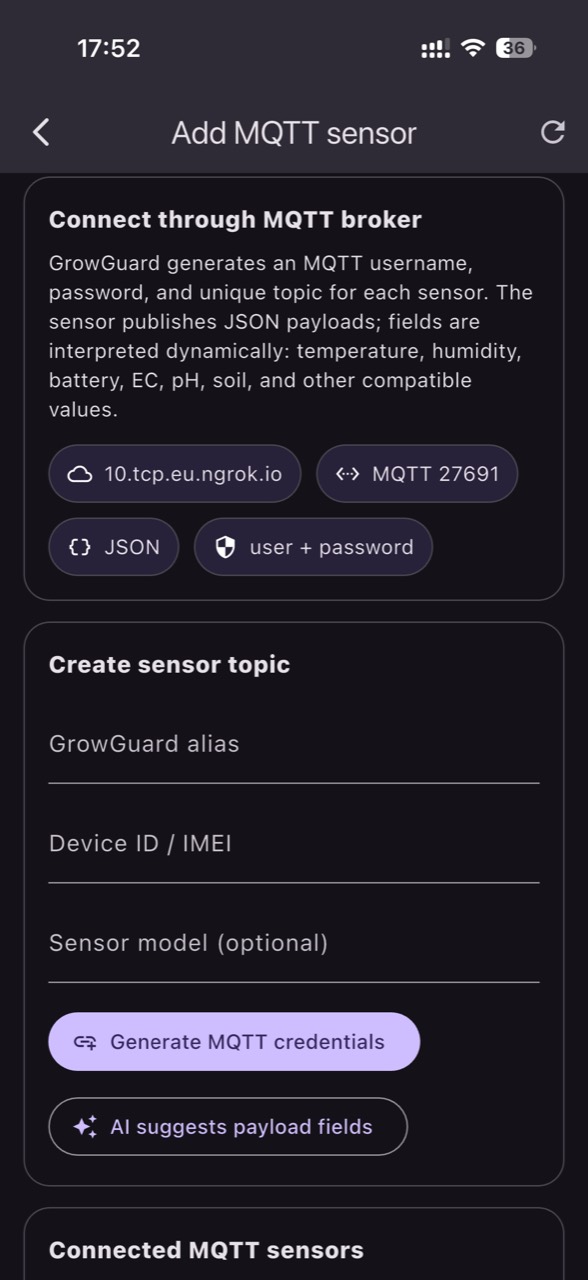
If you use a monitoring platform such as GrowGuard to view zone-based sensor data and alerts, treat it as a decision and audit tool, while automation remains a separate engineering project with dedicated confirmation signals and tests. A short invitation: build your workflow as a verifiable loop, and write down—per actuator—what “success” means in the greenhouse, not just in the broker.