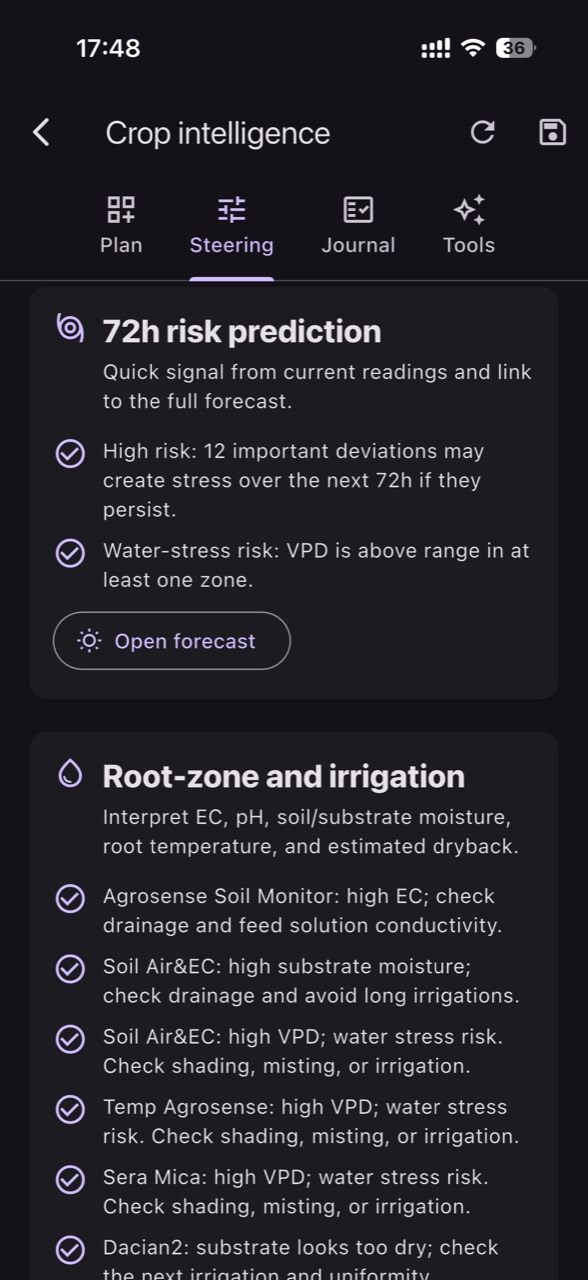
Onion and garlic have a relatively shallow root system and a critical period when water uniformity directly affects bulb size and final quality. That is why root-zone moisture is a useful indicator—and also easy to misread. A “good” number can hide stress, while an alert may be caused by poor sensor placement rather than a genuine need for water.
In practice, many alarms appear when the reading represents not the crop, but an atypical point: the edge of a drip tape wetting pattern, a compacted patch, a leaky row end, a small depression, or a windy corner. In onion/garlic, small differences in micro-relief and soil texture quickly translate into differences in evaporation and drainage, and the sensor magnifies that local difference.
This article is a diagnostic guide: how to distinguish a real crop or irrigation problem from a misleading reading; how to compare microclimates between zones; what to verify independently (outside the app); what practical decision you can take; and how to confirm, the next day or after irrigation, that the intervention was correct. The examples are hypothetical to illustrate common mechanisms.
1) Why root-zone moisture matters differently for onion and garlic
During vegetative growth and bulb initiation, onion and garlic respond quickly to swings between wetting and drying: growth becomes uneven, and plants can enter stress without obvious symptoms right away. Because roots typically explore a smaller soil volume than many other vegetables, a distribution error over just a few meters can completely change conditions in the active root zone.
What you observe in the field: “islands” of different vigor, leaves with slight loss of turgor during hot hours, or—on the other side—thick, glossy foliage in oversaturated spots. What to verify independently: a quick soil check at root depth both on-row and between rows, plus a check of drip uniformity. The practical decision is not automatically “more water,” but correcting uniformity; you confirm results by reduced patchiness and a stabilized moisture trend, not by chasing a single value.
2) Sensor placement: what “representative” means in row crops
A moisture sensor placed too close to an emitter or directly under a drip tape will see short, large “pulses” after irrigation that don’t represent the soil volume roots actually use. Conversely, a sensor placed too far away may stay “dry” while the root zone around the tape is adequately wet. In onion/garlic, small distances matter: the wetted front can remain narrow, especially in sandy soils or when irrigations are short.
What you observe in data: sharp spikes followed by rapid drops (sensor sitting in the “jet” of wetting) or an almost flat line regardless of irrigation (sensor outside the wetted volume). What to verify independently: open a small soil section immediately after irrigation (hypothetically, 30–60 minutes later) to see the actual wetted shape and the sensor’s position relative to it. Practical decision: reposition the sensor where roots and wetted soil overlap; confirm by comparing the next irrigation response with a nearby reference spot.
3) Two depths, two stories: surface layer vs. active layer
In onion and garlic, the surface layer warms and dries quickly, especially where the soil is loose or mulch differs between areas. A single shallow sensor can trigger frequent “dry” alerts even though water is still available below. But a sensor placed too deep can miss real root stress, particularly if roots remain shallow due to compaction or poor aeration after rain events.
What you observe in the crop: plants may look fine in the morning and show midday stress, suggesting the active layer is the issue rather than deep reserves. What to verify independently: assess actual rooting depth (hypothetically, pull a few plants and examine where fine roots concentrate) and do a simple consistency check of soil at two levels. Practical decision: measure at two points (or two depths) within the same zone; the result is that alerts align better with symptoms and field checks, not that alerts “disappear” artificially.
4) Microclimates within one field: wind, edges, slopes, and texture
In open-field production, onion and garlic are sensitive to microclimates created by exposed edges, windbreak effects, slight slopes, or texture changes (a sandy streak, a heavier clay patch). Evaporation, infiltration, and drainage shift, and the sensor reports a local truth. If you apply the same irrigation logic across the whole plot, you can end up with underwatered and oversaturated areas simultaneously—even if the “average” looks acceptable.
What you observe: repeat problems in the same places (corners, row ends, near roads), differences in soil surface temperature, and different drying speeds after rain. What to verify independently: compare soil moisture and structure manually in 3–5 points, not only next to the sensor, and track drying time after a rainfall event. Practical decision: divide the field into crop zones with different regimes and follow alerts separately; in GrowGuard, a sensor map helps keep incompatible microclimates from being mixed into one conclusion.
5) When an alert points to irrigation hardware, not the crop: the “response-to-irrigation” test
A fast diagnostic question is: “Does the sensor respond logically to an irrigation I know definitely happened?” If irrigation ran but the moisture curve doesn’t move at all, the likely cause is in the circuit: an un-fed sector, a closed valve, a clogged filter, insufficient pressure, or damaged tape. In onion/garlic, these failures can show late because plants may buffer the deficit for days before differences become obvious.
What you observe on the ground: one row or one tape line with consistently smaller plants, consistently drier soil, or slightly narrower leaves with a subtly different color. What to verify independently: a sector function/flow test, a pressure check if you have instruments, and visual inspection for cracks or clogging. Practical decision: repair/clean the sector and repeat a short irrigation for validation; confirm by a coherent moisture rise and improved row-to-row uniformity over the following days, not only immediately.
6) When an alert points to sensor/data issues: units, freshness, stuck values
Readings can mislead for non-agronomic reasons: misinterpreted units (for example, percent versus another scale), stale data (infrequent transmission or interruptions), “frozen” values (unchanged for hours/days), or unrealistic jumps. In onion/garlic moisture diagnostics, the first step is not changing irrigation—it is confirming the sensor is truly measuring and the data is fresh, especially after rainfall or a scheduled irrigation.
What you observe in the time series: perfectly repeated steps, no day/night variation, or no reaction to obvious events (rain, irrigation). What to verify independently: physically inspect the sensor (good soil contact, no air gaps), check battery status and transmission continuity; if in doubt, compare with a second measurement point or a manual soil check. Practical decision: reinsert the sensor, move it to representative soil, and note the intervention time; confirmation is when the curve regains normal dynamics during wetting and drying cycles.
7) Moisture vs. salinity: why not to confuse them, and how soil can fool you
In onion and garlic, stress can come from too little water or from increased salinity in the root zone, especially where evaporation is high and irrigation water carries salts. A common confusion follows: a temperature sensor does not measure EC/pH, and EC does not tell you which nutrients are excessive or deficient. The medium also matters: EC in irrigation water, in fertigation solution, in a soil/substrate extract, and in bulk soil are different measurements.
What you observe: leaf tip damage, slowed growth even though moisture seems “fine,” or negative reactions after frequent irrigations with saltier water. What to verify independently: measure pH and EC with dedicated probes, clearly stating the measurement medium (water, fertigation solution, soil/substrate extract); laboratory analysis complements on-site pH/EC monitoring rather than replacing it. Practical decision: adjust irrigation/leaching strategy or water source without guessing; confirm by stable EC trends and an improving growth rhythm, not by a single reading.
8) Risk alerts and microclimate: how to validate them without treating them as “diagnosis”
Risk alerts based on favorable conditions (for example, warm, wet windows that can support disease pressure) are useful for prioritizing field checks, but they are not pathogen detection. In onion and garlic, some foliar and basal issues follow specific microclimate windows: persistent dew in low spots, evening irrigations, high density, and stagnant air. VPD calculated from air temperature and humidity is an estimate; leaf temperature can differ from air.
What you observe: differences in leaf-wetness duration between edges and interior, and zones that dry more slowly after rain or irrigation. What to verify independently: targeted scouting right after the alert in the “critical” microclimate points, not only beside the sensor; note crop stage and practices that increase moisture (overhead irrigation, weeds, density). Practical decision: adjust irrigation timing and ventilation management in protected structures, or reduce moisture sources; verify via shorter leaf-wetness duration and repeated visual confirmations, not by expecting risk to disappear completely.
Conclusion
A monitoring system becomes genuinely useful in onion and garlic when you treat it as a diagnostic tool, not an oracle. Soil moisture must be tied to position relative to drip wetting, true rooting depth, and field microclimates. When an alert appears, first look for the mechanism: uneven distribution, an atypical spot, stale data, or a real shift in soil conditions.
If you build a few crop zones, periodically validate sensors with simple field checks, and use “response to irrigation” as your basic test, you’ll reduce rushed decisions. In GrowGuard you can compare zones and alert history to see whether an issue is local or widespread. For a commissioning and verification protocol tailored to your plot, it can be worth discussing it with a local sensor distributor or integrator who knows your field conditions.