Controlled water stress in vineyards does not mean “keeping vines thirsty.” It means dosing water so the plant stays functional, vegetative growth remains under control, and ripening is steered toward quality. The challenge is that in commercial vineyards, slope, soil texture, and exposure can change water availability over short distances—sometimes within the same block.
Sensors can be the difference between irrigation done “by calendar” and irrigation based on the real response of the soil and the microclimate. But only if you choose the right sensor type, install it in representative points, and commission it so values are comparable across blocks and weeks. Otherwise, you only digitize uncertainty.
This article explains the technical fundamentals: what controlled water stress means in practice for roots and leaves, what to measure (and in which units), how to place sensors in vineyard zones, how to verify independently in the field, and how to build a commissioning workflow that leads to repeatable, checkable irrigation decisions.
1) Why “controlled” and not “as little water as possible”: the vineyard mechanism
Vines respond to water deficit by reducing shoot growth, closing stomata, and therefore lowering transpiration. A moderate deficit can help manage vigor and balance the leaf–fruit relationship, but an excessive deficit suppresses photosynthesis, slows sugar accumulation, and can increase heat sensitivity. In parallel, excess moisture can sustain a microclimate that favors disease, especially when leaves remain wet for long periods.
What to observe: changes in vigor, shoot tip behavior, leaves that appear hotter, and differences between zones (top/bottom of slope, exposed/shaded). What to verify independently: field inspection and, where possible, checks of drip distribution (uniformity, clogging). Practical decision: don’t “turn on water” for the entire vineyard; choose sectors and durations based on which zone enters stress first. Result check: after irrigation, look for a response in the soil profile (at the relevant depth) and compare the trend to non-irrigated zones.
2) What you are actually measuring: moisture by depth, microclimate, and leaf wetness
For sensor-guided irrigation you need a picture of both the root zone and atmospheric demand. In soil, depth matters: a single shallow reading can mislead because it dries quickly and may not reflect reserves deeper down (hypothetical example). In air, temperature and relative humidity support estimation of VPD—the evaporative “pull.” But VPD is an estimate based on air conditions; leaf temperature can differ in wind, strong sun, or shade.
What to observe: moisture curves that decline steadily between irrigations, peaks from rain/irrigation, and different drying rates across blocks. What to verify independently: soil status with a spade or probe (structure, compaction, wetted depth) and, for microclimate, exposure differences (row ends, windbreak effects, shaded pockets). Practical decision: link “demand” (air temperature/RH, and leaf wetness if you track disease windows) with “supply” (moisture at depth). Result check: after irrigation you should see a clear increase at the targeted depth sensor, not only at the surface.
3) Choosing sensors: what you need, and what can fail
In vineyards, the most useful sensors are: soil moisture sensors (reporting volumetric water content or an index), air temperature/humidity sensors, and—where phytosanitary pressure justifies it—leaf wetness sensors. Don’t mix measurement types: a temperature sensor does not measure EC or pH; those require dedicated probes. Also, EC does not identify individual nutrients; it indicates total dissolved salts in the measurement medium, and interpretation in mineral soil differs from nutrient solutions.
What to observe: signal stability, seasonally plausible values, and response to events (rain/irrigation). What to verify independently: periodic comparison to simple observations (visual soil checks, infiltration behavior, occasional spot measurements) to catch drift or installation errors. Practical decision: choose sensors based on the question, not the price tag—controlled water stress starts with moisture by depth; if you also need treatment timing windows, add microclimate and leaf wetness. Result check: if a sensor does not react to a confirmed irrigation, treat it as an installation or irrigation-system problem, not as “extremely dry soil.”
4) Placement by zones: avoid the “vineyard as an average” mistake
In vineyards with slopes, variable textures, and mixed exposure, water stress and disease risk typically appear first in specific points. Placement should therefore target contrasting zones: lower vs upper slope, shaded vs exposed areas, heavier vs lighter soil. The goal is not to “capture the average,” but to enable comparisons and sector-based decisions. One sensor node can hide a corner that enters stress a week earlier than the rest (hypothetical example).
What to observe: consistent differences in drying speed and in irrigation response amplitude between zones. What to verify independently: map the drivers of variation (slope, drainage lines, potential shallow water table, row ends with different drip pressure) and compare them to the data patterns. Practical decision: define management zones and, as much as possible, tie them to real irrigation sectors. Result check: if irrigating a sector should affect a zone but the zone sensor shows no change, check hydraulics (pressure, clogging, run time) before changing thresholds.
5) Commissioning: from installation to trustworthy data in the first 14 days
Commissioning begins with correct soil installation: firm sensor–soil contact, no air gaps, protected cables, and exact recorded depths. Then comes a short “response validation” period: ideally using a clear event (a controlled irrigation or a rainfall) that should cause moisture to rise at certain depths, with a logical delay from shallow to deeper layers. If data show no response or unrealistic jumps, don’t “fix it in software”; look for the physical cause.
What to observe: reporting frequency (data freshness), dropouts, stuck values, and response lag by depth. What to verify independently: on the event day, confirm irrigation actually happened (run time, estimated flow, pressure) and inspect moisture with a spade near the sensor location. Practical decision: accept a sensor as operational only after it passes response and consistency checks; otherwise reinstall or relocate it. Result check: after correction, repeat the test at the next irrigation and confirm the curve shape makes sense—not just the absolute number.
6) Thresholds and alerts: building them locally without universal settings
In controlled water stress, thresholds are not universal “magic numbers.” Soil texture, rockiness, effective rooting depth, rootstock, crop load, and wine style objectives all change the vine’s response. Practically, start with history: identify periods when vines showed stress in field observations, then review what sensors showed on those dates in each zone. Your threshold becomes a decision band, not a single fixed value, and alerts help you respond before stress is visible across the whole block.
What to observe: when moisture decline becomes steeper (high atmospheric demand) and when irrigation no longer produces sufficient recovery. What to verify independently: align readings with phenology (active growth, post-fruit set, pre-veraison, etc.) and canopy observations. Practical decision: set zone-based alerts for both “trend” (sustained decline) and “level” (below a band), then define a clear action—either a short test irrigation or a full sector irrigation depending on intent. Result check: over the next 24–48 hours, confirm the drying slope stabilizes and the problem zone returns toward the band without creating persistently wet surface conditions.
7) Daily/weekly workflow: decide, verify, learn by zones
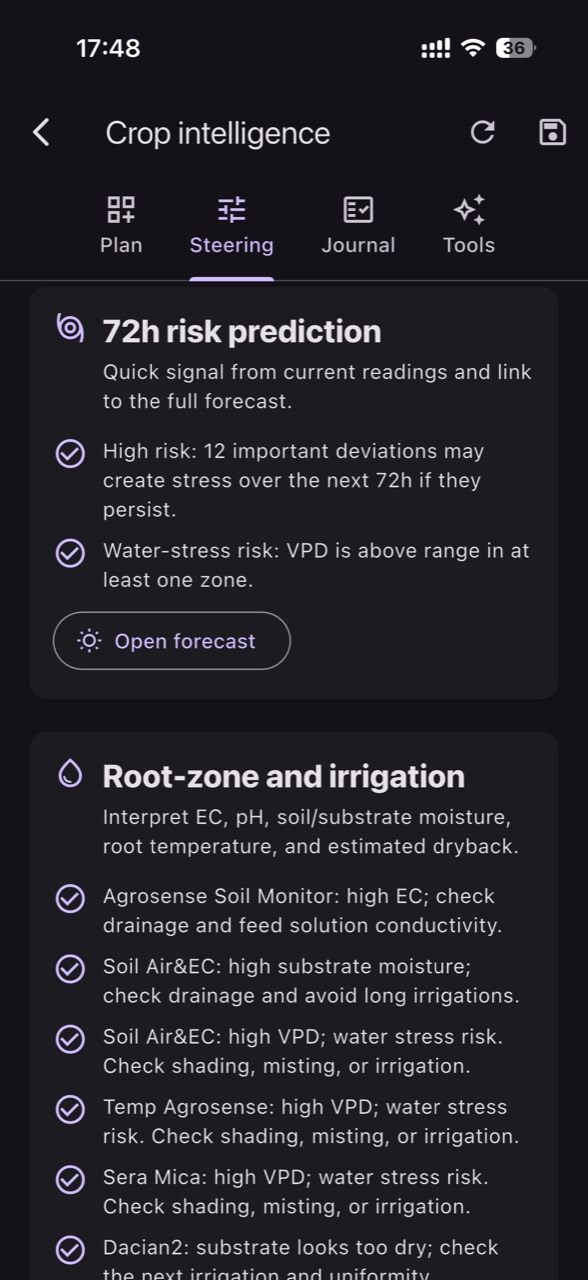
A useful workflow is a repeatable routine, not “watching graphs.” Daily, check data freshness (a sensor reporting too rarely can miss irrigation peaks), then compare zones: which enters stress first, which stays wet and could increase disease risk. Weekly, review events—rain, irrigations, heat waves—and confirm sensor responses match field reality. In GrowGuard, zone comparison and the map view can help you spot quickly whether a deviation is local rather than vineyard-wide.
What to observe: zone discrepancies, including cases where the lower slope stays consistently wetter and the upper slope dries faster. What to verify independently: inspect at least two points in each zone (not just beside the sensor) to confirm the sensor represents the zone rather than an anomaly. Practical decision: apply differentiated irrigations where infrastructure allows, or prioritize critical sectors; in parallel, adjust canopy management to reduce demand instead of compensating only with water. Result check: after intervention, look for convergence—the critical zone should move toward the behavior of the others, not swing unpredictably.
8) Bringing microclimate and disease risk into irrigation decisions
In vineyards, irrigation influences disease pressure indirectly through microclimate: overly wet soil and a dense canopy can sustain high humidity, and leaf-wetness episodes lengthen infection windows for downy mildew and may favor rots, depending on temperature and conditions. This does not mean a sensor “detects the pathogen”; it indicates favorable conditions, and you manage the risk accordingly. During persistently humid periods, an extra irrigation is harder to justify than during a hot, dry spell.
What to observe: the relationship between humid nights, leaf wetness duration (if measured), and vigor development. What to verify independently: targeted scouting in “closed” microclimates (depressions, vegetated edges, shaded rows) and consultation of the 48–72 hour forecast so you don’t irrigate right before rain. Practical decision: when climatic disease risk is high, prefer shorter, earlier-in-the-day irrigations (hypothetical example) to limit high nocturnal humidity periods. Result check: track whether nighttime humidity and leaf-wetness duration decrease after adjustments, while the soil remains within a functional range for roots without local ponding.
Conclusion
Controlled water stress in vineyards is built on correct comparisons: relevant depths, distinct zones, and verifiable events (irrigation/rain/heat). Sensors help only when they are commissioned rigorously, when data are fresh, and when every alert has an associated action and a post-intervention check in the soil profile and on the vine.
If you want to structure this workflow quickly across blocks with different exposure, a platform such as GrowGuard can support zone tracking, alerts, and correlation with history and forecast. Start with two or three contrasting zones, validate sensors in the first two weeks, and only then refine local thresholds alongside field observations.