In commercial vineyards, differences in slope, soil and exposure create “islands” of water stress and phytosanitary pressure. That is why decisions based on a block average can be right in one corner and wrong in another. A useful approach is to tie measurement to real zones and to clear operational questions.
Water stress in grapevines does not mean simply “more” or “less” water. Excess water can push vegetative growth at the expense of balance, while severe deficit can stop growth and affect ripening. At the same time, periods of persistent humidity and wet leaves increase the risk of downy mildew, rots and other problems driven by microclimate.
This guide explains technical fundamentals and a commissioning workflow for monitoring: which sensors to choose, where to place them, which alerts make sense, and how to verify independently that the data are correct. The examples are hypothetical and aim to show a repeatable method, not an irrigation or spray recipe.
1) Why water stress starts in “spots”, not across the whole block
Grapevines respond to water through stomatal control, shoot growth, transpiration and how assimilates are allocated to fruit. In a block with differences in soil texture and effective depth, the same rainfall becomes very different stored water: the lower area may stay wet longer, while a ridge dries quickly. The response is not linear, and stress typically appears first where the soil is most limiting.
What to observe in the field: differences in vigor, smaller leaves, slowed or stopped shoot growth, and uneven clusters. What to verify independently: rainfall history, soil texture, and effective rooting depth (via local pits or auger checks), and possibly spot checks with manual moisture sampling. Practical decision: don’t “correct” the whole block—split into zones and check whether an intervention changed the daily soil-moisture rhythm at root-active depth.
2) Vineyard microclimate: temperature, humidity, wind, and the canopy air layer
Disease risk and vine comfort depend on the microclimate inside the canopy, not only on the general weather report. Cold air can drain into lower areas, while shaded zones stay wetter in the morning. A south-facing exposure can accumulate heat and increase evaporation. These differences can change leaf-wetness duration and infection windows for downy mildew or rot, even within the same block.
What to observe: when dew lifts, how fast foliage dries after rain, and where disease is recurrent. What to verify: air temperature and relative humidity measured at canopy level and, if available, nearby wind direction/speed. Practical decision: adjust monitoring and scouting priorities toward zones that remain wet longer. Check the result: after canopy-management changes or a modified scouting route, see whether high-humidity “windows” shorten in the same zones—not just at a general weather station.
3) Measuring water stress: soil moisture at relevant depths, not one number
Soil-moisture sensors are only useful when installed at depths that match root activity and interpreted in the context of soil type. A volumetric water content reading does not, by itself, prove vine stress; it describes water held in a volume of soil. In vineyards with shallow topsoil or stony layers, the profile empties differently than in deep, finer soils, and the same reading can mean different plant access.
What to observe in data: the daily curve (decline between irrigations/rain, rise after), and separation by depth (surface dries fast, deeper layers more slowly). What to verify independently: the sensor’s real position relative to the drip line/emitter and a small excavation to confirm good soil contact (no air gaps). Practical decision: set alerts on trend (for example, accelerated decline at the “active” depth), not only on a fixed threshold. Check: after a hypothetical irrigation, an increase should appear first shallow, then later at deeper depth.
4) Leaf wetness and risk periods: “favorable conditions” are not “disease detected”
Downy mildew, rots and many fungal infections are influenced by combinations of temperature, high humidity and the duration of free moisture on the leaf. A leaf-wetness sensor—or a proxy such as very high relative humidity plus suitable temperature—describes conditions, not the confirmed presence of a pathogen. In vineyards, morning dew, valley fog or short showers can create repeated risk windows even when total rainfall looks low.
What to observe: first lesions appearing in historically “heavy” zones and persistent wetness after sunrise. What to verify: visual inspection and work history (canopy density, shoot positioning, leaf removal), plus comparisons between shaded and exposed zones. Practical decision: when alerts indicate a favorable window, prioritize scouting and look for early symptoms before deciding interventions. Check the result: after an agronomic change (for example, opening the canopy), track whether leaf-wetness duration decreases in that zone, not only at a general station.
5) Sensor choice and units: separate media and don’t mix measurements
During commissioning, the most common mistake is comparing quantities that are not equivalent. Air temperature and humidity are one medium, soil moisture is another, and EC/pH require dedicated probes plus a clearly defined medium (water, fertigation solution, substrate extract, or soil). EC does not tell you which nutrient is missing; it indicates dissolved salts in the measured medium. In vineyards, soil EC can matter in saline areas or under fertigation, but interpretation depends strongly on method.
What to observe: if you measure EC/pH, watch how values move after events (fertigation, rain) and whether the signal is stable; implausible “jumps” suggest installation or contact issues. What to verify independently: laboratory analysis for water and soil, because on-site pH/EC monitoring complements rather than replaces a water-quality assessment; also document whether EC is in solution or in soil. Practical decision: keep an internal “measurement dictionary” (units, medium, depth, location). Check: in internal reports, compare only compatible series (for example, EC in water to EC in water, not to EC in soil).
6) Zone placement: lower slope vs upper slope, shade vs exposure
A pragmatic strategy is to start with two or three “contrast points” rather than scattering sensors randomly. In sloped vineyards, a point low in the block (cooler, wetter) and one high (windier, drier) provides an immediate comparison. Add a shaded zone (forest edge, windbreak) that may hold wet leaves longer. The goal is not to “cover” everything, but to capture operational extremes where decisions diverge.
What to observe after installation: consistent zone differences, not just noise. What to verify: place air sensors so they are not pressed against a trunk or dominated by hot ground radiation; soil sensors should sit in the relevant irrigation line and at a repeatable distance from the emitter. Practical decision: if differences are stable, treat the zone as a management unit (scouting focus, verification schedule, and potentially differentiated irrigation if infrastructure allows). Check: after a weather event, zones should respond differently but logically (for example, the valley stays wetter longer).
7) Useful thresholds and alerts: start from trends and data frequency
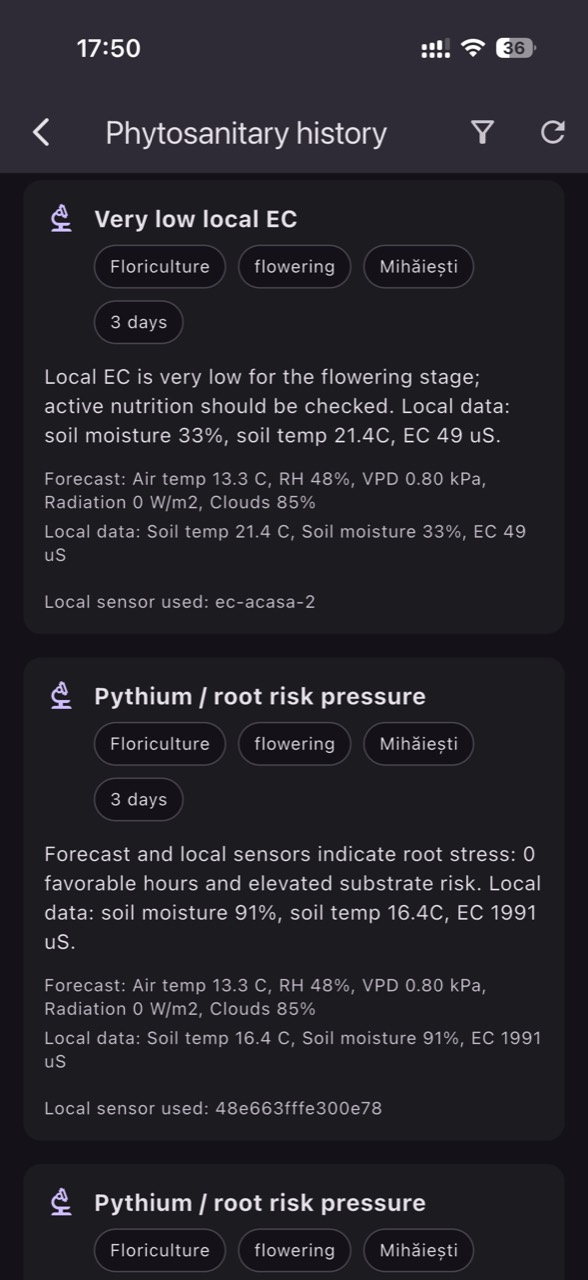
Alerts work when they are rare, explainable, and connected to an action. That requires attention to data freshness (how often a sensor reports) and condition duration: a 5-minute exceedance may be irrelevant, while a multi-hour event can change a decision. VPD calculated from air temperature and relative humidity is an estimate of atmospheric demand; leaf temperature can differ, so treat VPD as a comparative clue between zones and days—not a verdict.
What to observe: how many alerts arrive per week and how many led to a real field finding. What to verify independently: a routine for on-site checks after alerts (for example, a quick probe check of soil feel or a targeted canopy walk). Practical decision: tune thresholds so an alert means “worth checking now.” Check: after 2–3 weeks, evaluate the “false alarm” rate and reduce it using duration conditions, different thresholds by zone, and exclusions for known irrelevant intervals (for example, brief midday spikes).
8) Commissioning and audit workflow: from installation to a verifiable decision
A simple workflow has four steps: (1) define the question (“where does stress first appear?” / “how long are leaves wet in the valley?”), (2) choose the right sensors, (3) install in contrast zones, and (4) validate with field observations. In the first days, don’t try to optimize—hunt errors: stuck values, impossible swings, depth curves that are inverted, or time offsets. An initial audit greatly shortens the period of “not trusting the data.”
What to observe in validation: response after rain/irrigation, the daily temperature-humidity cycle, and coherence between nearby sensors. What to verify: sensor power/status, cable integrity, soil contact, and radiation shielding for air sensors. Practical decision: only after validation set alerts and start logging interventions (irrigation, canopy work, sprays) so you can interpret cause and effect. Check: after each major action, verify in the data whether the effect moved in the expected direction and whether zone differences narrowed—or intensified.
Conclusion
Managing water stress and microclimate in vineyards means measuring the differences that matter: soil at relevant depths, canopy air, and—when needed—leaf wetness. Then you turn data into routine: understand the mechanism, confirm in the field, make a targeted decision, and check its effect over the next hours and days in the same comparable zones.
If you use a monitoring platform such as GrowGuard, the goal is not “more charts” but rare, actionable alerts built on correct commissioning and periodic audits. Start with contrast zones, validate measurements, then expand the sensor network where decisions are repeatedly difficult. If you want a structured zone-alert setup and validation workflow, consider an initial configuration session with your team.